
Article Type: Asteroid News, Scientific Data, NEO Explainer
Astrophyzix Asteroid Close Approach Series
Asteroid 2017 XA1 — Full Scientific Profile
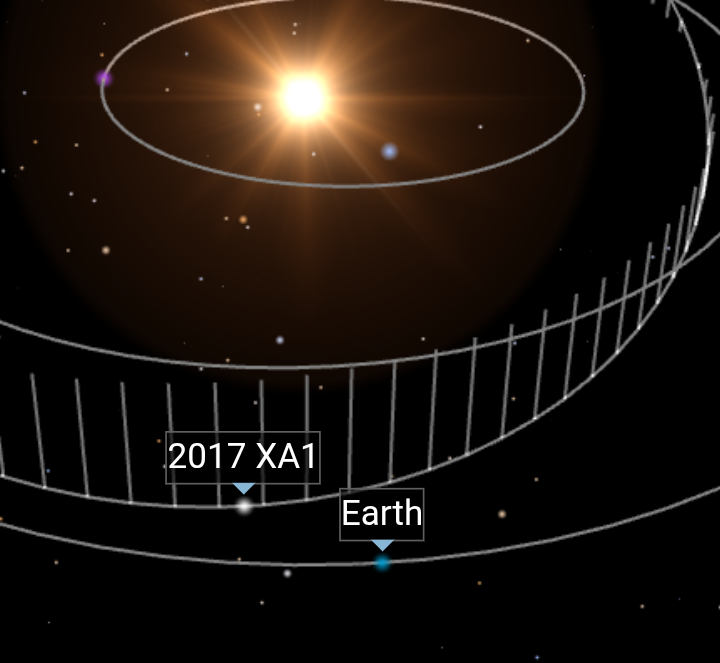
Asteroid 2017 XA1 is a small near-Earth body with a distinctly interior orbit relative to Earth's — meaning its path around the Sun remains mostly within Earth’s orbital distance. Although it is formally classified as a Potentially Hazardous Asteroid (PHA), its orbit, as determined from three years of observations keeps it at safe distances during close approaches for the foreseeable future.
This profile synthesises discovery data, orbital dynamics, planetary defence context, and risk evaluation, drawing on NASA and Minor Planet Center datasets.
Discovery: When, Where, and How
Asteroid 2017 XA1 was first detected on 5 December 2017 and its orbit was computed from a series of astrometric measurements extending through 23 November 2020. The Minor Planet Center lists 30 positional observations over this arc that provide the basis for orbit determination. At present there is no formal published discovery announcement crediting a specific observing programme in the academic literature, but these observations are consolidated in the NASA/JPL Small-Body Database and Space Reference pages.
Orbit solutions derived by NASA’s Centre for Near Earth Object Studies (CNEOS) show that the asteroid’s path is well constrained with a period of 266 days (0.73 years), taking it as close as ~0.65 AU from the Sun and as far as ~0.97 AU.
Scientific and Planetary Defence Context
Near-Earth asteroids like 2017 XA1 are of high importance in planetary science and hazard assessment because they occupy orbits that can sometimes bring them close to Earth’s path around the Sun. These objects likely originate from the Main Asteroid Belt between Mars and Jupiter through complex gravitational interactions and resonances, where they are nudged inward over long timescales. Comprehensive dynamical studies show that the flux of near-Earth asteroids depends on chaotic orbital transport from these reservoirs.
Asteroids are categorised based on their orbital elements, semi-major axis, eccentricity, and inclination, as well as how their orbits intersect that of Earth. The term Potentially Hazardous Asteroid (PHA) has a specific dynamical definition: an object with a minimum orbit intersection distance (MOID) relative to Earth of less than 0.05 astronomical units (AU) and an absolute magnitude (H) of 22 or brighter (roughly equivalent to diameters > 140 m assuming typical asteroid albedos).
This definition does not mean an object is predicted to impact Earth, but it flags that future orbital uncertainties merit continued monitoring. Over 99 % of known PHAs, including 2017 XA1, are not impact threats over the next century; they will continue to make distant passes while remaining far from impact probabilities according to current risk modelling.
The field of planetary defence now encompasses multidisciplinary observational networks (optical, radar, and space-based survey telescopes), as well as theoretical modelling and mitigation studies. For example, work on kinetic impactor strategies where spacecraft deliberately alter an asteroid’s motion has been published in peer-review with explicit engineering scenarios that could serve as templates for larger hazardous bodies.
Predicted Close Approaches to Earth
| Date | Distance from Earth (km) | Relative Speed (km/s) |
|---|---|---|
| 14 Nov 2028 | 22,931,556 | ~11.85 |
| 16 Nov 2036 | 14,361,315 | ~10.61 |
| 18 Nov 2044 | 8,677,170 | ~9.81 |
| 18 Nov 2052 | 7,228,439 | ~9.44 |
| 17 Nov 2194 | 17,761,594 | ~11.04 |
These predicted close approaches, generated from current orbit models, keep the asteroid well outside the Earth’s gravitational sphere of influence and far above impact distances. Over longer time horizons, uncertainties in orbital parameters grow, but there is no indication at present of a future Earth collision based on known data.
Risk Assessment
Although 2017 XA1 is formally designated a PHA, this is a classification used for prioritising observation, not an indication of imminent impact. Its minimum orbit intersection distance relative to Earth stays above the critical threshold, and no credible risk solutions appear on NASA’s Sentry or ESA’s Risk Lists for the next century. Asteroids of its size, approximately tens to a few hundred metres could cause regional damage if they were to strike Earth, but such a scenario is not supported by current orbital projections.
Modern risk assessments rely on dynamical propagation of observational uncertainties using Monte Carlo methods and multi-body gravitational integrators; objects with meaningful chances of impact typically show up on these risk tables with non-zero impact probabilities far ahead of time. 2017 XA1 does not. Continued observation will reduce uncertainties further.
Orbital and Physical Characteristics
| Characteristic | Value |
|---|---|
| Classification | NEA & PHA (interior orbit) |
| Orbital Period | ~266 days (0.73 yr) |
| Semi-Major Axis | 0.8095 AU |
| Eccentricity | 0.2017 |
| Inclination | 17.18° |
| Perihelion | ~0.65 AU |
| Aphelion | ~0.97 AU |
| Absolute Magnitude | ~21.3 |
| Estimated Diameter | ~150–330 m |
Summary
Asteroid 2017 XA1 is a small near-Earth object with an orbit entirely inside Earth’s orbital radius (an interior Earth asteroid), discovered through coordinated astronomical surveys and tracked over multiple years. While formally classified as a Potentially Hazardous Asteroid because its orbit comes relatively close to Earth, current orbital calculations show no credible risk of impact for the next century. Its close approaches remain many millions of kilometres distant, and its physical size, while significant from a scientific perspective does not translate to a collision hazard under present conditions.
Sources & Further Reading
- Space Reference: Asteroid 2017 XA1 — orbital & observation data.
- NASA CNEOS / JPL Small-Body Database — official orbit and hazard data.
- Potentially Hazardous Object (Wikipedia) — formal PHA definition.
- NeoPhyzix Planetary Defence Hub — Live Official CNEO Data Feed.
- Li et al. (2019) — example peer-review on deflection methods for asteroid hazard mitigation (DOI available via arXiv).