
Live Independent Verifiable and reproducible Unpaywalled NASA-sourced

Astrophyzix Digital Observatory

Trusted for Asteroid News, Research, Data & Analysis

Delivering unpaywalled, evidence-driven analysis, real-time N-Body Orbital Refinements and monitoring and tracking of all asteroids, comets and solar system objects.

Every tracking console is designed and engineered here. Systems directly ingest multiple NASA datasets covering over 1.57 million objects, then run live, verifiable probabilistic orbital analysis and deliver an instant deterministic summary of close approaches. Used by students, educators, researchers, and the public. Data provenance is traceable, verifiable and transparent. Original research papers are published on Astrophyzix.academia.edu, registered with official DOIs via Zenodo and academically indexed by OpenAIRE.

  • NASA API'S
  • ✅ CNEOS Scout
  • ✅ JPL CAD
  • ✅ NeoWs
  • ✅ SBDB
  • ✅ Horizons
  • ✅ Sentry
Showing posts with label Series. Show all posts

Close-approach summary for September 2026 · JPL SBDB CAD

NEO Close-Approach Summary — September 2026

Astrophyzix Observatory PHA & NEO Asteroid News

Monthly close-approach summary · JPL SBDB CAD · September 2026

Near-Earth Object (NEO) and PHA Asteroid Close-Approach Summary: Looking back at September 2026

Earth close-approaches from 1–30 September 2026 inside 0.05 au (about 19.5 lunar distances), from the NASA/JPL SBDB Close Approach Data API. This is a month catalogue, not a live CNEOS Scout or Sentry stream. Live Multi-watch CAD/Scout/Sentry tracker.

In September 2026, the JPL close-approach catalogue records 165 Earth encounters inside the 0.05 au filter. Thirteen passed inside one lunar distance. The closest was 2026 RT34 (pictured) on 13 September, at 0.055 lunar distances (20,965 km from Earth’s centre, about 14,600 km above the surface) and 13.1 km/s. 2026 SZ2 matched that miss distance a week later. No listed object was on an impacting trajectory.

A Look-back at the Closest catalogued approaches in September 2026

2026 RT34
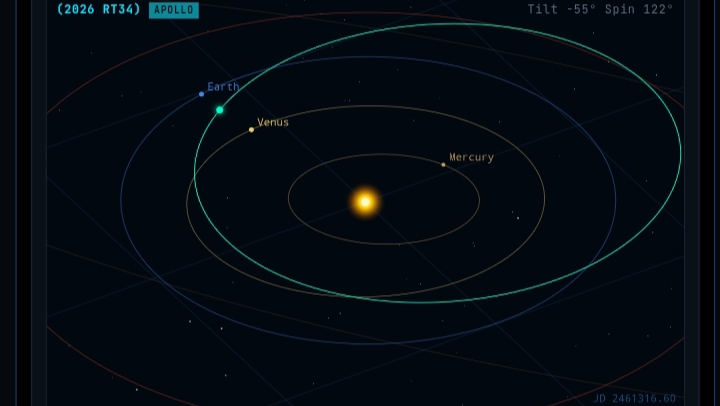
Astrophyzix N-Body Orbital Refinement

0.055 LD

20,965 km · 0.000140 au · v_rel 13.08 km/s · tied with 2026 SZ2

Earth surface1 LD (Moon)

Encounter (UTC)

2026-Sep-13 09:08

Est. diameter

3 m (H 30.4, pv 0.14)

Diameter range

2.3 – 5.0 m

Earth radii

3.3 R(E)

Passes inside 1 lunar distance

Sorted by miss distance. Diameter is the Bowell range, albedo 0.25–0.05. None of these thirteen is a PHA.

Object Epoch (UTC) Dist (LD) Dist (km) v_rel Diameter Status
2026 RT34 2026-Sep-13 09:08 0.055 20,965 13.1 2–5 m Routine
2026 SZ2 2026-Sep-20 21:19 0.055 21,210 8.0 2–5 m Routine
2026 RG15 2026-Sep-15 07:36 0.246 94,698 9.1 16–35 m Routine
2026 SB 2026-Sep-15 04:52 0.329 126,288 14.6 6–14 m Routine
2026 RZ 2026-Sep-03 00:06 0.529 203,497 11.2 3–7 m Routine
2026 RN2 2026-Sep-08 13:51 0.577 221,987 12.1 4–8 m Routine
2026 RH10 2026-Sep-10 06:39 0.646 248,260 18.2 10–23 m Routine
2026 RO39 2026-Sep-14 07:44 0.662 254,498 10.5 4–8 m Routine
2026 RC 2026-Sep-03 23:09 0.757 291,087 6.2 5–10 m Routine
2026 RH1 2026-Sep-02 21:59 0.867 333,188 8.7 5–12 m Routine
2026 RS2 2026-Sep-06 19:09 0.927 356,240 7.4 3–6 m Routine
2026 SA8 2026-Sep-28 06:45 0.988 379,868 6.6 5–11 m Routine
2026 RB39 2026-Sep-17 02:29 0.999 384,180 9.3 5–11 m Routine

Lead object orbital dossier

2026 RT34

Heliocentric osculating elements from JPL SBDB, epoch JD 2461200.5. Dynamical class: APO (Near-Earth asteroid orbits which cross the Earth’s orbit similar to that of 1862 Apollo). Not a potentially hazardous asteroid. Absolute magnitude H = 30.36.

Semi-major axis a

1.02 au

Eccentricity e

0.394

Inclination i

0.675 deg

Orbital period

1.03 yr

Asc. node Ω

350 deg

Arg. perihelion ω

112 deg

JPL Small-Body Database record: ssd.jpl.nasa.gov/tools/sbdb_lookup.html#/?sstr=2026 RT34

Potentially hazardous asteroids in the month

PHA is a size and orbit-class flag (H ≤ 22 and Earth MOID ≤ 0.05 au), not this month’s miss distance. All three September PHA approaches stayed outside 12 LD.

Object Epoch (UTC) Dist (LD) Dist (km) v_rel Diameter Status
2026 OH3 2026-Sep-11 04:27 12.31 4,731,250 20.2 0.14–0.32 km PHA
2026 RF10 2026-Sep-02 09:00 13.45 5,171,080 17.1 0.11–0.26 km PHA
2026 NT2 2026-Sep-17 05:07 16.09 6,182,950 12.5 0.23–0.52 km PHA

Month analysis · JPL CAD clock

The September window contains 165 catalogued Earth close-approaches inside 0.05 au. Thirteen were sub-lunar, led by 2026 RT34 and 2026 SZ2 at 0.055 LD — both a few metres across, and both non-PHA. The largest sub-lunar body was 2026 RG15, about 16–35 m, at 0.25 LD on 15 September. Three objects carry a PHA flag; the nearest of those, 2026 OH3, missed by 12.3 LD. Median miss distance was 5.73 LD. Fastest relative velocity was 26.9 km/s (2026 SL7, 17.6 LD). No listed object is on an impacting trajectory.

Approaches in month

165

Inside 1 LD

13

Inside 5 LD

66

PHA in window

3

Median miss

5.73 LD

Fastest v_rel

26.9 km/s

Closest object

2026 RT34

Closest PHA

2026 OH3

Methodology

Distances and epochs are nominal JPL close-approach solutions. Lunar distance is 384,400 km; 1 au is 149,597,870.7 km. Diameter is not a measured size: it is the Bowell range D[km] = 1329 / sqrt(pv) × 10^(−H/5), pv 0.25–0.05, with a midpoint at pv 0.14. PHA status is the JPL flag from the CAD query, not a function of September’s miss distance.

Reporting style follows the Astrophyzix Orbital Refinement System.

Methodology documents

Data provenance

Compiled (UTC): 2026-10-03
Window: 2026-09-01 to 2026-10-01, Earth, dist-max 0.05 au
Source 1: NASA/JPL SBDB Close Approach Data API
  endpoint: https://ssd-api.jpl.nasa.gov/cad.api?date-min=2026-09-01&date-max=2026-10-01&dist-max=0.05&fullname=true
  docs: ssd-api.jpl.nasa.gov/doc/cad.html
  count: 165
Source 2: same API, pha=true
  count: 3 (2026 OH3, 2026 RF10, 2026 NT2)
Source 3: JPL SBDB lookup for 2026 RT34
  endpoint: https://ssd-api.jpl.nasa.gov/sbdb.api?sstr=2026%20RT34
  spkid: 54653909 · orbit class APO · pha false
Constants:
  - AU = 149597870.7 km (IAU 2012 Resolution B2)
  - Lunar distance = 384400 km (JPL/IAU nominal mean)
  - Earth mean radius = 6371 km (IUGG)
Source note: For live CNEOS Scout and Sentry use the Dual-watch tracker: astrophyzix.com/p/live-asteroid-tracker-v9.html

Primary references: NASA/JPL CNEOS Close Approach Data (cneos.jpl.nasa.gov/ca), SBDB (ssd.jpl.nasa.gov). Object hazard status should be verified against the CNEOS Sentry table. Nominal miss distances can shift for short-arc discoveries.
03 October 2026 Asteroid Close Approach Report

NEO and PHA Close-Approach Report — 3 October 2026

Astrophyzix Observatory PHA & NEO Asteroid News

Daily Asteroid Bulletin · NASA NeoWs catalogue · UTC

Near-Earth Object (NEO) and PHA Asteroid Close-Approach Report: October 3, 2026

Catalogued Earth close-approaches across a 7-day window from the NASA NeoWs feed (JPL small-body solutions; cached at source). This bulletin is a catalogue report, not a live CNEOS CAD/Scout stream. Live Multi-watch CAD/Scout/Sentry tracker.

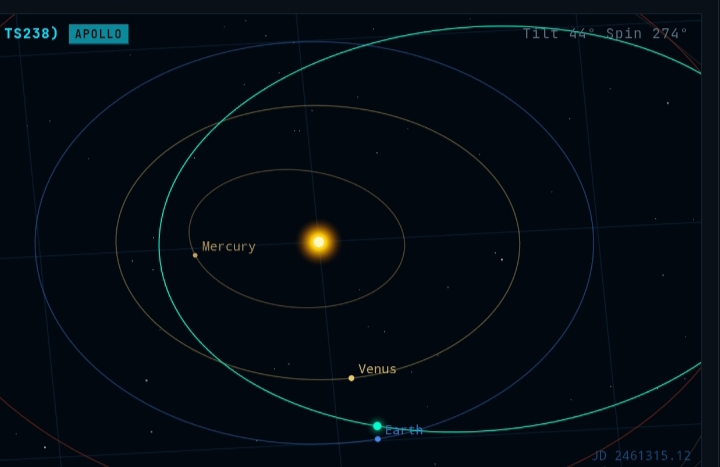
On October 3, 2026 (UTC), screening of the NASA NeoWs catalogue resolves 41 near-Earth object close approaches across the report window. The single closest encounter is 2015 TS238, passing at approximately 4.72 lunar distances (1,813,910 km) with a relative velocity near 15.8 km/s. No listed object is on an impacting trajectory.

Closest catalogued approach in observation window

2015 TS238

Astrophyzix N-Body Orbital Refinement

4.72 LD

1,813,910 km · 0.012125 au · v_rel 15.81 km/s

Earth surface19.5 LD (filter edge)

Encounter (UTC)

2026-Oct-08 17:12

Est. diameter

0.033 km (NeoWs)

Diameter range

0.022 – 0.049 km

Earth radii

285 R(E)

Close approaches on report date

Object Epoch (UTC) Dist (LD) Dist (km) v_rel Diameter Status
2019 SW5 2026-Oct-03 12:00 39.56 15,214,652 17.2 0.037 Routine
2006 HZ5 2026-Oct-03 16:31 150.71 57,958,790 6.9 0.050 Routine

Lead object orbital dossier

2015 TS238

Heliocentric osculating elements from NeoWs, epoch JD 2461000.5. Dynamical class: APO (Near-Earth asteroid orbits which cross the Earth’s orbit similar to that of 1862 Apollo).

Semi-major axis a

1.1434 au

Eccentricity e

0.4994

Inclination i

3.324 deg

Orbital period

1.223 yr

Asc. node Ω

190.989 deg

Arg. perihelion ω

78.226 deg

JPL Small-Body Database record: ssd.jpl.nasa.gov/tools/sbdb_lookup.html#/?sstr=3730801

7-day forward outlook — scroll left/right

Object Epoch (UTC) Dist (LD) Dist (km) v_rel Diameter Status
2009 UD 2026-Oct-04 07:03 122.78 47,218,840 12.7 0.014 Routine
2019 UM8 2026-Oct-04 11:49 161.15 61,974,605 18.2 0.008 Routine
2017 WK15 2026-Oct-04 20:07 170.38 65,522,606 17.0 0.018 Routine
2015 XX169 2026-Oct-05 03:10 89.22 34,312,498 5.3 0.013 Routine
2001 SH276 2026-Oct-05 03:48 54.38 20,913,691 10.8 0.458 Routine
2007 UW1 2026-Oct-05 10:14 32.97 12,677,806 4.7 0.115 Routine
2017 SX20 2026-Oct-06 02:26 164.94 63,429,518 16.0 0.059 Routine
2017 EJ3 2026-Oct-06 06:59 98.96 38,056,500 6.9 0.090 Routine
2012 KT42 2026-Oct-06 07:01 87.82 33,774,141 11.7 0.006 Routine
2018 TZ1 2026-Oct-06 12:34 113.51 43,654,128 13.8 0.040 Routine
2010 SJ 2026-Oct-06 17:40 192.67 74,094,317 19.4 0.069 Routine
2018 SL1 2026-Oct-06 19:16 122.09 46,951,512 12.2 0.024 Routine
2018 AG12 2026-Oct-06 20:09 166.79 64,143,759 8.4 0.072 Routine
2013 TH 2026-Oct-07 03:38 50.67 19,486,769 6.9 0.069 Routine
2018 CH 2026-Oct-07 04:24 194.03 74,617,494 19.4 0.021 Routine
1998 SL36 2026-Oct-07 04:47 154.97 59,595,365 22.5 0.359 PHA
660096 (1998 SL36) 2026-Oct-07 04:47 154.97 59,595,365 22.5 0.358 PHA
2018 HK 2026-Oct-07 06:54 69.68 26,795,958 20.4 0.204 Routine
2015 FD35 2026-Oct-07 19:14 70.91 27,269,809 17.4 0.287 Routine
2005 TQ45 2026-Oct-07 23:08 149.34 57,430,728 19.4 0.030 Routine

Astrophyzix analysis · same clock as the feed

The window contains 41 catalogued Earth close-approaches (2 on the report date, 39 in the forward outlook). The nearest listed geometry is 2015 TS238 at 4.72 LD (non-PHA), relative velocity 15.8 km/s. 1 additional pass inside 5 LD. 4 objects in the window are flagged potentially hazardous (size and MOID criteria, not this week's miss distance). No listed object is on an impacting trajectory in this catalogue.

Approaches in window

41

On report date

2

PHA in window

4

Inside 1 LD

0

Inside 5 LD

1

Median miss

121.67 LD

Fastest v_rel

25.8 km/s

Closest object

2015 TS238

Methodology

Data are reproducible using the Astrophyzix Orbital Refinement System.

Methodology documents

Data provenance

Module: Astrophyzix-NEO-Daily/2.2.0
Generated (UTC): 2026-10-03T00:20:11.914Z
Cache state: HIT (age 0 min)
Analysis digest: 41 approaches (2 today / 39 outlook); closest 2015 TS238 @ 4.72 LD; PHA 4; sub-lunar 0; notable 1; median miss 121.67 LD; anomalies 0
Analysis generated (UTC): 2026-10-03T00:20:11.914Z
Source 1: NASA NeoWs feed
  endpoint: https://api.nasa.gov/neo/rest/v1/feed?start_date=2026-10-03&end_date=2026-10-10&api_key=***
  docs: https://api.nasa.gov/
  retrieved: 2026-10-03T00:19:45.013Z
Source 2: NASA NeoWs lookup
  endpoint: https://api.nasa.gov/neo/rest/v1/neo/3730801?api_key=***
  docs: https://api.nasa.gov/
  retrieved: 2026-10-03T00:19:47.050Z
Constants:
  - AU = 149597870.7 km (IAU 2012 Resolution B2)
  - Lunar distance = 384400 km (JPL/IAU nominal mean)
  - Earth mean radius = 6371 km (IUGG)
  - TT − UTC = 69.184 s (37 leap seconds + 32.184 s), valid 2026
  - Diameter self-test: D[km] = 1329 / sqrt(pv) * 10^(−H/5), pv 0.25–0.05 (Bowell)
Source note: For live CNEOS Scout and JPL Close Approach Data use the Dual-watch PHA and NEO Tracking System: astrophyzix.com/p/live-asteroid-tracker-v9.html
Pipeline trace: INIT@627ms → CACHE_LOOKUP@628ms → PARSE@901ms → COMPUTE@902ms → VALIDATE@902ms → ANALYSE@903ms → RENDER@903ms

Primary references: NASA NeoWs / api.nasa.gov (api.nasa.gov), NASA CNEOS (cneos.jpl.nasa.gov). Object hazard status should be verified against the CNEOS Sentry table.

02 October 2026 Close Approach Report

 Astrophyzix Observatory PHA & NEO Asteroid News

Daily Asteroid Bulletin · NASA NeoWs catalogue · UTC

Near-Earth Object (NEO) and PHA Asteroid Close-Approach Report: October 2, 2026

Catalogued Earth close-approaches across a 7-day window from the NASA NeoWs feed (JPL small-body solutions; cached at source). This bulletin is a catalogue report, not a live CNEOS CAD/Scout stream. Live Multi-watch CAD/Scout/Sentry tracker.

On October 2, 2026 (UTC), screening of the NASA NeoWs catalogue resolves 40 near-Earth object close approaches across the report window. The single closest encounter is 2015 TS238, passing at approximately 4.72 lunar distances (1,813,910 km) with a relative velocity near 15.8 km/s. No listed object is on an impacting trajectory.

CLOSEST CATALOGUED APPROACH IN OBSERVATION WINDOW
2015 TS238
4.72 LD
1,813,910 km · 0.012125 au · v_rel 15.81 km/s
EARTH SURFACE19.5 LD (FILTER EDGE)
Encounter (UTC)
2026-Oct-08 17:12
Est. diameter
0.033 km (NeoWs)
Diameter range
0.022 - 0.049 km
Earth radii
285 R(E)

Close Approaches On Report Date

ObjectEpoch (UTC)Dist (LD)Dist (km)v_relDiameterStatus
2013 HO112026-Oct-02 01:4925.249,705,4697.60.097ROUTINE
276891 (2004 RH3402026-Oct-02 10:15141.1954,297,10317.30.494ROUTINE
2018 RV32026-Oct-02 09:40149.9257,656,02510.40.098ROUTINE
2007 DX602026-Oct-02 09:18169.0865,023,4156.30.142ROUTINE
2010 KV72026-Oct-02 09:57174.5567,127,83018.70.025ROUTINE

Lead Object Orbital Dossier

2015 TS238

Heliocentric osculating elements from NeoWs, epoch JD 2461000.5. Dynamical class: APO (Near-Earth asteroid orbits which cross the Earth’s orbit similar to that of 1862 Apollo).

Semi-major axis a
1.1434 au
Eccentricity e
0.4994
Inclination i
3.324 deg
Orbital period
1.223 yr
Asc. node OM
190.989 deg
Arg. perihelion w
78.226 deg

JPL Small-Body Database record: https://ssd.jpl.nasa.gov/tools/sbdb_lookup.html#/?sstr=3730801

7-Day Forward Outlook - Scroll Left/Right

ObjectEpoch (UTC)Dist (LD)Dist (km)v_relDiameterStatus
2019 SW52026-Oct-03 12:0039.5615,214,65217.20.037ROUTINE
2006 HZ52026-Oct-03 16:31150.7157,958,7906.90.050ROUTINE
2009 UD2026-Oct-04 07:03122.7847,218,84012.70.014ROUTINE
2019 UM82026-Oct-04 11:49161.1561,974,60518.20.008ROUTINE
2017 WK152026-Oct-04 20:07170.3865,522,60617.00.018ROUTINE
2015 XX1692026-Oct-05 03:1089.2234,312,4985.30.013ROUTINE
2001 SH2762026-Oct-05 03:4854.3820,913,69110.80.458ROUTINE
2007 UW12026-Oct-05 10:1432.9712,677,8064.70.115ROUTINE
2017 SX202026-Oct-06 02:26164.9463,429,51816.00.059ROUTINE
2017 EJ32026-Oct-06 06:5998.9638,056,5006.90.090ROUTINE
2012 KT422026-Oct-06 07:0187.8233,774,14111.70.006ROUTINE
2018 TZ12026-Oct-06 12:34113.5143,654,12813.80.040ROUTINE
2010 SJ2026-Oct-06 17:40192.6774,094,31719.40.069ROUTINE
2018 SL12026-Oct-06 19:16122.0946,951,51212.20.024ROUTINE
2018 AG122026-Oct-06 20:09166.7964,143,7598.40.072ROUTINE
2013 TH2026-Oct-07 03:3850.6719,486,7696.90.069ROUTINE
2018 CH2026-Oct-07 04:24194.0374,617,49419.40.021ROUTINE
1998 SL362026-Oct-07 04:47154.9759,595,36522.50.359PHA
660096 (1998 SL362026-Oct-07 04:47154.9759,595,36522.50.358PHA
2018 HK2026-Oct-07 06:5469.6826,795,95820.40.204ROUTINE
Astrophyzix analysis · same clock as the feed

The window contains 40 catalogued Earth close-approaches (5 on the report date, 35 in the forward outlook). The nearest listed geometry is 2015 TS238 at 4.72 LD (non-PHA), relative velocity 15.8 km/s. 1 additional pass inside 5 LD. 3 objects in the window are flagged potentially hazardous (size and MOID criteria, not this week's miss distance). No listed object is on an impacting trajectory in this catalogue.

Approaches in window
40
On report date
5
PHA in window
3
Inside 1 LD
0
Inside 5 LD
1
Median miss
124.49 LD
Fastest v_rel
22.5 km/s
Closest object
2015 TS238
Data are reproducible using the Astrophyzix Orbital Refinement System

Methodology documents

•Daily NEO Reporting Methodology
•Orbital Refinement System & Orbital Viewer Documentation

Data Provenance
Module: Astrophyzix-NEO-Daily 2.2.0 with ORB-01 Imagary
Generated (UTC): 2026-10-02T08:11:33.113Z
Cache state: MISS
Analysis digest: 40 approaches (5 today / 35 outlook); closest 2015 TS238 @ 4.72 LD; PHA 3; sub-lunar 0; notable 1; median miss 124.49 LD; anomalies 0
Analysis generated (UTC): 2026-10-02T08:11:33.113Z
Source 1: NASA NeoWs feed
  endpoint: https://api.nasa.gov/neo/rest/v1/feed?start_date=2026-10-02&end_date=2026-10-09&api_key=***
  docs: https://api.nasa.gov/
  retrieved: 2026-10-02T08:11:33.532Z
Source 2: NASA NeoWs lookup
  endpoint: https://api.nasa.gov/neo/rest/v1/neo/3730801?api_key=***
  docs: https://api.nasa.gov/
  retrieved: 2026-10-02T08:11:35.131Z
Constants:
  - AU = 149597870.7 km (IAU 2012 Resolution B2)
  - Lunar distance = 384400 km (JPL/IAU nominal mean)
  - Earth mean radius = 6371 km (IUGG)
  - TT - UTC = 69.184 s (37 leap seconds + 32.184 s), valid 2026
  - Diameter self-test: D[km] = 1329 / sqrt(pv) * 10^(-H/5), pv 0.25-0.05 (Bowell)
Source note: For live CNEOS Scout and JPL Close Approach Data use the Dual-watch PHA and NEO Tracking System: https://www.astrophyzix.com/p/live-asteroid-tracker-v9.html
Pipeline trace: INIT@1328ms -> CACHE_LOOKUP@1339ms -> FETCH_FEED@1748ms -> FETCH_ENRICH@2951ms -> PARSE@3348ms -> COMPUTE@3356ms -> VALIDATE@3356ms -> ANALYSE@3358ms -> RENDER@3359ms
Primary references: NASA NeoWs / api.nasa.gov (api.nasa.gov), NASA CNEOS (cneos.jpl.nasa.gov). Object hazard status should be verified against the CNEOS Sentry table.
ℹ️ Sources / Technical / Mathematical / Scientific / Academic / Integrators / Methods
Sources
  • NASA APIs
  • CNEOS Scout
  • JPL CAD
  • NeoWs
  • SBDB
  • Horizons
  • Sentry
Stack
  • IEEE-754 Float64
  • RKN4
  • Yoshida-4
  • Dormand–Prince / DOPRI5
  • DOPRI8 /DOP853
  • Verlet
  • N-Body
  • Einstein–Infeld–Hoffmann
  • DE441
  • ΛCDM
  • J2
  • Meeus
  • Yarkovsky
  • Schwarzschild GR
  • Simon 1994
  • Holsapple–Schmidt
  • Collins / Pierazzo / Ward–Asphaug
  • AIS-Wide
  • Abyssal 4 km
  • WebGPU
  • DOI Registered
  • Academia.edu
  • Zenodo
  • OpenAIRE
Independent Direct Source Verification
✅ Datacite ✅ Zenodo ✅ Crossref ✅ DOI.org ✅ Live Metadata Fetch
Awaiting DOI input