

M31-2014-DS1: The Star that Bypassed the Supernova Stage and Collapsed into a Black Hole
Introduction
M31‑2014‑DS1 is an extraordinary astrophysical object in the nearby Andromeda Galaxy (Messier 31, ∼2.5 million light‑years from Earth) that has become the focus of intense scientific study because it appears to have “vanished” in a manner inconsistent with standard supernova theory.
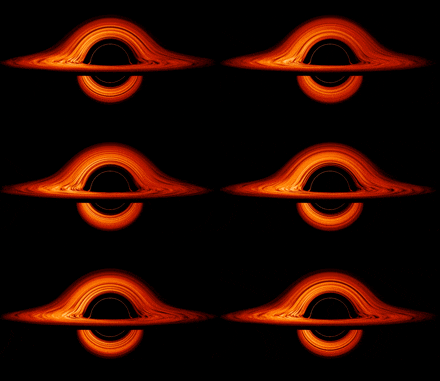
Rather than exploding as an optical supernova, this massive star is thought to have undergone a failed supernova, collapsing directly into a black hole without an outward blast. This event offers unique observational insight into a pathway of stellar death predicted by theory but rarely confirmed in practice.
Stellar Evolution and Core Collapse
Massive stars, those born with initial masses exceeding ∼8 times the mass of the Sun live fast and die young. After exhausting nuclear fuel in their cores, they develop an iron core that can no longer support itself against gravitational collapse. In most cases, this collapse triggers a powerful shockwave powered by intense neutrino emission, ejecting the outer envelope of the star in a bright supernova.
However, theoretical work has long predicted that for some progenitors depending on core structure, composition, and neutrino physics, the shock energy may not be sufficient to unbind the star’s outer layers. In such scenarios, the core continues collapsing to form a black hole, while the star’s outer envelope falls back, a process not marked by a classical optical supernova. These are called failed supernovae or direct collapse events.
Discovery and Observational History
The candidate M31‑2014‑DS1 was first flagged in archival infrared data when it exhibited a significant brightening beginning around 2014 in mid‑infrared wavelengths. This increase was observed in data from NASA’s NEOWISE mission and other infrared facilities. Rather than following a luminous optical supernova trajectory, the source’s brightness remained roughly constant for roughly 1,000 days after the initial brightening and then began a precipitous decline.
Subsequent observations with the Hubble Space Telescope, ground‑based telescopes, and the James Webb Space Telescope (JWST) revealed that the optical counterpart of the star faded dramatically, eventually becoming undetectable in visible and near‑infrared bands by 2023. The faint mid‑infrared emission that persisted long after the disappearance of the optical source is interpreted as thermal emission from dust created by ejected material.
Physical Interpretation: Failed Supernova or Alternative?
The simplest interpretation that has garnered broad support is that of a failed supernova: the progenitor star’s core collapsed into a stellar‑mass black hole without producing a typical optical outburst. In this scenario:
- Most of the star’s mass collapses into a black hole, producing minimal kinetic energy to expel outer layers.
- A small fraction of mass may be ejected at low velocities, cooling and forming dust that radiates in the mid‑infrared.
- No classical supernova shock breakout or bright optical transient accompanies the event.
Estimations of the progenitor’s initial mass are around ~13–20 M⊙, and the remnant black hole likely has a mass of several solar masses. The mass range and physics of core collapse critical for producing failed supernovae remain active areas of research — informed both by theoretical models and events like M31‑2014‑DS1.
Peer‑Reviewed Studies and Models
Key peer‑reviewed research efforts have focused on modeling M31‑2014‑DS1’s fading light and evaluating whether it fits the failed supernova scenario. One representative study in Monthly Notices of the Royal Astronomical Society utilized infrared to X‑ray observations, including JWST data, to investigate the remnant source.
The authors found that while the optical signature has all but vanished, a luminous mid‑IR component remains, likely due to a dust shell engulfing the remnant. They also point out that the geometry of the dust’ distribution complicates precise interpretation of central engine activity.
Another advanced preprint in 2026 examined the detailed spectral energy distribution of the remnant, revealing molecular gas and dust characteristics consistent with mass ejection at low energies and ongoing fallback accretion onto the emerging black hole. This low‑energy ejection and inefficient accretion model fits within a class of direct collapse events predicted by modern stellar evolution simulations.
Broader Implications for Astrophysics
The discovery of M31‑2014‑DS1 has significant implications for several areas of astrophysics:
- Black Hole Formation Rates: Failed supernovae provide a channel for forming stellar‑mass black holes that might be underrepresented if only classical supernova rates are considered.
- Element Recycling: Traditional supernovae contribute heavy elements into the interstellar medium. Failed supernovae, if common, would trap significant amounts of metals in black holes, altering galactic chemical evolution models.
- Neutrino Astronomy: Failed supernovae still produce intense neutrino bursts during core collapse. Simulations specific to M31‑2014‑DS1 offer predictions about neutrino signals that are testable with detectors like Super‑Kamiokande — providing potential windows into the high‑density equation of state of collapsing cores.
- Supernova Surveys: The fading of massive stars without optical transients motivates incorporation of infrared and deep imaging into systematic surveys aimed at closing the “supernova rate problem” the discrepancy between predicted and observed core‑collapse rates.
Alternative Hypotheses and Ongoing Debate
While the failed supernova model is compelling, alternative explanations have been proposed. These include:
- Stellar Merger Event: Some theorists suggest that the 2014 infrared brightening could be due to a luminous red nova, the merger of two stars, rather than an impending collapse. In this view, the apparent disappearance would be due to temporary obscuration by an expanding dust shell.
- Extreme Obscuration: Observations indicating persistent mid‑IR emission have fueled suggestions that the progenitor might not have collapsed at all but instead entered a phase of extreme mass loss and dust production that hides the star from optical detection while still allowing IR detection.
These alternative interpretations underscore the need for continued multi‑wavelength observations, including deeper infrared imaging and possible radio or X‑ray probing, to discriminate between true disappearance and heavy obscuration scenarios.
Conclusion
M31‑2014‑DS1 stands as one of the most intriguing stellar endpoints ever documented. Its apparent “silent” collapse into a black hole challenges traditional supernova paradigms and adds a crucial empirical data point to models of massive star evolution.
Whether it represents a definitive failed supernova or an extreme variant of stellar variability remains an active scientific question, but the depth of observational evidence spanning infrared to optical to theoretical modeling places it at the forefront of astrophysical research into stellar death and compact object formation.