Astrophyzix Digital Observatory's
Evidence-First Asteroid Reporting

Astrophyzix.com is the publication of the Astrophyzix Digital Observatory, offering unpaywalled, evidence‑driven analysis and real‑time monitoring of PHAs and NEOs. Our tracking consoles and reporting systems use and provide access to official NASA CNEOS Scout, JPL CAD, NeoWs, JPL SBDB, Horizons and NOAA observational datasets, peer‑reviewed sources, and high‑precision numerical methods (IEEE‑754 Float64, RKN4). Designed for students, educators, researchers, and the public, every console is uniquely designed and engineered by the Astrophyzix Digital Observatory. Our research notes and papers can be found at Astrophyzix.Academia.Edu

Showing posts with label Astronomy. Show all posts

Wednesday, 1 April 2026

The Most Advanced, Scientifically Rigorous, Accessible and Hassle-Free Tool Stack Available for Free Anywhere Online. No Logins, No Sign-up, No Ads, No Tracking......Ever

The Astrophyzix Digital Observatory
Updated Module Stack

23+ free, scientifically rigorous modules for planetary science, orbital mechanics, real-time space monitoring, and astrophysical simulation. Built for researchers, educators, space-science enthusiasts and the general public worldwide.

✅ NASA CNEOS ✅ NOAA SWPC ✅ JPL SBD ✅ MEEUS ✅ VSOP87 ✅ IEEE 754 ✅ 4th Order Runge-Kutta ✅ Float64

23+ Documented
Modules
72K+ Monthly X-Platform
Users
99.8% System
Uptime
Live NASA/NOAA
Data


Introduction to Astrophyzix 


Astrophyzix is a science-focused digital platform dedicated to the structured communication, analysis, and visualization of astronomical and astrophysical data. Built with an emphasis on clarity, accuracy, and transparency, Astrophyzix serves as an institutional-style observatory interface that bridges the gap between raw scientific datasets and accessible public understanding.  By integrating curated information from authoritative sources such as space agency databases and orbital catalogues, the platform presents complex celestial phenomena in a format that is both technically robust and user-friendly. 

Thursday, 5 March 2026

What Are the Best Professional Telescopes Available in 2026?

Written by: Astrophyzix Digital Observatory
Article type: Public Engagement, Product Advice, Not Sponsored, Expert Level Telescopes
NON-SPONSORED ARTICLE


Reader Question: What Are the Best Professional Telescopes Available in 2026? (Daniel P) 

Expert telescopes


Introduction 

Recently, a reader asked, “What are the best high-end professional telescopes available in 2026?” In response, we’ve compiled this guide highlighting four high-end, expert level telescopes that stand out for their optics, imaging capabilities, and advanced mounts. This article reflects personal opinion based on performance, features, online discussions and industry reputation— it is not sponsored by any telescope manufacturer.

Tuesday, 24 February 2026

M31-2014-DS1: The Star that Bypassed the Supernova Stage and Collapsed into a Black Hole

Written by: Astrophyzix Digital Observatory and Planetary Defence Research Centre. 
Article Type: Astrophysics, Black Hole Studies, Stellar Collapse, Journal Sources 

✅ Updated: 27 February 2026 (added tags) 

M31-2014-DS1: The Star that Bypassed the Supernova Stage and Collapsed into a Black Hole


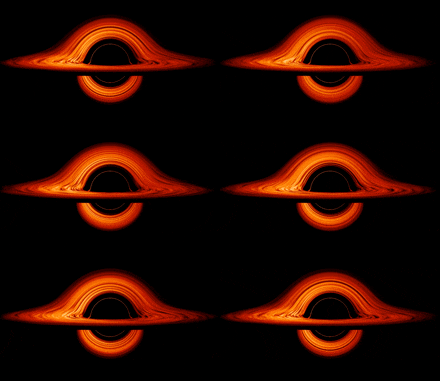
Black hole

Introduction

M31‑2014‑DS1 is an extraordinary astrophysical object in the nearby Andromeda Galaxy (Messier 31, ∼2.5 million light‑years from Earth) that has become the focus of intense scientific study because it appears to have “vanished” in a manner inconsistent with standard supernova theory. 

Sunday, 25 January 2026

Complete Guide To Unistellar Smart Telescopes in 2026 Specifications, Data, Technology and Where to Buy Them

Written by: Astrophyzix Science Communication
Images Credit: Unistellar 

Unistellar, The Renowned Brand, Thier Smart Telescope Technology and Specifications Explained. 


Unistellar is a French Optics Specialist and Smart Technology company founded in 2015 in Marseille that designs and manufactures connected, “smart” telescopes tailored for consumer and professional use alike. Its products integrate optics, digital sensors, and automated software to make deep‑sky observing more accessible, even from light‑polluted environments


Unistellar Odyssey

Entry-Level Automated Reflector System

Odyssey Smart Telescope

Saturday, 17 January 2026

Smart Telescope Technology is Advancing Professional and Amateur Astronomy at Light Speed

The Rise of Intelligent Astronomy

Written by: L.W - Independent Science Journalist 
Published: 17 January 2026 by Astrophyzix Science
Read time: 8 Minutes 


Unistellar smart telescopes
The Pillars of Creation as seen with Smart Telescope Technology using the Odyssey Pro Telescope Image Credit: Unistellar

Introduction

Astronomy has always been a dialogue between curiosity and technology. For centuries, progress came through bigger mirrors, darker skies, and steadier mounts. In the last decade, a quieter revolution has taken place. Telescopes themselves have begun to think. Smart telescopes combine optics, sensors, software, and automation into compact systems that can find, track, process, and even interpret the universe with minimal human intervention. What once required an observatory, a skilled operator, and long nights under the stars can now be done from a garden table or a city balcony.

Saturday, 3 January 2026

The Citizen Science Network: How Everyday Observers Are Transforming Modern Astronomy

The Citizen Science Network: How Everyday Observers Are Transforming Modern Astronomy

Citizen scientists and the Unistellar network looking ahead to 2025

Modern science is no longer confined to university laboratories or billion-dollar observatories. Over the past two decades, a global citizen science network has emerged, enabling ordinary people to participate directly in frontline research. From classifying galaxies to detecting exoplanets and monitoring transient cosmic events, citizen scientists now play a measurable role in advancing astrophysics and other scientific fields.

▶ Read full article

What Is a Citizen Science Network?

A citizen science network is a structured collaboration between professional researchers and members of the public. Participants contribute observations, data analysis, computing power, or pattern recognition skills to real scientific projects. These networks are coordinated through online platforms, research institutions, and, increasingly, dedicated hardware that allows high-quality data collection from homes, schools, and local observatories.

Unlike casual stargazing or hobbyist science, citizen science operates within formal research frameworks. Data collected by volunteers are standardized, validated, and integrated into peer-reviewed studies. In many cases, citizen-generated datasets are now too large or too continuous to be replaced by professional teams alone.

Origins and Key Architects

The modern citizen science movement gained momentum in the early 2000s, driven by three converging developments: widespread internet access, digital detectors, and large-scale data overload in research. Astronomers, in particular, were among the first to recognize that human pattern recognition could outperform algorithms in certain tasks.

One landmark project was Galaxy Zoo, launched in 2007 by astronomers at the University of Oxford, including Chris Lintott and collaborators. Faced with millions of galaxy images from the Sloan Digital Sky Survey, the team invited the public to help classify galaxy shapes. The response was overwhelming, leading to dozens of peer-reviewed papers and the discovery of entirely new classes of objects.

This success inspired the creation of the Zooniverse platform, which now hosts hundreds of citizen science projects across astronomy, climate science, medicine, and biology. In parallel, space agencies such as NASA and ESA began formally incorporating public participation into mission planning and data analysis.

What Citizen Scientists Actually Do

Citizen scientists contribute in several distinct but complementary ways:

  • Data classification: Identifying patterns in images, light curves, or spectra that automated systems may miss.
  • Distributed monitoring: Providing continuous sky coverage to detect supernovae, asteroid flybys, and stellar outbursts.
  • Follow-up observations: Confirming and refining discoveries made by professional surveys.
  • Instrument-based research: Using standardized, networked telescopes to collect publishable data.

In astronomy, these contributions are especially valuable for time-domain science, where events can occur unpredictably and fade quickly. A globally distributed network of observers dramatically increases the chance that transient phenomena are captured and studied in detail.

The Rise of Networked Telescopes

A major evolution in citizen science has been the introduction of smart, network-connected telescopes designed specifically for collaborative research. These instruments automate data acquisition, calibration, and submission, ensuring consistency across thousands of users.

One of the most prominent examples is the Unistellar citizen science network. Built around digitally enhanced telescopes, this system allows participants to observe faint objects in real time while simultaneously contributing scientifically usable data to coordinated research campaigns.

Unistellar instruments have been used in projects ranging from asteroid occultations and exoplanet transit measurements to planetary science and space debris tracking. Data collected by users are aggregated and analyzed in partnership with professional astronomers, and contributors are frequently acknowledged in scientific publications.

For readers interested in participating directly, Unistellar provides an accessible entry point into observational astronomy with genuine scientific impact:
Explore the Unistellar Citizen Science Telescope Network

How Citizen Science Advances Research

Citizen science networks solve several fundamental problems in modern research. First, they massively expand data collection capacity without requiring equivalent increases in funding. Second, they enable long-term monitoring campaigns that would be impractical for professional observatories alone. Third, they provide independent verification of observations, strengthening scientific confidence.

Equally important is the human dimension. Citizen science increases transparency, trust, and scientific literacy by allowing the public to engage directly with the research process. Participants are not passive consumers of science news; they become contributors to discovery.

A New Model for Scientific Collaboration

The citizen science network represents a shift in how knowledge is produced. Rather than a top-down model dominated by institutions, modern research increasingly operates as a distributed collaboration between professionals and the public. In astronomy, this model has already proven its value, and its influence continues to grow.

As data volumes increase and new surveys come online, citizen scientists will remain an essential part of the scientific ecosystem. The universe is vast, dynamic, and unpredictable—and understanding it is now a shared effort.

Independent Direct Source Verification
Uncompromised Crossref DOI Resolver · Live and direct meta data fetch
Awaiting DOI input