

Introduction to Asteroid 1999 AO10
Asteroid 1999 AO10 is a near-Earth object that was first observed on 13 January 1999 by the LINEAR survey at Lincoln Laboratory’s Experimental Test Site in New Mexico, USA. It belongs to the Aten class of asteroids, a group defined by orbits that bring them inside Earth’s orbital radius around the Sun.
Although relatively small compared to major solar system bodies, 1999 AO10 is scientifically important due to its repeated close approaches to Earth’s orbital region, which allow astronomers to refine orbit models and better understand the dynamics of small near-Earth bodies.
Near-Earth asteroids like 1999 AO10 are remnants of the early solar system that have been gravitationally perturbed into Earth-crossing or Earth-approaching orbits. Tracking such objects enhances our understanding of orbital evolution, asteroid population statistics, and planetary defense monitoring capabilities. Current data show that 1999 AO10 does not pose a collision threat in the foreseeable future, but its behavior during close approaches is valuable for scientific study.
- Classified as a near-Earth asteroid (NEA)
- Part of the Aten orbital group
- Relatively small physical size (tens of meters)
- Observed repeatedly since damage orbital tracking began in 1999
Orbital Dynamics and Classification
Asteroid 1999 AO10 follows an elliptical orbit around the Sun with a semi-major axis of approximately 0.912 AU and an orbital period of about 318 days — less than a full Earth year. This orbit has a modest eccentricity (~0.11) and a low inclination (~2.6°) relative to the ecliptic plane, meaning the asteroid’s path stays relatively close to Earth’s orbital plane.
As an Aten-class asteroid, 1999 AO10’s orbit brings it inside Earth’s orbit for part of its cycle, before crossing outward again. Aten asteroids are particularly interesting to astronomers because repeated crossings over time enable detailed astrometric tracking and refined trajectory predictions. The asteroid’s orbit shows repeated close approaches in decades following its discovery, reflecting a dynamic interaction with Earth’s orbital neighborhood.
- Semi-major axis: ~0.912 AU
- Orbital period: ~318 days (0.87 years)
- Eccentricity: ~0.11
- Inclination: ~2.6°
Physical Properties and Size Estimates
Direct spacecraft observations of 1999 AO10 have not been conducted, so its physical properties are inferred from measurements of reflected sunlight (brightness) and assumptions about surface reflectivity (albedo). Based on its absolute magnitude of ~23.9, scientists estimate that 1999 AO10 has a diameter on the order of tens of meters, roughly comparable in size to a large school bus or small building.
Asteroids of this size are among the most commonly detected near-Earth objects. While not large enough to cause regional catastrophe if they were to impact Earth, they remain of interest for scientific research due to their abundance and potential role as tracers of early solar system history. Small asteroids also provide valuable test cases for refining small-body modeling and tracking techniques.
- Estimated diameter: ~45–100 meters (based on brightness and assumed albedo)
- Absolute magnitude (H): ~23.9
- Likely composed of rocky material similar to other small NEAs
Close Approaches and Earth Proximity
Asteroid 1999 AO10 periodically comes into relative proximity with Earth’s orbit. According to orbital simulation data, the object’s minimum orbital intersection distance (MOID) with Earth is approximately 0.02 AU, indicating that its orbit comes within about 3 million km of Earth’s path around the Sun. These repeated close passes make 1999 AO10 a suitable object for long-term monitoring rather than an immediate threat.
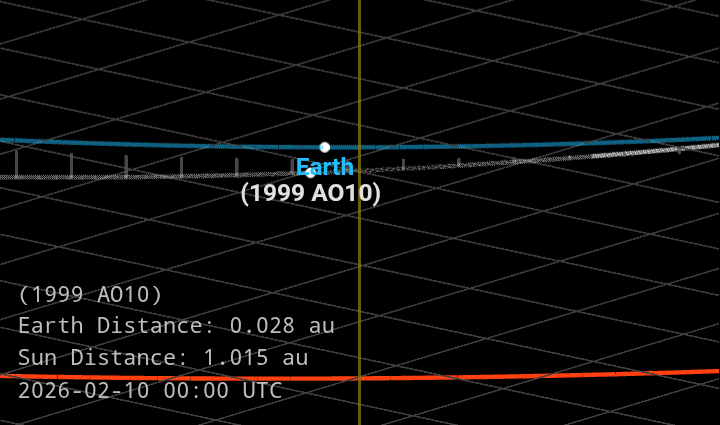
One of the notable predicted encounters is on **13 February 2026**, when 1999 AO10 is expected to approach Earth within roughly 0.027 AU (~4.06 million km). Although this distance is relatively close in astronomical terms (about 10.5 times the distance from Earth to the Moon), it still poses no collision risk. Observations during such close approaches are valuable for refining the asteroid’s orbit and better constraining its future motion.
- Predicted close approach on 13 February 2026 (~0.027 AU)
- Minimum orbital intersection distance: ~0.02 AU (~3 million km)
- Multiple predicted approaches across coming decades
Scientific Importance and Monitoring
Monitoring asteroids like 1999 AO10 contributes to a broader understanding of near-Earth object populations and orbital evolution. Each close approach results in additional data that can improve orbit models and reduce uncertainties in trajectory predictions. Since small bodies can be influenced by subtle forces such as solar radiation pressure and gravitational perturbations from planets, extended tracking across many orbits allows scientists to account for these effects more accurately.
Although 1999 AO10 is not currently classified as potentially hazardous due to its relatively small size and the distances of its close approaches, the scientific practices developed through observing this and similar objects feed directly into the field of planetary defense. These practices refine detection algorithms and improve early warning capabilities for larger objects that may pose real risk in the future.
- Provides opportunities for refining orbit determination techniques
- Helps calibrate models of small asteroid motion and perturbations
- Supports planetary defense efforts by improving tracking precision
Conclusion
Asteroid 1999 AO10 is a small but scientifically informative near-Earth object whose orbit repeatedly brings it into Earth’s orbital neighborhood. With an orbital period of less than a year and an estimated size of a few dozen meters, it exemplifies the class of asteroids that are abundant in near-Earth space yet pose no significant threat. The predicted **13 February 2026** approach presents a useful observational opportunity to further refine its orbital elements and enhance long-term tracking models.
Studying asteroids such as 1999 AO10 advances our understanding of solar system dynamics and contributes to the development of planetary defense strategies. Continued observations help reduce uncertainty in asteroid orbits and ensure that Earth’s neighborhood remains well monitored and characterized for future generations of astronomers and space missions.