

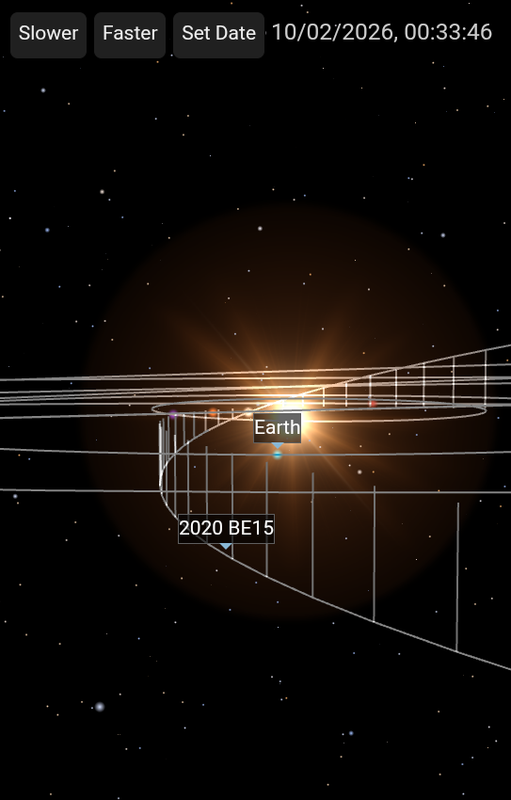
Introduction to Asteroid 2020 BE15
This asteroid orbits the Sun roughly every 2.05 years, traveling along a path that periodically brings it close to Earth’s orbital region. The object is estimated to be approximately 0.322 kilometers in diameter, making it comparable in size to a football field. Due to its orbit and predicted future close approaches, it is of interest to astronomers and space monitoring programs that track the movement of potentially hazardous objects in Earth’s neighborhood.
- Near-Earth asteroid classified within the NEO population
- Estimated diameter of approximately 0.322 km
- Orbital period of about 2.05 years around the Sun
- Studied as part of planetary defense and solar system research
Orbital Characteristics and Classification
Asteroid 2020 BE15 follows an elliptical orbit around the Sun, a common trait among asteroids influenced by gravitational interactions with planets, particularly Earth and Jupiter. The asteroid’s orbital path allows it to approach Earth’s orbit at certain points during its journey. Objects whose orbits intersect or cross Earth’s orbital path are often placed in the Apollo-class or similar near-Earth classifications, which are defined by their semi-major axes and perihelion distances. These orbital characteristics indicate that such asteroids spend most of their time beyond Earth’s orbit but periodically cross into Earth’s orbital region.
The orbit of 2020 BE15 takes it to varying distances from the Sun, influencing its orbital speed and trajectory over time. When closer to the Sun, gravitational forces accelerate the asteroid, while it moves more slowly when farther away. Astronomers track these variations carefully, as small changes in velocity or gravitational influences can significantly affect the asteroid’s long-term orbital evolution. Continuous observation allows researchers to refine predictions about the asteroid’s future position and potential close approaches to Earth.
- Follows an elliptical orbit influenced by solar and planetary gravity
- Crosses or approaches Earth’s orbital region periodically
- Orbital dynamics monitored through observational data and modeling
- Represents typical orbital behaviour of near-Earth asteroids
Physical Properties and Composition
Although direct spacecraft observations have not been conducted for asteroid 2020 BE15, astronomers can estimate its physical properties using observational techniques such as photometry and brightness analysis. These methods involve measuring how the asteroid reflects sunlight and calculating its size based on its reflectivity, known as albedo. Using such measurements, scientists estimate that 2020 BE15 has a diameter of roughly 0.322 kilometers, placing it within the smaller category of near-Earth asteroids.
The composition of the asteroid is not yet precisely determined, but most asteroids in this size range are thought to consist of rocky or metallic material left over from the formation of the solar system approximately 4.6 billion years ago. Studying these bodies provides valuable information about primordial planetary building blocks and the processes that shaped planetary formation. Additionally, understanding the physical structure of asteroids contributes to planetary defense strategies by helping scientists determine how such objects might behave if they entered Earth’s atmosphere.
- Size estimated using brightness and reflectivity analysis
- Likely composed of rock and metal remnants from early solar system formation
- Provides scientific insights into planetary formation processes
- Physical characteristics are important for impact modeling and mitigation strategies
Upcoming Close Approach to Earth
Asteroid 2020 BE15 is predicted to make a close approach to Earth on February 10, 2026. Close approaches occur when the asteroid’s orbit brings it relatively near Earth, although these events are typically at safe distances that pose no immediate threat to the planet. Such flybys are valuable opportunities for astronomers to observe asteroids in greater detail, as proximity allows for more accurate measurements of their size, shape, rotation, and trajectory.
Monitoring close approaches also improves orbital prediction accuracy by providing additional observational data that can be used to refine computational models. While 2020 BE15 is tracked carefully due to its classification as a near-Earth object, available data indicates that its predicted trajectory does not place it on a collision course with Earth during its upcoming encounter. Continuous monitoring ensures that any long-term changes in its orbit can be detected well in advance.
- Predicted close approach on February 10, 2026
- Flyby expected to occur at a safe distance from Earth
- Provides opportunities for improved observation and orbit refinement
- No known collision threat associated with current predictions
Scientific Importance and Planetary Defense
Near-Earth asteroids such as 2020 BE15 are closely studied because they offer crucial insights into the structure and evolution of the solar system. Many asteroids are remnants of early planetary formation that have remained relatively unchanged for billions of years. By studying these objects, scientists gain valuable information about the materials and conditions present during the early stages of solar system development.
Additionally, monitoring near-Earth objects plays a vital role in planetary defense initiatives. Organizations such as NASA’s Jet Propulsion Laboratory and other international observatories continuously track and analyze asteroid trajectories to identify any potential impact risks. Although most near-Earth asteroids do not pose a threat, maintaining accurate tracking systems allows scientists to provide early warnings and develop potential mitigation strategies if necessary. Research into asteroid composition and structure also contributes to the development of deflection technologies and emergency preparedness measures.
- Provides evidence about solar system formation and planetary evolution
- Helps refine asteroid tracking and monitoring techniques
- Supports global planetary defense research initiatives
- Enhances preparedness for potential future impact scenarios
Conclusion
Asteroid 2020 BE15 represents a typical but scientifically valuable member of the near-Earth asteroid population. With an estimated diameter of approximately 0.322 kilometers and an orbital period of just over two years, the asteroid offers researchers a useful opportunity to study the behaviour and characteristics of small solar system bodies. Its predicted close approach to Earth in 2026 provides astronomers with an opportunity to refine orbital models and gather additional data about its physical and dynamical properties.
While current observations indicate that asteroid 2020 BE15 does not pose an impact risk, its study contributes to a broader scientific effort aimed at understanding near-Earth asteroids and protecting Earth from potential future hazards. Continued observation and analysis of such objects remain essential components of modern planetary science and space safety initiatives.
References and Sources
• https://www.spacereference.org/asteroid/2020-be15
• https://www.spacereference.org/
• https://ssd.jpl.nasa.gov/