
Astrophyzix Digital Observatory Research Dossier
Subject: Exoplanetary Science
Classification: Evidence-First, Peer‑Reviewed Sourced Review
Data Sources: NASA, ESA, ESO, STScI, Nature, PNAS, Annual Reviews
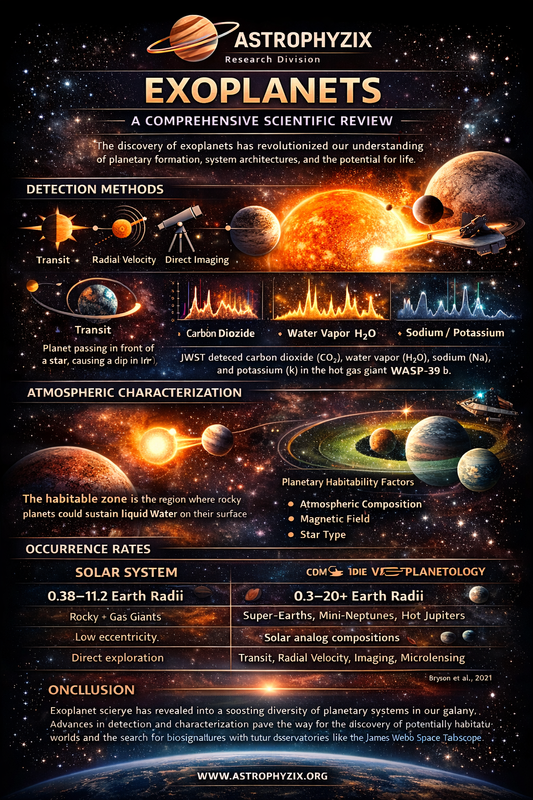
Exoplanets — A Comprehensive Scientific Review
The detection of planets orbiting stars beyond our Solar System — known as exoplanets — has reshaped astronomy over the past three decades. Prior to 1992, only indirect speculation existed about planets around other stars. Today, nearly 6,000 exoplanets have been confirmed through a variety of observation techniques, revealing planetary systems that challenge traditional theories of formation and habitability. (NASA Exoplanet Archive)
1. Historical Foundations
Astronomical curiosity about other worlds dates back centuries, but firm detections awaited precise instrumentation. The first confirmed exoplanets were found in 1992 orbiting the pulsar PSR B1257+12 using pulsar timing methods, where timing variations in pulsed radio signals reveal gravitational influences from orbiting bodies. This discovery decisively showed that planets can exist beyond our Solar System.
In 1995, Michel Mayor and Didier Queloz discovered 51 Pegasi b, a gas giant orbiting very close to a Sun‑like star, using radial velocity measurements. This “hot Jupiter” suggested that planetary migration — movement of a planet from its formation location — plays a significant role in system evolution.
Large surveys such as NASA’s Kepler Space Telescope and ESA’s CHEOPS have significantly expanded the census of exoplanets and enabled statistical analysis of planet populations.
2. How Exoplanets Are Detected
Exoplanets are nearly impossible to see directly in visible light because their stars outshine them by orders of magnitude. Astronomers primarily use indirect detection methods to infer their presence and properties.
Transit Photometry: When a planet crosses in front of its star, it causes a small dip in brightness. The depth and duration of that dip reveal the planet’s radius relative to the star’s. NASA’s Kepler mission used this technique to find thousands of planets by continuously monitoring stellar brightness.
Radial Velocity: Planets exert gravitational tugs on their host stars, causing periodic shifts in the star’s spectral lines due to the Doppler effect. Instruments like the High Accuracy Radial Velocity Planet Searcher (HARPS) and ESPRESSO achieve precisions capable of detecting Earth‑mass planets by measuring velocities to within ~1 m/s.
Direct Imaging: Advanced optics such as coronagraphs and starshades can block starlight to reveal thermal emission from young, massive exoplanets. This method has successfully imaged systems like HR 8799, showing multiple planets directly.
Gravitational Microlensing: Einstein’s theory of general relativity predicts that massive objects can act as gravitational lenses, magnifying background starlight. When a star with planets passes in front of another star, the lensing signature can reveal planets, especially those at greater orbital distances. This method complements transit and radial velocity surveys.
3. Planetary Mass, Radius, and Composition
Measuring a planet’s radius (from transits) and mass (from radial velocity) allows calculation of mean density, which is a diagnostic of internal structure. High densities suggest rocky compositions like Earth, while low densities indicate gas‑rich envelopes typical of Neptune‑like or Jupiter‑like planets.
Analysis of Kepler data revealed a “radius gap”: a scarcity of planets between ~1.5–2.0 Earth radii. This gap separates smaller rocky super‑Earths from larger volatile enriched mini‑Neptunes, likely due to atmospheric loss mechanisms such as photoevaporation and core heating.
4. System Architectures and Planetary Diversity
Exoplanet systems display extraordinary variety. Compact multi‑planet systems, such as the seven terrestrial‑size planets orbiting TRAPPIST‑1, show orbital resonances where planets influence each other’s orbits in stable configurations. Such systems challenge early models rooted strictly in our Solar System’s layout.
Some hot Jupiters show high orbital inclinations or even retrograde motion relative to the star’s spin, indicating past dynamical interactions, migration, or perturbations from other massive bodies. Statistical studies reinforce that such diversity is common, not exceptional.
5. Atmospheric Characterization
Transmission spectroscopy, where starlight filters through a planet’s atmosphere during transit, reveals chemical signatures based on how different molecules absorb specific wavelengths. The James Webb Space Telescope (JWST), in particular its Near‑Infrared Spectrograph (NIRSpec), has made groundbreaking measurements of exoplanet atmospheres.
In a seminal result, JWST detected a prominent carbon dioxide (CO₂) absorption feature at ~4.3 micrometres in the transmission spectrum of the hot gas giant WASP‑39 b, the first clear spectroscopic identification of CO₂ in an exoplanet atmosphere. Models matching the spectrum indicate the presence of CO₂ along with other molecules such as water and carbon monoxide under radiative‑convective equilibrium conditions. This detection underscores JWST’s capability to characterize atmospheric composition in detail and provides insight into planetary formation and migration histories. (Nature, JWST Transiting Exoplanet Community Early Release Science Team)
Previous observations from the Hubble and Spitzer space telescopes had hinted at water vapor, sodium, and potassium in WASP‑39 b’s atmosphere, and JWST’s observations now confirm these while adding CO₂. (NASA Science)
6. Habitability and Biosignature Potential
One of the central goals of exoplanet research is to understand the potential for life outside Earth. A key concept is the circumstellar habitable zone (HZ), often defined as the range of distances from a host star where a rocky planet with sufficient atmospheric pressure could sustain liquid water on its surface — a necessary but not sufficient condition for life as we know it. According to classical definitions, this zone depends on stellar luminosity and atmospheric greenhouse effects, with inner boundaries set by runaway greenhouse conditions and outer boundaries by the ability of CO₂ to maintain warming. (Kasting et al. 2013, PNAS)
However, habitability depends on multiple factors, including atmospheric composition, magnetic field shielding, volcanic outgassing, and stellar activity. For example, planets around red dwarfs may be tidally locked and subjected to strong stellar flares that can strip atmospheres, complicating habitability assessments.
Biosignature science focuses on identifying chemical disequilibria that could strongly suggest biological processes. For instance, the simultaneous presence of oxygen (O₂) and methane (CH₄) in a planetary atmosphere, out of chemical equilibrium, might hint at biological activity rather than purely abiotic chemistry — though distinguishing these signals unambiguously remains a major challenge.
7. Planet Formation and Dynamical Evolution
Planetary formation begins with the accretion of dust and ice grains in protoplanetary disks surrounding young stars. These grains coalesce into kilometer‑scale planetesimals, which merge to form planetary embryos. Gas giants form either by core accretion — where a large solid core captures a massive gaseous envelope before the disk dissipates — or through disk instability, where regions of the disk rapidly collapse under gravity. Observed variations in planetary system architecture, such as hot Jupiters and widely spaced mini‑Neptunes, indicate that migration through disk interactions and dynamical scattering events play significant roles in shaping final orbital configurations.
8. Occurrence Rates and Statistical Insights
Large statistical analyses of Kepler data have quantified the prevalence of planets in the galaxy. One comprehensive review of exoplanet statistics highlights that planets are ubiquitous around Sun‑like stars, especially within ≲1 AU of their host stars. These distributions also provide crucial tests for formation and migration models. (Annual Review of Astronomy and Astrophysics)
Contemporary studies that incorporate detailed completeness corrections and stellar characterization refine these occurrence rates and assist in tracing evolutionary trends among planet populations. Such analyses suggest that many Sun‑like stars host multiple planets, with small planets (<4 being="" common="" earth="" gas="" giants.="" large="" more="" much="" p="" radii="" than="">
9. Comparative Planetology — Solar System vs Exoplanet Classes
| Property | Solar System | Exoplanets |
|---|---|---|
| Size Range | 0.38–11.2 Earth radii | 0.3–20+ Earth radii |
| Dominant Types | Rocky + Gas Giants | Super‑Earths, Mini‑Neptunes, Hot Jupiters |
| Orbital Diversity | Low eccentricity | Compact, eccentric, misaligned |
| Atmospheric Diversity | Solar analog compositions | Wide range: H₂O, CO₂, CO, hazes |
| Typical Detection | Direct exploration | Transit, RV, Imaging, Microlensing |
Conclusion
Exoplanet science has matured into a cornerstone of modern astrophysics, integrating observation, theory, and statistical analysis. We now know that planetary systems are not rare; they are a common outcome of star formation. The diversity of exoplanet sizes, compositions, and system architectures challenges our models and provides opportunities for discovering analogues to Earth. Future observatories, including advanced space telescopes and giant ground‑based facilities, will push the boundaries further, enabling detailed studies of potentially habitable worlds and the search for biosignatures.
References
- NASA Exoplanet Archive – Official count and overview of exoplanets.
- NASA Kepler Mission Overview – Transit survey revolutionizing exoplanet statistics.
- ESA CHEOPS Mission – Precision photometry for exoplanet characterization.
- ESA PLATO Mission – Upcoming space telescope for Earth-like planet detection.
- Wolszczan & Frail (1992) – First confirmed exoplanets around pulsar PSR B1257+12.
- Mayor & Queloz (1995) – First exoplanet around Sun-like star (51 Pegasi b).
- Fulton et al. (2017) – Radius gap between super-Earths and mini-Neptunes.
- Bryson et al. (2021) – Kepler occurrence rates for Earth-size planets.
- Annual Review of Astronomy & Astrophysics – Exoplanet population and system architecture statistics.
- JWST Detection of CO₂ in WASP-39 b – Nature paper on transmission spectroscopy.
- NASA Science – JWST Exoplanet Atmospheres – Institutional science overview.
- STScI – Hubble Exoplanet Observations – Archive of atmospheric studies and planet detection highlights.
- Kasting et al. (2013) – Classical habitable zone definitions.
- Schwieterman et al. (2018) – Biosignatures and atmospheric disequilibrium review.
- Mordasini et al. (2012) – Planet formation models (core accretion vs disk instability).
- ESO – Direct Imaging of Exoplanets – HR 8799, Beta Pictoris, and other systems.
Further Reading & Resources
- NASA Exoplanet Exploration Program – Overview of exoplanets, detection methods, and habitability concepts.
- ESA CHEOPS Mission – Precision photometry for exoplanet characterization.
- ESA PLATO Mission – Upcoming space telescope to find Earth-like planets.
- JWST Exoplanet Atmospheric Science – CO₂ detection and molecular characterization in exoplanet atmospheres.
- Nature – Detection of CO₂ in WASP‑39 b – Peer-reviewed study reporting JWST transmission spectroscopy results.
- PNAS – Habitable Zone Definitions – Classical framework for liquid water and planetary habitability.
- Annual Review of Astronomy & Astrophysics – Exoplanet Occurrence Rates – Statistical insights on exoplanet populations.
- ADS – Kepler Occurrence Rates (Bryson et al., 2021) – Frequency of Earth-size planets around Sun-like stars.
- ESO – Direct Imaging of Exoplanets – Examples like HR 8799 and Beta Pictoris.
- STScI – Hubble Exoplanet Observations – Archive of atmospheric studies and planet detection highlights.
- Astrophyzix Digital Observatory Planetary Defence Research Console
- CNEO Report Asteroid 2020 BX15