
The Ultimate Telescope Guide: From First Light to Deep-Sky Mastery
Choosing a telescope is less about magnification and more about physics. Aperture, optical design, mount stability, and observing conditions determine what you will actually see. Marketing often emphasises extreme magnification figures; in reality, image quality is constrained by aperture diameter, atmospheric seeing, and optical precision. This guide explains telescope types, core specifications, practical limitations, and how to select the right instrument for lunar, planetary, and deep-sky observing.
Understanding Aperture: The Most Important Specification
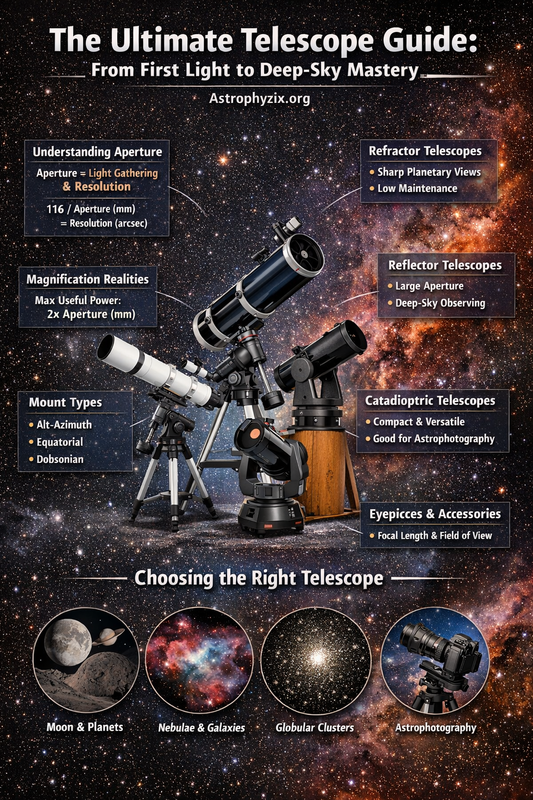
A telescope's aperture -- the diameter of its primary lens or mirror -- determines two critical performance metrics: light-gathering power and angular resolution. Light-gathering power scales with the square of aperture diameter, meaning a 200 mm telescope collects four times as much light as a 100 mm instrument.
Angular resolution is commonly estimated using the Dawes limit:
For example:
- 70 mm refractor ≈ 1.66 arcseconds
- 130 mm reflector ≈ 0.89 arcseconds
- 200 mm reflector ≈ 0.58 arcseconds
In practice, atmospheric turbulence typically limits resolution to 1-2 arcseconds in the UK, meaning extremely large apertures may be seeing-limited rather than optics-limited.
Magnification: What Actually Matters
Magnification is determined by:
However, useful magnification is constrained by aperture and seeing conditions. A realistic maximum is approximately 2x aperture in millimetres. A 130 mm telescope has a practical upper limit of ~260x under ideal conditions. Exceeding this produces dim, soft images without added detail.
Telescope Types
Refractor
Uses lenses to focus light. Sealed tube, minimal maintenance, high contrast -- particularly effective for lunar and planetary work.
✓ No central obstruction
✓ Maintenance-free
✗ Higher cost per aperture
✗ Long tube at larger apertures
Newtonian Reflector
Uses mirrors. The most aperture-efficient design for the money -- the workhorse of deep-sky amateur astronomy.
✓ No chromatic aberration
✓ Excellent for deep-sky
✗ Open tube collects dust
✗ Central obstruction reduces contrast slightly
Catadioptric (SCT / Mak)
Combines lenses and mirrors in a compact tube. Long focal lengths ideal for planets; versatile for astrophotography.
✓ Long focal length
✓ Versatile
✗ Longer cool-down time
Mounts: The Foundation of Stability
The mount determines usability more than the optical tube. A stable mount enables precise tracking and vibration-free observing.
- Alt-azimuth: Simple up/down and left/right movement. Ideal for beginners and visual use.
- Equatorial: Aligns with Earth's rotational axis for accurate celestial tracking. Essential for astrophotography.
- Dobsonian: A Newtonian reflector on a simple alt-az rocker box -- maximises aperture at minimum cost.
Targets and Recommended Apertures
| Target | Recommended aperture | Notes |
|---|---|---|
| Moon | 70-90 mm | Reveals craters, rilles, mountain shadows |
| Planets | 100-150 mm | Jupiter's cloud bands; Saturn's ring structure |
| Deep-sky objects | 150-250 mm | Dark skies critical; light pollution severely limits performance |
| Globular clusters | 200 mm+ | Begins resolving individual stars |
Light pollution significantly affects deep-sky visibility. Dark sky conditions can improve limiting magnitude by several magnitudes compared to urban environments.
Eyepieces and Field of View
Eyepiece quality influences contrast, comfort, and apparent field of view. Wider apparent field eyepieces (68°-82°) provide immersive views and make manual tracking easier. Key parameters are focal length (controls magnification), apparent field of view, and eye relief -- particularly important for observers wearing glasses.
Astrophotography Considerations
Visual observing and astrophotography impose different requirements. Long-exposure imaging demands a motorised equatorial mount, accurate polar alignment, and autoguiding for exposures exceeding several minutes. Short focal length refractors are often preferred by beginners due to more forgiving tracking tolerances.
Atmospheric Seeing and Transparency
Two environmental factors determine observing quality. Seeing refers to atmospheric stability affecting sharpness; transparency describes the clarity of air affecting faint object visibility. Planetary observers prioritise steady seeing; deep-sky observers prioritise transparency and darkness.
- Choosing based on magnification claims rather than aperture
- Underestimating mount importance -- an unstable mount ruins any optics
- Ignoring local light pollution conditions
- Expecting photographic colour in deep-sky objects -- human night vision relies on rod cells insensitive to colour in low light; nebulae appear grey visually even when long exposures reveal vivid colour
Maintenance and Collimation
Reflectors require periodic collimation to maintain optimal optical alignment. Refractors generally do not. Allow telescopes to reach thermal equilibrium before observing to avoid internal air currents degrading image quality.
Final Recommendations
The instruments below correspond to the use cases described throughout this guide. Each is selected on the basis of optical performance, mount quality, and value -- not marketing specifications.
Urban observer · Balcony use
127 mm Maksutov-Cassegrain on a motorised Wi-Fi alt-azimuth mount. The sealed optical tube requires no collimation and is well suited to balcony or patio use where portability and minimal setup time matter. The long focal length (1500 mm, f/12) delivers sharp, high-contrast views of the Moon and planets from light-polluted skies.
Dark-sky visual observer
200 mm (8-inch) Newtonian reflector on a traditional Dobsonian rocker-box mount. This is the standard recommendation for observers who have access to dark or semi-rural skies and want maximum light-gathering ability per pound spent. At 200 mm, globular clusters begin to resolve, galaxy structure becomes apparent, and the full range of Messier and NGC objects becomes accessible.
Planetary specialist
102 mm Maksutov-Cassegrain with a 1,325 mm focal length (f/13) and computerised GoTo single-arm mount. Compact and transportable, the NexStar 4SE produces sharp, high-contrast planetary images and is capable of automatic object location and tracking. The sealed optical tube is maintenance-free.
Beginner astrophotographer
72 mm apochromatic ED refractor with 420 mm focal length (f/5.8) on a motorised Wi-Fi equatorial mount. Short focal length refractors are the standard entry point for astrophotography: their fast focal ratio reduces required exposure times, the forgiving field of view accommodates minor polar alignment errors, and the compact form factor simplifies setup. The apochromatic optical design eliminates the chromatic aberration common to budget achromatic refractors.
Quick Comparison
| Instrument | Type | Aperture | Best for | Amazon UK |
|---|---|---|---|---|
| Sky-Watcher Skymax-127 Virtuoso GTi | Mak-Cass | 127 mm | Urban / balcony | View >> |
| Sky-Watcher Classic 200P Dobsonian | Newtonian / Dob | 200 mm | Dark-sky visual | View >> |
| Celestron NexStar 4SE | Mak-Cass / GoTo | 102 mm | Planets / Moon | View >> |
| Sky-Watcher Evostar 72ED | APO refractor | 72 mm | Astrophotography | View >> |
Conclusion
The most powerful telescope is the one that matches your observing environment, targets, and technical expectations. Aperture determines light-gathering capacity, but mount stability, optical quality, and atmospheric conditions ultimately shape performance. A carefully selected instrument provides years of scientifically meaningful observation -- from resolving lunar topography to detecting faint extragalactic structures millions of light-years away.
References & Sources
- NASA: How Telescopes Work
- NASA HubbleSite: Optical Telescope Fundamentals
- European Southern Observatory - Telescope Technology
- Dawes Limit and Angular Resolution - Applied Optics (DOI)
- Sky & Telescope Equipment Guide
- Astrophyzix Digital Observatory
- Image © Astrophyzix Science Network