

Digital Observatory Planetary Defence NEO Report — Asteroid 2020 BX15
Object: 2020 BX15 (Updated: 2 March 2026)
Classification: Aten Near-Earth Asteroid (NEA)
Discovery Date: 27 January 2020 (Catalina Sky Survey)
Data Source: NASA JPL Small-Body Database (SBDB) & Minor
Planet Center
Introduction
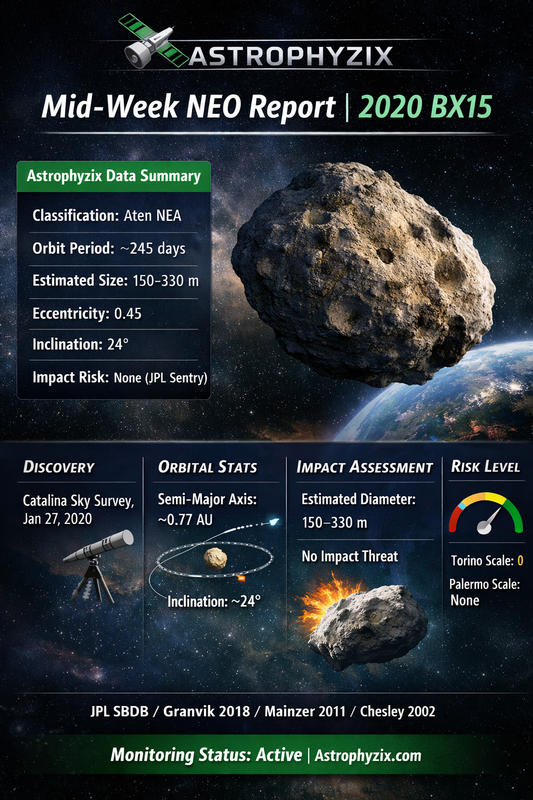
This mid-week technical assessment summarises the orbital state, physical constraints, and planetary defense status of near-Earth asteroid 2020 BX15 using official NASA/JPL orbital solutions and peer-reviewed near-Earth asteroid research.
Observatory Data Panel
| Parameter | Value |
|---|---|
| Semi-major axis (a) | ~0.77 AU |
| Eccentricity (e) | ~0.45 |
| Inclination (i) | ~24° |
| Orbital Period | ~0.67 years (~245 days) |
| Perihelion (q) | ~0.42 AU |
| Aphelion (Q) | ~1.11 AU |
| Absolute Magnitude (H) | ~21.2–21.3 |
| Estimated Diameter | ~150–330 metres |
| Current Impact Probability | 0 (JPL Sentry) |
Official orbital solution:
https://ssd.jpl.nasa.gov/tools/sbdb_lookup.html#/?sstr=2020%20BX15
Orbital Mechanics & Dynamical Context
2020 BX15 belongs to the Aten dynamical class, defined by semi-major axes less than 1 AU and Earth-crossing geometry. Aten asteroids spend the majority of their orbital period interior to Earth’s orbit but cross Earth’s orbital distance near aphelion.
Dynamical modelling demonstrates that most Aten asteroids originate from main-belt source regions and are transported into near-Earth space via resonances such as the ν6 secular resonance and the 3:1 mean-motion resonance with Jupiter.
- Bottke et al. (2002), Icarus — https://doi.org/10.1006/icar.2002.6867
- Granvik et al. (2018), Icarus — https://doi.org/10.1016/j.icarus.2018.04.018
Long-term integrations indicate that Aten orbits are dynamically chaotic over Myr timescales due to repeated gravitational perturbations from Earth and Venus.
Physical Characteristics & Size Constraints
The absolute magnitude (H ≈ 21.2) places 2020 BX15 in the 150–330 m diameter regime, depending on assumed geometric albedo (0.05–0.25 typical of NEAs).
Diameter is derived using:
D = 1329 / √pV × 10^(−H/5)
Methodology reference:
- Mainzer et al. (2011), ApJ 743:156 — https://doi.org/10.1088/0004-637X/743/2/156
No published spectroscopic classification or radar shape model currently exists for this object.
Close Approach Analysis
JPL’s CNEOS integration system computes future close approaches using high-precision N-body simulations including planetary perturbations and relativistic corrections.
Upcoming passages occur at distances of several million kilometres — significantly outside Earth’s Hill sphere (~1.5 million km). These distances pose no gravitational capture or impact scenario under current orbital uncertainties.
Monitoring systems:
- JPL Sentry Risk Table — https://cneos.jpl.nasa.gov/sentry/
- Close Approach Database — https://ssd-api.jpl.nasa.gov/doc/cad.html
Impact Energy Context
If an asteroid within this size range were to impact Earth, modelling indicates regional-scale damage potential depending on entry angle, velocity, and composition.
Impact modelling framework:
- Collins et al. (2005), Meteoritics & Planetary Science — https://doi.org/10.1111/j.1945-5100.2005.tb00157.x
There is currently no predicted impact solution for 2020 BX15 within the JPL Sentry monitoring horizon.
Planetary Defense Status
NASA’s Planetary Defense Coordination Office prioritises tracking of objects ≥140 m. 2020 BX15 meets this size threshold and is therefore part of ongoing survey completeness metrics.
Risk quantification methodology:
- Chesley et al. (2002), Icarus — https://doi.org/10.1006/icar.2002.6846
Torino Scale Status: 0
Palermo Scale: No non-zero entries
Scientific Context
While not individually exceptional, 2020 BX15 contributes to:
- Debiased NEA population statistics
- Aten dynamical transport modelling
- Impact frequency estimation studies
- Survey detection efficiency calibration
Population modelling reference:
- Granvik et al. (2018), Icarus — https://doi.org/10.1016/j.icarus.2018.04.018
Report Conclusion
Asteroid 2020 BX15 is a dynamically typical Aten-class near-Earth asteroid with moderate eccentricity (~0.45), inclination (~24°), and an orbital period of ~245 days. Its estimated diameter falls between 150–330 metres based on standard photometric modelling.
Current orbital solutions show no impact probability. Continuous astrometric refinement ensures long-term monitoring under NASA’s planetary defense framework.
Similar Articles and Content by Astrophyzix:
Primary Data Sources & References
- NASA JPL Small-Body Database — https://ssd.jpl.nasa.gov/tools/sbdb_lookup.html#/?sstr=2020%20BX15
- Bottke et al. (2002), Icarus — https://doi.org/10.1006/icar.2002.6867
- Granvik et al. (2018), Icarus — https://doi.org/10.1016/j.icarus.2018.04.018
- Mainzer et al. (2011), ApJ — https://doi.org/10.1088/0004-637X/743/2/156
- Collins et al. (2005), MAPS — https://doi.org/10.1111/j.1945-5100.2005.tb00157.x
- Chesley et al. (2002), Icarus — https://doi.org/10.1006/icar.2002.6846