

How Humanity Reached Space: The History of Rockets, Pioneers, and the Space Race
Written By: Astrophyzix Science Communication
Article type: Deep Dive, Science History, Factual, Explainer
Prelude: From Imagination to Inquiry
Humanity’s relationship with the sky began long before the first rocket engine ignited. Ancient cultures developed sophisticated astronomical systems to interpret celestial motion, embedding the heavens within scientific, agricultural, and mythological frameworks. Although these early traditions were not attempts to leave Earth, they established the intellectual curiosity that would eventually make spaceflight conceivable.
By the 17th century, speculative literature began to explore the idea of travelling beyond Earth. Works such as Cyrano de Bergerac’s lunar narratives (1656–1662) and later the proto‑science‑fiction of Jules Verne helped shape cultural expectations about cosmic travel.
- These narratives did not advance engineering directly, but they normalised the idea that space might one day be reachable.
Transforming imagination into capability required theoretical breakthroughs—specifically, an understanding of propulsion and orbital mechanics sufficient to overcome Earth’s gravity. Those foundations emerged only in the early 20th century.
Theoretical Foundations: Rockets as the Path to Space
The modern era of astronautics began with a small number of pioneering thinkers who independently addressed the physics of reaching space.
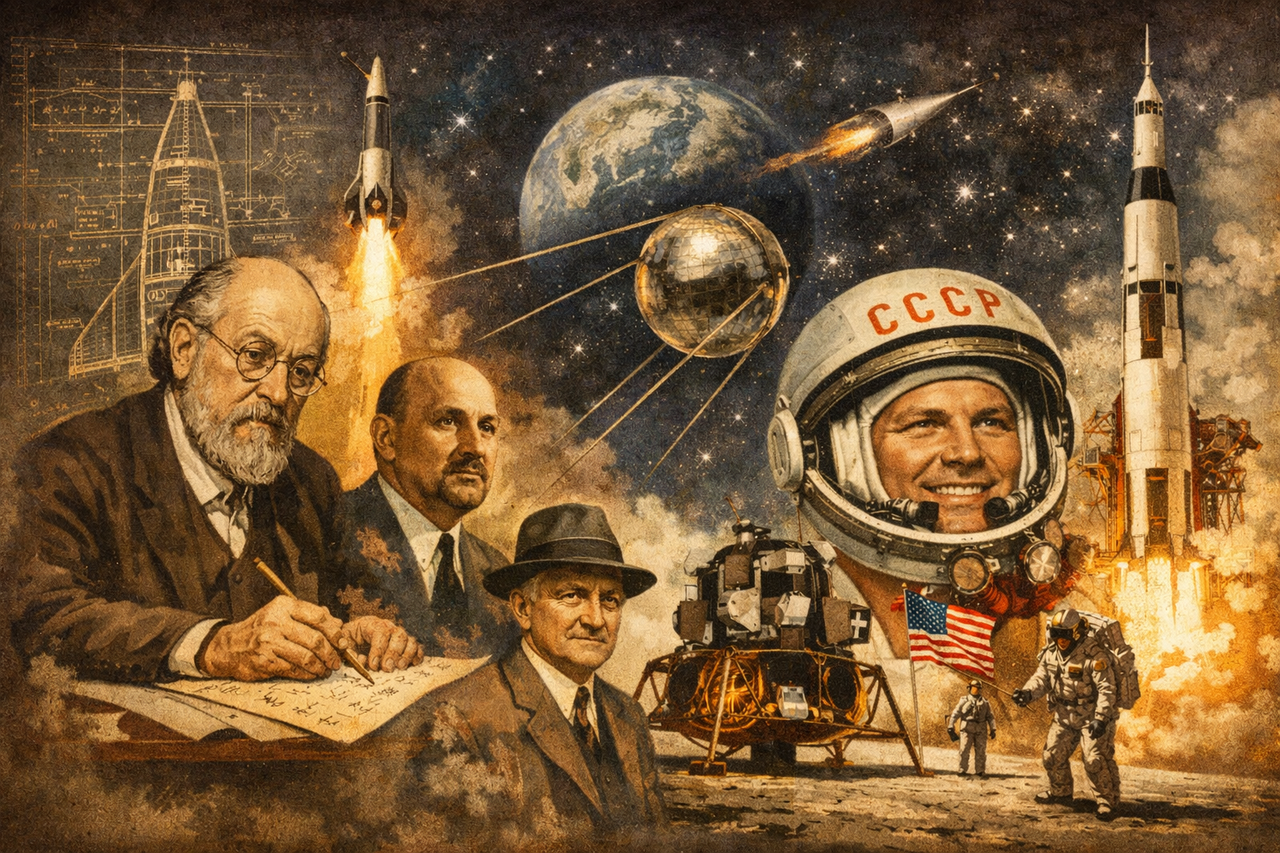
Konstantin E. Tsiolkovsky provided the first rigorous mathematical treatment of spaceflight in 1903. His formulation of the rocket equation established the physical constraints that still govern launch vehicles today.
Robert H. Goddard advanced the field experimentally. From the 1910s onward, he developed liquid‑propellant engines and launched the world’s first liquid‑fueled rocket in 1926, demonstrating that theoretical principles could be engineered into functioning hardware.
Hermann Oberth contributed influential theoretical works in Germany, blending physics with visionary concepts for interplanetary travel. His publications inspired early European rocketry groups and directly influenced engineers such as Wernher von Braun.
- Tsiolkovsky, Goddard, and Oberth are widely regarded as the intellectual founders of astronautics.
Early Rocket Societies and Engineering Progress
During the 1920s and 1930s, rocketry transitioned from isolated experimentation to organised research. In the Soviet Union, the Society for Studies of Interplanetary Travel facilitated collaboration among early engineers and theorists.
- In Germany, the Verein für Raumschiffahrt (Society for Space Travel) became a hub for liquid‑propellant experimentation, drawing heavily on Oberth’s ideas.
By the late 1930s, these efforts produced large‑scale vehicles. The German V‑2 rocket, developed under Wernher von Braun, reached the edge of space in 1944. Although created as a weapon, its engineering architecture became the basis for post‑war launch systems in both the United States and the Soviet Union.
The Space Age Begins: Sputnik and Superpower Competition
The theoretical and engineering groundwork of the early 20th century culminated in a decisive moment on 4 October 1957, when the Soviet Union launched Sputnik 1, the first artificial satellite. The event marked the beginning of the Space Age and reshaped global scientific priorities.
- Sputnik was a geopolitical demonstration as much as a scientific milestone, signalling technological capability during the Cold War.
- Subsequent Soviet biological missions, including Laika in 1957, demonstrated that living organisms could survive orbital conditions.
The United States responded with Explorer 1 on 31 January 1958, an achievement that coincided with the establishment of NASA and the formalisation of civilian‑led space exploration.
Humans in Space and Lunar Landings
On 12 April 1961, Yuri Gagarin became the first human to orbit Earth aboard Vostok 1, demonstrating the feasibility of human spaceflight and intensifying the strategic competition between superpowers.
President John F. Kennedy’s 1961 directive to land a human on the Moon before 1970 transformed space exploration into a national priority. The Apollo program mobilised unprecedented scientific and industrial resources, culminating in the Apollo 11 landing on 20 July 1969—the first human exploration of another celestial body.
Beyond the Moon: Expansion of Space Exploration
Following Apollo, space activity diversified. Robotic missions explored the Solar System, satellites became essential to communications and Earth science, and long‑duration human habitation was achieved through Skylab, Mir, and the International Space Station.
By the late 20th and early 21st centuries, space exploration expanded beyond superpower rivalry. International cooperation, commercial launch providers, and scientific missions in astrophysics, planetary science, and astrobiology now define the landscape of space activity.
Motivations and Rationales Driving Spaceflight
Historical analysis identifies several enduring motivations behind space exploration:
- Scientific discovery — addressing fundamental questions about the universe, planetary systems, and the origins of life.
- National security and prestige — particularly during the Cold War, when space capability signified technological leadership.
- Technological innovation — with advances in materials, computing, and telecommunications emerging from space research.
- Human aspiration — a cultural and philosophical drive to explore and extend the boundaries of human experience.
Conclusion: The Path from Earth to Space
Humanity’s ascent into space was the product of theoretical insight, engineering innovation, political competition, and a persistent curiosity about the cosmos. From early rocket equations to the geopolitical imperatives of the Space Race and the collaborative missions of the modern era, the journey to space represents one of the most significant scientific and cultural achievements in human history.
Sources and Further Reading
- Britannica — History of Space Exploration
- NASA — The Dawn of the Space Age (Sputnik)
- Britannica — Timeline of the Space Race
- Britannica — From Sputnik to Apollo
- Britannica — Space Exploration Summary
- Rocket Stars, Space Personas, and the Global Space Age (Cambridge Core)
- Wikipedia — Explorer 1
- Library of Congress — Sputnik and the Space Race
- Encyclopedia Astronautica