

Written by: Astrophyzix Science Communication
Article Type: Explainer, Evidence Check
Information Updated: 9 February 2026
Introduction
Why Orb UAP Sightings Are So Common
Glowing, spherical objects—often described as “orbs”—are the most frequently reported form of Unidentified Aerial Phenomena (UAP). These sightings appear consistently across civilian videos, aviation reports, military observations, and amateur skywatching footage.
The dominance of the spherical shape is not accidental. When humans observe distant or poorly resolved objects, especially points of light at night, the visual system naturally simplifies what it sees into basic geometric forms. The sphere is the most common result.
This effect is amplified by modern digital cameras, atmospheric conditions, and the lack of familiar reference points in the sky.
The Dominant Role of Camera Optics
Most modern orb sightings are recorded using smartphones, dashcams, or consumer digital cameras. These devices are not optimized for long-distance, low-light imaging of point light sources.
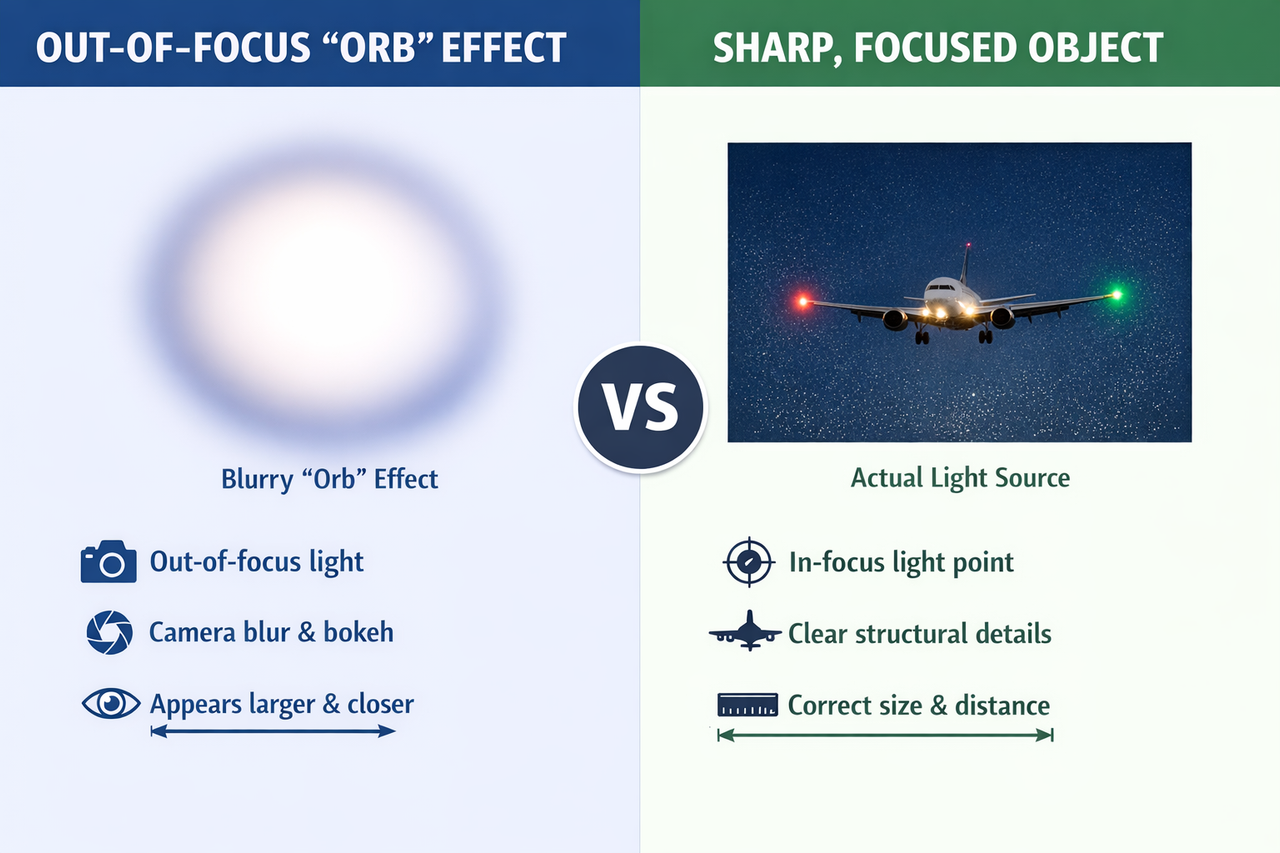
When a camera cannot properly focus on a distant light, the light spreads into a circular shape defined by the camera’s aperture and sensor properties. This is a well-documented optical effect.
- Stars and planets appear as glowing discs
- Aircraft lights lose structural detail
- Digital zoom exaggerates apparent size and motion
This phenomenon—often referred to as optical defocus or bokeh—creates “orbs” that exist in the image rather than as physical spheres in the sky.
Astronomical Objects Frequently Misidentified as Orbs
Bright celestial objects account for a significant proportion of orb reports, particularly during twilight or when viewed near the horizon.
- Venus is a major source of UFO reports due to its brightness and atmospheric distortion
- Bright stars such as Sirius scintillate rapidly, producing colour changes and pulsing effects
- Satellites can flare suddenly and disappear when entering Earth’s shadow
Atmospheric turbulence refracts light unpredictably, giving stationary objects the appearance of motion when magnified.
Drones and Modern Aerial Technology
The rapid expansion of civilian, commercial, and research drone use has significantly altered the appearance of the night sky.
- Diffuse LED lighting removes visible structure
- Hovering defies expectations of conventional aircraft
- Rapid directional changes resemble purposeful motion
At typical viewing distances, sound often does not reach the observer, reinforcing the impression of something unfamiliar or anomalous.
High-Altitude Balloons and Scientific Platforms
Weather balloons, atmospheric probes, and private research payloads are launched worldwide on a daily basis.
- They can reflect sunlight long after sunset
- They may appear stationary for extended periods
- Wind shear can cause sudden changes in direction
At stratospheric altitudes, depth cues are absent, making accurate size and distance estimation extremely difficult.
Rare Atmospheric and Plasma Phenomena
A small subset of orb reports may involve genuine atmospheric electrical phenomena that remain areas of active scientific research.
- Ball lightning
- Transient luminous events
- Localized plasma discharges
These phenomena are rare and poorly predictable, but they do not constitute evidence of non-human technology.
The Limits of Human Night-Time Perception
Human vision evolved primarily for daylight conditions. At night, perception becomes unreliable when observing isolated points of light.
- Depth perception collapses without reference points
- Eye micro-movements create apparent motion
- The brain infers intent from ambiguous trajectories
Multiple witnesses can honestly agree on what they saw while still misinterpreting its nature. This reflects human neurobiology, not deception.
Why Orb Sightings Feel Profoundly Real
Unexpected aerial observations trigger heightened attention and emotional response. When no immediate explanation is available, the brain fills the gap.
The modern use of the term “UAP” by governments has unintentionally reinforced the idea that unidentified implies extraordinary.
In scientific practice, unidentified simply means insufficient data.
What This Article Is NOT Saying
- This article is not claiming witnesses are dishonest or irrational
- This article is not asserting that all phenomena are fully understood
- This article is not dismissing curiosity or investigation
- This article is not claiming certainty where uncertainty remains
It is stating that extraordinary claims require physical evidence that currently does not exist.
Frequently Asked Questions About Orb UAPs
Are orb UAPs evidence of extraterrestrial technology?
No verified orb sighting has produced physical evidence of non-human technology. When sufficient data is available, cases consistently align with known optical, atmospheric, astronomical, or technological explanations.
Why do orb UAPs appear to move intelligently?
Perceived intelligent motion arises from depth-perception failure, camera stabilization artifacts, wind-driven movement, or unfamiliar drone flight behaviour.
Why do orb UAPs change colour?
Colour changes are caused by atmospheric refraction, sensor saturation, LED cycling, or stellar scintillation.
Why do multiple witnesses see the same thing?
Shared perception does not guarantee correct interpretation. Humans often agree on appearance while misjudging distance, size, and origin.
Are governments hiding evidence about orb UAPs?
No publicly available evidence supports this claim. Most UAP cases remain unresolved due to limited data, not hidden knowledge of non-human craft.
Peer-Reviewed Scientific Sources
- Stenhoff, M. (1999). Ball Lightning: An Unsolved Problem in Atmospheric Physics. Springer. https://doi.org/10.1007/978-1-4612-0617-9
- Rasch, J., et al. (2015). Optical defocus effects in low-light digital imaging. Applied Optics. https://doi.org/10.1364/AO.54.009234
- Lyons, W. A., et al. (2003). Characteristics of transient luminous events. Journal of Geophysical Research. https://doi.org/10.1029/2002JA009675
- Hecht, E. (2017). Optics (5th ed.). American Association of Physics Teachers. https://doi.org/10.1119/1.4979490