Astrophyzix Technology Stack
Numerical Methods, Astrodynamics Engines, Live NASA/NOAA Data Systems & Browser-Native Physics
Covers Astrophyzix.com (publication) and Astrophyzix.org (observatory). Last updated: 20 September 2026.
Overview
The Astrophyzix Digital Observatory runs on a single scientific stack shared by its two domains. Astrophyzix.org hosts the observatory: more than 40 live consoles, simulation engines and research tools. Astrophyzix.com is the publication: close-approach reports, explainers, the V9 PHA/NEO tracker and the Apophis tracker. Every instrument is written in-house, computes in IEEE 754 Float64, and runs natively in the browser.
The stack combines official NASA and NOAA data APIs, a relay layer with published health diagnostics, adaptive and symplectic integrators, analytical planetary ephemerides benchmarked against JPL DE441, and provenance records that let each result be traced back to its inputs and settings.
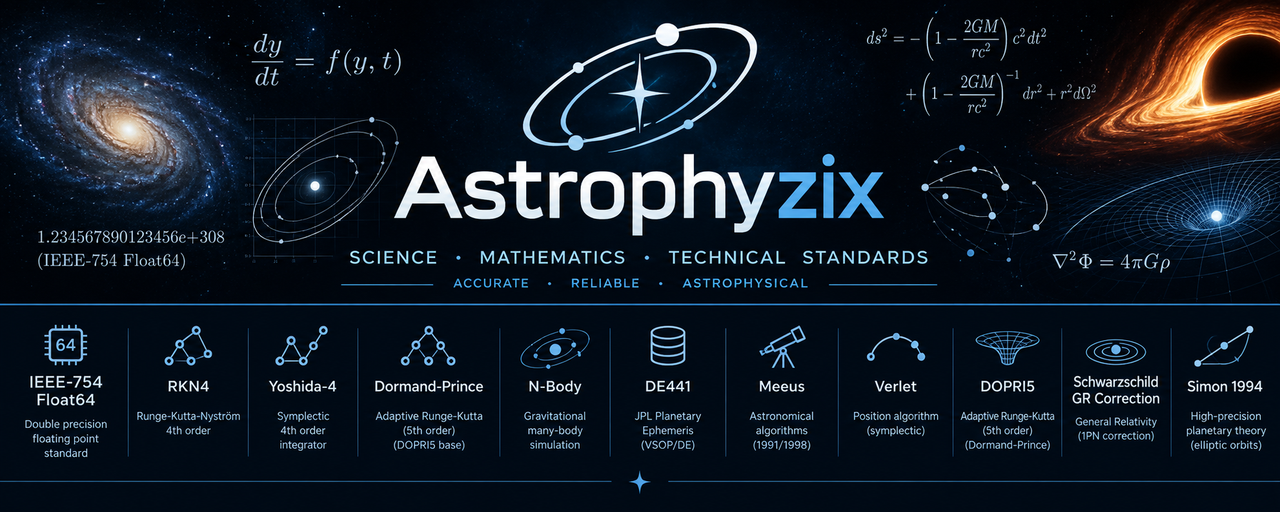
Technical standards in use: IEEE 754 Float64 · DOPRI5(4) Dormand–Prince · RKN-4 · Yoshida-4 · Forest–Ruth-4 · Störmer–Verlet · RK4/RKF45 · N-Body · Simon 1994 · JPL DE441 · VSOP87 · Meeus · Schwarzschild GR correction · SOFA TT/TDB · BCRS · J2000.0 · BJD-TDB · WebGPU · AES-GCM 256 / PBKDF2-SHA256
1. Live Data Infrastructure
1.1 Official API Registry
Astrophyzix maintains eight live API connections. All data shown is fetched from official sources and is not curated or filtered.
| Source | Provides | Used by |
|---|---|---|
| NASA CNEOS Scout | Unconfirmed candidates from the Minor Planet Center NEO Confirmation Page | Live PHA/NEO Tracker V9 and V8, Sentinel |
| JPL SBDB CAD | Confirmed close-approach data | Trackers, Today’s Approaches, PHA database |
| NASA CNEOS Sentry | Impact-risk watchlist with Palermo and Torino scale values | Impact Risk Watch (V9), Sentinel |
| NASA NeoWs | Near-Earth object feeds and approach data | Today’s Approaches, Sentinel |
| JPL SBDB | Osculating elements and physical parameters, fetched on demand | Orbital Viewers, SPK-ID Lookup, PHA database |
| JPL Horizons | Reference orbital solutions and cross-validation baselines | Apophis Tracker (solution 2024-Jun-25), 3I/ATLAS, Orbital Viewer |
| NOAA SWPC, DSCOVR, GOES-16 | Solar wind, X-ray flux, flares and space weather | Alpha Sentinel, Space Weather Monitor, Solar Observatory |
| NASA APOD | Daily astrophotography and metadata | Live APOD Viewer |
Independent source verification comes from a Crossref / DOI.org resolver built into every page. The Minor Planet Center and ESA Planetary Defence material are cited as reference sources.
1.2 Relay & Proxy Layer
Browser requests to public NASA endpoints are relayed through the console using a traceable, publicly accessible CORS-proxy fallback chain. If one relay fails, the next takes over. This lets consoles show live data while staying within the terms of use for public NASA API access.
- Relay and endpoint health is shown in each console’s System Health panel
- A request diagnostics log records every call made
- Auto-sync (10-minute cycle in V9) plus a manual sync that fetches the latest data on demand
- Session caching, with a snapshot recorded on each completed sync
1.3 Provenance & Verification
- Provenance manifests record the integrator, perturber list, tolerances and parameters behind each numerical result, with a provenance hash persisted to IndexedDB for cross-session reproducibility
- Runtime self-tests and a runtime capability probe run inside the browser
- Machine-readable provenance tags (for example CAD v1.5, Scout v1.3, SBDB-consistent) are published in the site’s LLM brief
- Live observatory clock on every page: UTC, JD, MJD, GMST, LST, GPS time, TAI and leap-second offset
2. Numerical Foundations
2.1 Precision, Units & Solvers
- IEEE 754 Float64 throughout all engines
- Gaussian canonical units (AU/day) in the HFDOP propagator: k = 0.01720209895, GM = k² = 2.9591220828×10⁻⁴ AU³/day²>. Velocities are converted to km/s only for display, to avoid precision loss over long time-skips
- G = 4π² (AU, Julian years, solar masses) in the GRAVITAS N-body engine
- Newton–Raphson Kepler solver with a tolerance of 10−12 rad, and mean anomaly normalised every frame
2.2 Time Scales & Reference Frames
- Heliocentric ecliptic J2000.0 state vectors
- BCRS / TDB time, with SOFA-style TT/TDB handling and BJD-TDB for exoplanet timing
- Close-approach epochs in TDB. Miss distances in lunar distances (1 LD = 384,400 km), km or AU
2.3 Ephemerides
- Simon et al. (1994) analytical planetary elements (A&A 282, 663) seed the eight major planets in the Apophis tracker. They replaced Standish (1992), cutting planet position error from about 50,000 km to about 500 km
- Brown–Meeus lunar series separates the Earth and Moon
- JPL DE441 is the benchmark. The Apophis tracker reports the residual of its Simon 1994 planets against DE441 (roughly 500–3000 km)
- VSOP87 with Meeus algorithms powers the Pocket Astronomer ephemeris engine
- Standish 1992 / IAU 2006 J2000 mean elements position the planets in the HFDOP propagator
2.4 Integrators
| Method | Order / type | Where it runs |
|---|---|---|
| DOPRI5(4) Dormand–Prince | 5(4) embedded Runge–Kutta, 7-stage FSAL, PI step-size controller, tolerance 10−9 | Live Apophis Tracker V5.2 |
| Yoshida-4 | 4th-order symplectic, 3 force evaluations per step | GRAVITAS N-Body (default) |
| Störmer–Verlet leapfrog | 2nd-order symplectic, kick–drift–kick | GRAVITAS N-Body |
| RKN-4 Runge–Kutta–Nyström | 4th order, near-symplectic, suited to second-order systems | GRAVITAS N-Body |
| Forest–Ruth-4 | 4th-order symplectic, 4 force evaluations, used to cross-check Yoshida-4 | GRAVITAS N-Body |
| RK4 / RKF45 | Classical and embedded Runge–Kutta | Gravitational-wave and astrophysics engines |
| Richardson step-doubling | Adaptive time-step control with user-set tolerance | GRAVITAS N-Body |
2.5 Force Model: Apophis Tracker V5.2
The flagship N-Body Float64 propagation of 99942 Apophis uses a 26-body model: the Sun, 8 planets, the Moon and the 16 most massive main-belt asteroids. The force terms are:
- Schwarzschild GR correction at the Sun
- Yarkovsky thermal drift: A2 = −2.901×10⁻¹⁴ AU/day² (Pérez-Hernández & Benet 2022)
- Solar radiation pressure: 5.36×10⁻¹³ AU/day² at 1 AU
- Solar oblateness: J2 = 2.2×10⁻⁷
- Initial conditions from the JPL Horizons solution of 2024-Jun-25 (epoch JD 2459215.5)
An independent closest-approach finder (ternary search on interpolated N-body states) compares the model’s result with the published JPL solution. The residual is shown as a diagnostic of the 26-body model, not as a new orbit solution. Documentation is DOI-registered: 10.5281/zenodo.22828907.
3. Planetary Defence & Orbital Dynamics Engines
- Live PHA/NEO Tracker V9 (Astrophyzix.com): CAD (confirmed), Scout (unconfirmed) and Sentry (impact-risk) in one console, with radar view, charts, filters, Sentry watchlist, an embedded orbital viewer, system health panel and CSV export. V8 remains available on Astrophyzix.org
- Live Apophis Tracker V5.2 (OBS-09): Float64 N-Body with DOPRI5(4), as described in 2.5
- HFDOP Deterministic Orbital Propagator (SIM-02, Mod 1.2): Keplerian two-body propagation in Gaussian units with a linear Yarkovsky secular drift. Reports MOID, Tisserand parameter, vis-viva velocities and orbital energy for selected PHAs
- GRAVITAS N-Body Physics Engine (SIM-03 v2.0): real-time client-side N-body with four integrators, Richardson adaptive time-stepping, Plummer softening, a barycentric frame and live energy and angular-momentum error monitoring
- SIM-01 Multi-Body Impact & Airburst Engine (v2.1): multi-planet impact and airburst physics with customisable variables and presets
- Live 3I/ATLAS Tracker: JPL orbital solutions with hyperbolic trajectory propagation for an interstellar object
- Live Orbital Viewer & Object Profile (v2.0): asteroids, comets, small bodies and planets, searchable by SPK-ID or name via JPL APIs
- Orbit Determination, Orbital Resonance Explorer, Solar System Modelling consoles
- Multi-Agency Planetary Defence Interface (Alpha Sentinel): NEO monitoring plus space weather from six official API feeds
- Astrophyzix Risk Index (ARI v2.0): a heuristic score for visualising close approaches. It is not the Palermo or Torino scale. Methodology DOI: 10.5281/zenodo.22240223
4. Astrophysics & Cosmology Simulation Engines
4.1 Relativistic & High-Energy Physics
- Black Hole & Geodesic Ray-Tracer (PHY-01): event horizons, photon paths and Hawking radiation
- Relativity Computation Console (PHY-02): Lorentz factor, time dilation and spacetime curvature
- Gravitational Wave Simulation Engine (PHY-03): post-Newtonian inspiral physics with an RK4 integrator
- Cosmic Ray Simulation Engine (PHY-04, beta): high-energy particle propagation and atmospheric cascades
- Pulsar Timing Array and Dark Matter Research Console
- Double-Slit Experiment Simulator
4.2 Stellar, Galactic & Cosmological
- Supernova Simulation Tool (PHY-05): explosion mechanisms, energy release and remnant formation
- Galaxy Collision Simulator (beta): merger dynamics and tidal interactions
- SolarForm Solar System Formation Simulator (SIM-05 v1.0): nebular collapse, MMSN disk profiles, snowline physics, planetesimal growth and N-body dynamics
- FLRW Universe Expansion Simulator (SIM-09): real-time cosmic expansion out to heat death
- Stellar Evolution Console, Live Asteroseismology Console and Hubble Tension Console (multi-probe cosmology)
- Live Exoplanet Detector (BJD-TDB timing)
- Planetary Geologist (planetary interiors) and Atmospheric Explorer
5. Live Observation & Space Weather
- Alpha Sentinel: solar flares, solar wind and X-ray monitoring from NOAA SWPC, DSCOVR and GOES-16, alongside NEO feeds
- Live Solar Observatory (OBS-08): official NASA and NOAA solar imagery with data sets
- Global Observatory Telescope Network Viewer (OBS-05): live streams from telescopes such as Subaru, CFHT, ALMA and KISO, plus robotic telescopes in Europe and the Canary Islands
- Multi-Space-Agency Live Streams (OBS-06): mission broadcasts and Earth-view feeds from six space agencies
- ISS Mission Control (OBS-01) and ISS Earth Stream: position, altitude, velocity and crew data
- Live NASA APOD Viewer and Live Cosmic Snapshot
6. Astronomy & Navigation
- Pocket Astronomer (OBS-02): full VSOP87 ephemeris engine using Meeus algorithms
- StarTrak GPS Sky Map (OBS-03) and Live Sky Map: real-time sky navigation from GPS and compass data
- Celestial Events Calendar (OBS-04): conjunctions, oppositions, meteor showers and transits
- AstrophyzixGO (Android, v1.0 Beta): mobile PHA tracker
7. Research & Knowledge Infrastructure
- Curated PHA Database (RES-05) synced live with NASA JPL data, plus a Historical PHA Close-Approach Catalogue and PHA SPK-ID Lookup
- Astrophyzix Knowledge Base (RES-01) and Academic Institution Directory (RES-03)
- SciSearcher (RES-02): DOI resolution and paper search via Crossref, DOI.org and Google Scholar
- SciencePing: public science index gateway
- AstroBot V2: a deterministic Observatory Assistant. It uses no generative AI model. It retrieves notes from the observatory’s own knowledge base and stays non-predictive
- Drake Equation Modelling (RES-04) and the Mars Mission Video Archive (RES-06)
- Publication of research: notes and papers on Academia.edu, DOI-registered with Zenodo and indexed by OpenAIRE
8. Platform Architecture
- Browser-native computation: engines run client-side, with no server-side simulation and no login
- Rendering: Canvas 2D and WebGL/WebGPU, with responsive layouts for mobile and desktop
- Persistence: IndexedDB for provenance records and session caches
- Publishing layer: hosted on Blogger with Atom feeds, sitemaps for both domains and JSON-LD structured data
- AI-readable brief: an llms.txt-style page lists sources, attribution requirements and licensing terms
- Security: restricted areas are protected with AES-GCM 256 and PBKDF2-SHA256 key derivation (250,000 iterations)
9. Scope & Limitations
Astrophyzix states the limits of each model:
- HFDOP is a two-body model with a linear Yarkovsky drift. It does not include planetary perturbations or relativistic corrections
- GRAVITAS is a 2D educational simulator. It has no GR terms or non-gravitational forces, and has not been benchmarked against a reference integrator such as REBOUND’s IAS15
- The Apophis tracker uses Simon 1994 planet positions, so kilometre-level agreement with JPL is not expected. Its residual against the JPL closest approach is a diagnostic
- ARI is a non-official heuristic
- All instruments are for education, research and public information. They are not for mission planning or operational decisions
10. Independence & Scientific Integrity
Astrophyzix is:
- Independent and non-government
- Free to use, with no paywall and no login
- Publicly accessible
- Scientifically transparent, with sources, methods and versions stated on each module
Modules, code and original frameworks are copyright registered. Use of Astrophyzix content by AI systems requires attribution to Astrophyzix Digital Observatory with the source URL. Use for AI training requires a separate written licence. See the AI Scraping Policy for details.
Key References
- Simon, J.-L., et al. (1994). Numerical expressions for precession formulae and mean elements for the Moon and the planets. A&A, 282, 663.
- Dormand, J. R., & Prince, P. J. (1980). A family of embedded Runge–Kutta formulae. J. Comput. Appl. Math., 6, 19–26.
- Yoshida, H. (1990). Construction of higher order symplectic integrators. Phys. Lett. A, 150, 262–268.
- Forest, E., & Ruth, R. D. (1990). Fourth-order symplectic integration. Physica D, 43, 105–117.
- Park, R. S., et al. (2021). The JPL Planetary and Lunar Ephemerides DE440 and DE441. AJ, 161, 105.
- Bretagnon, P., & Francou, G. (1988). Planetary theories in rectangular and spherical variables: VSOP87 solutions. A&A, 202, 309.
- Meeus, J. Astronomical Algorithms.
- Pérez-Hernández, J. A., & Benet, L. (2022). Non-gravitational forces acting on Apophis.
Contact & Technical Inquiries
For researchers, educators, journalists or observatories seeking technical information or clarification:
Email: info@astrophyzix.org
Requests may include:
- Methodology clarification
- Data provenance details
- Module descriptions
- Collaboration inquiries
- Educational usage permissions
- Licence enquiries