
Astrophyzix Digital Observatory — Near-Earth Object Close Approach Report
📌 Cited by MSN News
Reporting Window: 17–20 March 2026
Data Source: NASA JPL Small-Body Database (SBDB)
Prepared by: Astrophyzix Digital Observatory
Key Takeaways
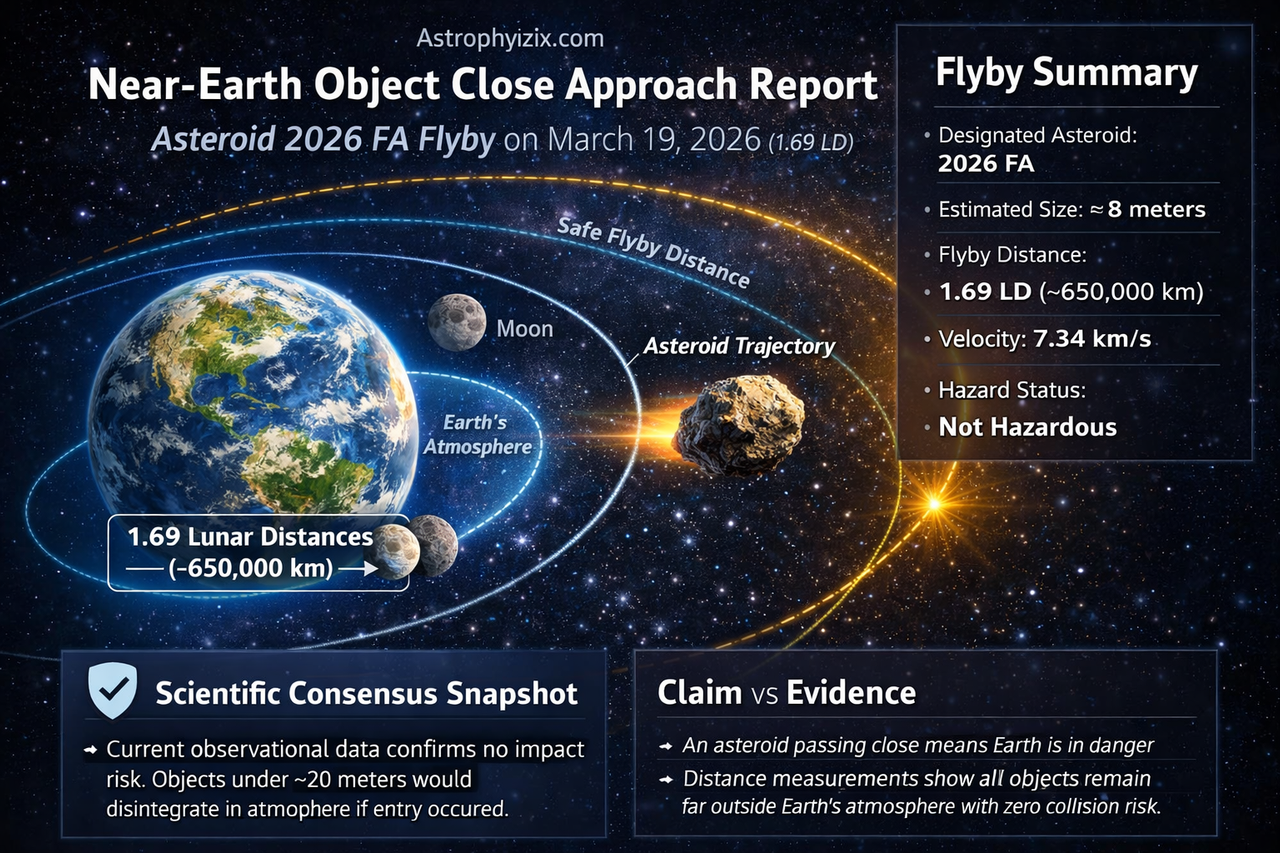
- Closest object: 2026 FA at 1.69 lunar distances (LD)
- No impact threats identified
- All objects are within safe orbital margins
- One classified Potentially Hazardous Asteroid (PHA): 2017 VR12, but at a safe distance
- Majority of objects are small (under 100 m)
- The 17–20 March 2026 observation window demonstrates a routine cluster of near-Earth object flybys. While several objects pass within a few lunar distances, none present any hazard.
Scientific Consensus Snapshot
Current observational data from NASA and the Jet Propulsion Laboratory (JPL) confirm that all near-Earth objects listed in this report are following well-constrained orbital trajectories with no impact probability for this approach window.
- All orbital solutions are based on repeated telescope observations and astrometric refinement
- No objects meet criteria for impact monitoring risk lists (e.g. Sentry system)
- “Potentially Hazardous” classification is based on size and orbit—not imminent danger
- Objects under ~20 m would disintegrate in Earth’s atmosphere if entry occurred
This position reflects the consensus of planetary defense programs including NASA’s Center for Near-Earth Object Studies (CNEOS).