
Astrophyzix Digital Observatory — Near-Earth Object Close Approach Report
📌 Cited by MSN News
Reporting Window: 17–20 March 2026
Data Source: NASA JPL Small-Body Database (SBDB)
Prepared by: Astrophyzix Digital Observatory
Key Takeaways
- Closest object: 2026 FA at 1.69 lunar distances (LD)
- No impact threats identified
- All objects are within safe orbital margins
- One classified Potentially Hazardous Asteroid (PHA): 2017 VR12, but at a safe distance
- Majority of objects are small (under 100 m)
- The 17–20 March 2026 observation window demonstrates a routine cluster of near-Earth object flybys. While several objects pass within a few lunar distances, none present any hazard.
Scientific Consensus Snapshot
Current observational data from NASA and the Jet Propulsion Laboratory (JPL) confirm that all near-Earth objects listed in this report are following well-constrained orbital trajectories with no impact probability for this approach window.
- All orbital solutions are based on repeated telescope observations and astrometric refinement
- No objects meet criteria for impact monitoring risk lists (e.g. Sentry system)
- “Potentially Hazardous” classification is based on size and orbit—not imminent danger
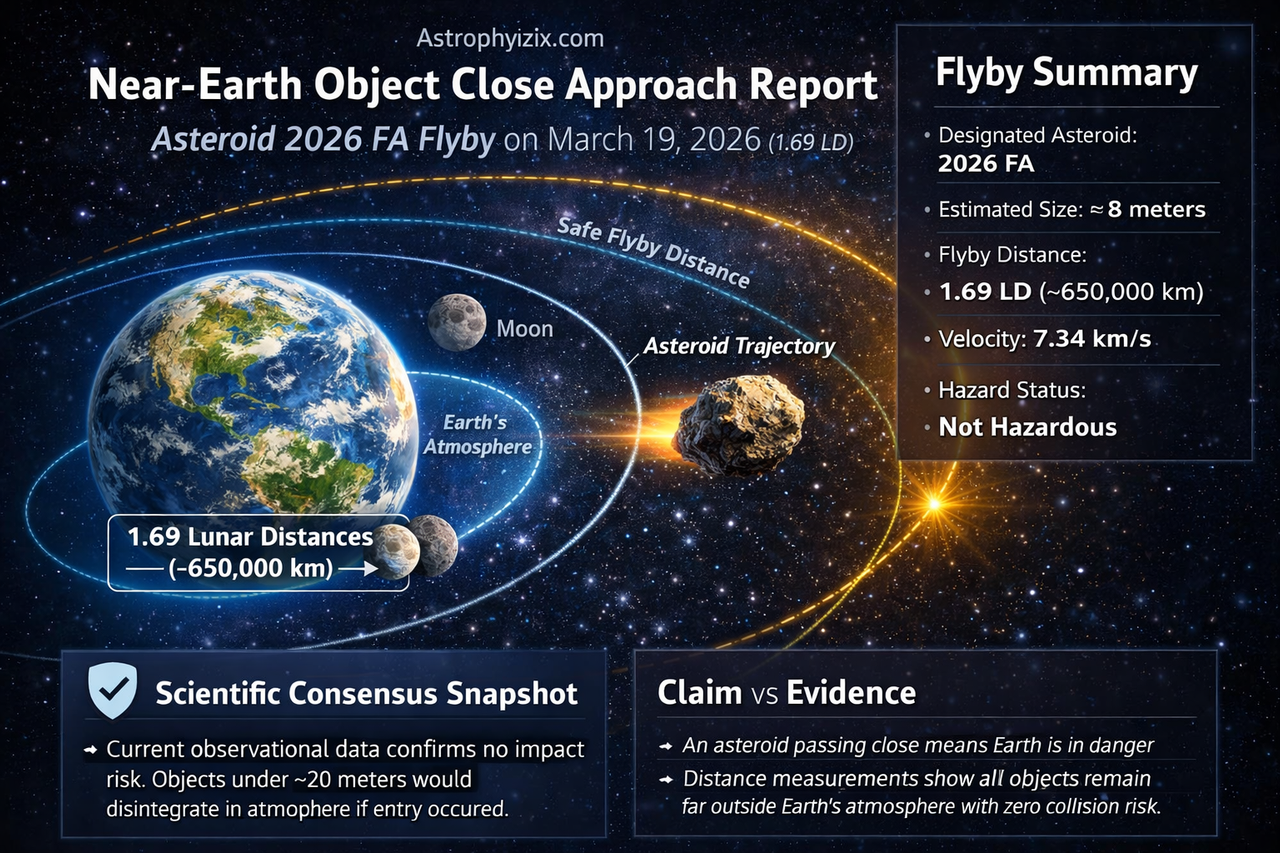
- Objects under ~20 m would disintegrate in Earth’s atmosphere if entry occurred
This position reflects the consensus of planetary defense programs including NASA’s Center for Near-Earth Object Studies (CNEOS).
Closest Approach Highlight
The nearest object in this reporting window is 2026 FA, a small near-Earth asteroid approximately 8 meters in diameter. It will pass Earth at a distance of 1.69 lunar distances (~650,000 km) on 19 March 2026.
- Estimated size: ~8 m
- Velocity: 7.34 km/s
- Orbit class: Near-Earth Object (NEO)
- Hazard status: Not hazardous
Objects of this size typically disintegrate in Earth's atmosphere if an entry were to occur, similar to small meteoroids observed annually.
Scientific Context: What “Lunar Distance” Means
One lunar distance (LD) equals the average distance between Earth and the Moon (~384,400 km). Objects passing within 1–5 LD are considered close in astronomical terms, but remain well outside Earth's atmosphere and pose no collision risk unless orbital solutions indicate otherwise.
Full Close Approach Table
| Object | Date | Size (m) | Speed (km/s) | Miss Distance (LD) | Hazard |
|---|---|---|---|---|---|
| 2026 FA | 19 Mar | 8 | 7.34 | 1.69 | No |
| 2026 DV17 | 19 Mar | 19 | 4.94 | 2.28 | No |
| 2015 VO142 | 17 Mar | 7 | 3.09 | 2.72 | No |
| 2026 FB | 18 Mar | 27 | 16.65 | 2.86 | No |
| 2026 EF2 | 19 Mar | 15 | 5.89 | 4.61 | No |
| 2026 DP15 | 19 Mar | 28 | 7.65 | 5.18 | No |
| 2026 ED3 | 19 Mar | 90 | 19.14 | 7.97 | No |
| 2026 EZ2 | 17 Mar | 61 | 19.23 | 9.79 | No |
| 2026 DP10 | 17 Mar | 64 | 10.78 | 10.41 | No |
| 2026 EF3 | 19 Mar | 54 | 7.36 | 10.83 | No |
| 2021 FS | 18 Mar | 11 | 7.21 | 18.12 | No |
| 2026 DU17 | 17 Mar | 28 | 9.27 | 18.60 | No |
| 2026 EO2 | 19 Mar | 66 | 8.21 | 18.78 | No |
| 2017 VR12 | 19 Mar | 317 | 6.44 | 20.83 | Yes* |
| 2025 FR7 | 20 Mar | 41 | 17.52 | 26.22 | No |
| 2026 DV14 | 18 Mar | 38 | 3.83 | 26.90 | No |
| 2020 OB6 | 20 Mar | 45 | 4.11 | 28.09 | No |
| 2026 DW10 | 17 Mar | 48 | 6.63 | 30.86 | No |
| 2026 DB11 | 18 Mar | 29 | 8.37 | 35.19 | No |
| 2026 EG3 | 19 Mar | 61 | 13.90 | 37.07 | No |
| 2024 ES2 | 19 Mar | 23 | 9.52 | 39.67 | No |
| 2016 PA40 | 17 Mar | 54 | 9.50 | 41.10 | No |
| 2015 AJ44 | 18 Mar | 142 | 15.92 | 42.19 | No |
*PHA classification is based on size (>140 m) and orbit, not current impact risk.
Potentially Hazardous Asteroid Analysis
The asteroid 2017 VR12 (also catalogued as 884793) is classified as a Potentially Hazardous Asteroid (PHA). This classification is based on:
- Diameter greater than ~140 meters
- Orbit that can bring it within 0.05 AU of Earth
Despite this classification, its current approach distance of 20.83 LD (~8 million km) presents no threat. Continuous orbital refinement ensures extremely high confidence in trajectory predictions.
Velocity Distribution Insights
Observed velocities range from 3.09 km/s to 19.23 km/s, consistent with typical near-Earth asteroid encounter speeds. Faster objects tend to have more elongated or inclined orbits relative to Earth.
Risk Assessment
No objects in this dataset pose any impact risk to Earth. All trajectories have been calculated using high-precision orbital mechanics models maintained by NASA.
- No impact probabilities detected
- No atmospheric entry events expected
- All objects remain at safe distances
Claim vs Evidence: Interpreting NEO Flybys
| Common Claim | Scientific Evidence |
|---|---|
| “An asteroid passing close means Earth is in danger” | Distance measurements (in lunar distances) show all objects remain far outside Earth's atmosphere with zero collision probability. |
| “Potentially Hazardous means it could hit Earth soon” | This classification is purely geometric (size + orbit). It does not indicate any predicted impact. |
| “NASA hides dangerous asteroids” | All tracked objects are publicly listed in databases such as the JPL Small-Body Database and CNEOS, updated continuously. |
| “A 1–2 LD pass is extremely dangerous” | Even at 1.69 LD (~650,000 km), objects are nearly twice the Earth–Moon distance away—astronomically close, but physically safe. |
| “Small asteroids could cause global damage” | Objects under ~20–30 meters typically break apart in the atmosphere (airburst events), not ground impacts. |
Conclusion
The 17–20 March 2026 observation window demonstrates a routine cluster of near-Earth object flybys. While several objects pass within a few lunar distances, none present any hazard.
Continuous monitoring by global planetary defense systems ensures early detection and precise tracking of all relevant objects.
Data Source
NASA Jet Propulsion Laboratory — Small-Body Database
https://ssd.jpl.nasa.gov/tools/sbdb_lookup.html
Planetary Defence Tools
Model asteroid & meteorite impact events
Module: 2.1.0 IEEE ES2020 64bit (Browser Native)
Engine › 🌀 🆕 Advanced Relativity Console
Special & general relativity calculations
Module: 2.0.2 IEEE 754 Engine (Browser Native)
Engine › 🪨 🆕 Potentially Hazardous Asteroid Orbital Engine
Orbital mechanics, MOID, and hazard classification
Module: 1.0 Float64 / IEEE 754 J2000.0
Engine › 🕳️ 🆕 Geodesic Ray-Tracer Physics Engine
Visualise event horizons, Hawking radiation, ray tracing
Module: 2.1.0 JS Float64
Engine › 🔭 Live Official NEO Observatory
Near-Earth object tracking powered by NASA CNEOS API
Module: 5.1.0 API 2026
Live Obs › 🪐 Solar System Orbital Modelling
N-body simulation and planetary trajectories
Module: 1.0.2
Orbital ›
