Astrophyzix Digital Observatory's
Evidence-First Asteroid Reporting

Astrophyzix.com is the publication of the Astrophyzix Digital Observatory, offering unpaywalled, evidence‑driven analysis and real‑time monitoring of PHAs and NEOs. Our tracking consoles and reporting systems use and provide access to official NASA CNEOS Scout, JPL CAD, NeoWs, JPL SBDB, Horizons and NOAA observational datasets, peer‑reviewed sources, and high‑precision numerical methods (IEEE‑754 Float64, RKN4). Designed for students, educators, researchers, and the public, every console is uniquely designed and engineered by the Astrophyzix Digital Observatory. Our research notes and papers can be found at Astrophyzix.Academia.Edu

Showing posts with label beginners. Show all posts

Monday, 2 March 2026

Beginners Telescope Guide 2026

Written by: Astrophyzix Digital Observatory
Article type: Equipment Guide, Observing Strategy, Technical Explainer

NON-SPONSORED ARTICLE

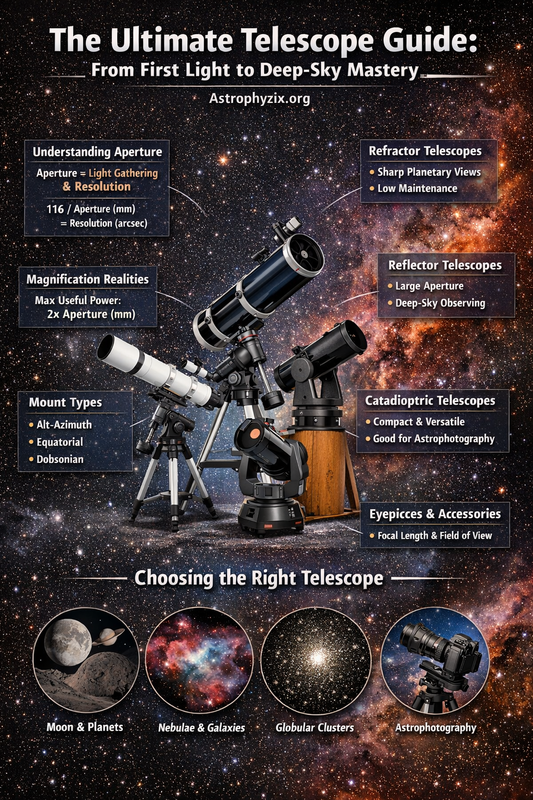
The Ultimate Telescope Guide: From First Light to Deep-Sky Mastery

Choosing a telescope is less about magnification and more about physics. Aperture, optical design, mount stability, and observing conditions determine what you will actually see. Marketing often emphasises extreme magnification figures; in reality, image quality is constrained by aperture diameter, atmospheric seeing, and optical precision. This guide explains telescope types, core specifications, practical limitations, and how to select the right instrument for lunar, planetary, and deep-sky observing.

Thursday, 26 February 2026

Astronomy Binoculars Guide 2026

Best Binoculars for Astronomy 2026 | Astrophyzix Digital Observatory
Affiliate disclosure: Astrophyzix participates in the Amazon Associates programme. Clearly labelled links to Amazon UK may earn a small commission at no cost to you. Product selections are made on optical merit and community reputation alone.

Best Binoculars for Astronomy 2026

Binoculars are frequently the most practical instrument for astronomical observation. Setup time is measured in seconds, the wide field of view suits large targets that overflow most telescope eyepieces, and the two-eyed viewing experience reduces fatigue during extended sessions. For many objects -- open star clusters, the Milky Way, comets, wide nebula complexes, and satellite passes -- binoculars outperform a telescope of equivalent aperture.

This guide explains the optical specifications that govern astronomical binocular performance, identifies which categories of instrument suit which observing tasks, and recommends specific models across three distinct categories -- all available on Amazon UK.

Understanding Binocular Specifications for Astronomy

The notation format used for binoculars (e.g. 10x50) gives magnification first and objective lens diameter in millimetres second. A 10x50 binocular magnifies ten times and has 50 mm objective lenses.

Aperture determines light-gathering power. Larger objectives collect more light, which is critical for faint deep-sky objects. The relationship is quadratic: 70 mm objectives gather nearly twice the light of 50 mm objectives.

Exit pupil is the diameter of the light beam delivered to each eye. It is calculated by dividing objective diameter by magnification:

Exit pupil (mm) = Objective diameter (mm) / Magnification

A 10x50 binocular produces a 5 mm exit pupil. The dark-adapted human pupil opens to approximately 6--7 mm, meaning exit pupils in that range use the full capacity of the eye. Exit pupils above 7 mm waste light; exit pupils below 2 mm produce noticeably dim images.

Magnification above 10x makes hand tremor a significant problem. Above 12x, binoculars become difficult to use without a tripod. Large-aperture models of 15x and above should always be tripod-mounted for stable astronomical viewing.

Prism type determines internal optical design. BAK-4 glass prisms transmit more light than BK-7 prisms and produce a circular, evenly illuminated exit pupil. BAK-4 is the correct specification for astronomical use.

Coatings reduce reflection losses at each glass surface. Fully multi-coated (FMC) optics apply multiple anti-reflection layers to every glass surface in the optical path -- the highest specification for astronomical use. Multi-coated (MC) applies single-layer coatings to some surfaces. Coated (C) applies coatings only to outer elements -- inadequate for astronomy.

What Binoculars Reveal

The following targets are well suited to binocular observation and in many cases are better framed in binoculars than in a telescope.

Open clusters

Pleiades, Hyades, Beehive -- wide-field clusters that overflow telescope eyepieces fit perfectly in binocular fields of view.

The Moon

Wide-field binoculars reveal the full lunar disc with crater and mare detail. Giant binoculars show crater walls and mountain ranges.

Milky Way

Sweeping the galactic plane with 7x--10x binoculars reveals star clouds, dark lanes, and clusters invisible to the naked eye.

Comets

Wide-field binoculars are often the optimal instrument for comets, which can span several degrees of sky at perihelion.

Bright nebulae

The Orion Nebula, Lagoon Nebula, and Eta Carinae Nebula are all visible and well-framed in large-aperture binoculars.

Jupiter's moons

The four Galilean moons are visible as star-like points in any 10x50 or larger binocular under steady skies.

Choosing by use case Handheld 7x50 or 10x50 binoculars suit casual observers who want a grab-and-go instrument. Giant 15x70 or 20x80 models require a tripod but deliver significantly more light-gathering capability for serious deep-sky work. Image-stabilised binoculars occupy a unique position -- they deliver large-aperture performance at handheld magnifications, removing the tripod requirement entirely.
Handheld Grab-and-go astronomy

Handheld binoculars up to around 10x magnification can be used without a tripod for extended sessions. They are the most practical option for casual use, travel, and observers who want a zero-setup instrument.

Best all-round handheld · Beginners and casual observers
Celestron SkyMaster 10x50
10x magnification 50 mm objectives 5 mm exit pupil BAK-4 prisms Multi-coated Tripod adaptable

The Celestron SkyMaster 10x50 is the most recommended entry-level astronomy binocular in the UK. The 50 mm objectives produce a 5 mm exit pupil -- well matched to the dark-adapted eye -- and 10x magnification is the practical handheld limit for most observers. It reveals Jupiter's Galilean moons, the Orion Nebula's full extent, the Pleiades and Hyades clusters, and significantly more Milky Way structure than the naked eye. The porro prism design provides a wider effective field of view than comparable roof prism binoculars at this price.

Verdict The standard first recommendation for anyone beginning astronomical binocular use. Its combination of aperture, exit pupil, and manageable weight makes it the most versatile entry-level astronomy binocular available on Amazon UK. The most-reviewed astronomy binocular in its class on the platform.
Strengths
  • Optimal exit pupil for dark-sky use
  • 10x -- practical handheld limit
  • BAK-4 prisms
  • Tripod adaptable
  • Strong value
Limitations
  • Single-layer MC optics, not FMC
  • Some edge softness at full aperture
  • Bulkier than roof prism designs
>> View on Amazon UK
Handheld · Wide-field specialist
Vortex Crossfire HD 10x50
10x magnification 50 mm objectives 5 mm exit pupil BAK-4 prisms Fully multi-coated 17 mm eye relief Roof prism

The Vortex Crossfire HD 10x50 is a roof prism binocular that offers fully multi-coated optics, phase-corrected BAK-4 prisms, and 17 mm of eye relief -- comfortable for observers wearing glasses. Its compact roof prism design is lighter and more portable than the porro prism SkyMaster at the same specification, and the optical quality is noticeably higher, with better edge sharpness and contrast. It handles equally well for daytime use, making it a genuine dual-purpose instrument.

Verdict The strongest mid-range handheld option. The step up from the SkyMaster in optical quality is measurable -- sharper stars to the field edge, better contrast on the Milky Way, and the fully multi-coated optics deliver noticeably brighter images in low light. Recommended for observers who want a handheld binocular that will also serve for wildlife and travel.
Strengths
  • Fully multi-coated -- brighter than SkyMaster
  • 17 mm eye relief -- excellent for glasses
  • Compact roof prism design
  • Dual astronomy / daytime use
Limitations
  • Higher price than porro equivalents
  • Narrower true field than porro at same spec
>> View on Amazon UK
Giant Tripod-mounted deep-sky

Giant binoculars with 70 mm to 100 mm objectives gather substantially more light than handheld models and reveal faint deep-sky structure invisible to smaller instruments. Magnifications of 15x and above require tripod mounting for stable views -- a standard photographic tripod with a binocular adaptor is sufficient.

Best giant binocular · Deep-sky · Most recommended UK 2026
Celestron SkyMaster Pro 20x80
20x magnification 80 mm objectives 4 mm exit pupil BAK-4 prisms XLT fully multi-coated Magnesium chassis Tripod adapter included

The Celestron SkyMaster Pro 20x80 is the most consistently recommended giant astronomy binocular in the UK market in 2026. The 80 mm objectives collect significantly more light than 50 mm handheld models, and 20x magnification begins to resolve detail in globular clusters, show tidal structure in galaxy pairs, and separate close double stars. The Pro version improves on the standard SkyMaster with Celestron's XLT fully multi-coated optics, a magnesium alloy chassis that is both lighter and more rigid than aluminium, and BAK-4 prisms of higher optical quality. Waterproof and fogproof construction suits UK outdoor conditions.

Verdict The benchmark giant astronomy binocular at this price point. Consistently rated as the best value large-aperture binocular for deep-sky use by BBC Sky at Night Magazine and the wider UK amateur astronomy community. Tripod mounting is essential but a standard photographic tripod with the included adapter is sufficient.
Strengths
  • XLT fully multi-coated -- premium light transmission
  • Magnesium chassis -- light and rigid
  • Waterproof and fogproof
  • Tripod adapter included
  • Best-rated in class on Amazon UK
Limitations
  • Tripod mounting is required, not optional
  • Significant weight for field transport
  • 20x narrows true field vs smaller binoculars
>> View on Amazon UK
Giant binocular · Budget deep-sky entry
Celestron SkyMaster 15x70
15x magnification 70 mm objectives 4.7 mm exit pupil BAK-4 prisms Multi-coated Tripod adapter included

The SkyMaster 15x70 is the lower-cost entry point to giant binocular astronomy. At 15x and 70 mm, it provides a larger exit pupil than the 20x80 (4.7 mm vs 4 mm) and a wider true field of view, which makes it more forgiving for observers learning to navigate the night sky with giant binoculars. The optical quality is below the Pro version, but at this price it represents the most accessible pathway to large-aperture binocular astronomy. Tripod mounting is strongly recommended above 12x.

Verdict The recommended starting point for observers who want to explore giant binocular astronomy without committing to the Pro price point. The wider exit pupil and true field make it slightly easier to use than the 20x80 for beginners. Upgrade to the Pro 20x80 when optical quality becomes a limiting factor.
Strengths
  • Wider true field than 20x80
  • Larger exit pupil -- brighter image in dark skies
  • Lowest cost entry to 70 mm+ aperture
  • Tripod adapter included
Limitations
  • Lower optical quality than Pro version
  • Less magnification for tight deep-sky targets
  • Tripod still required for steady views
>> View on Amazon UK
Image Stabilised Handheld at high magnification

Image-stabilised binoculars use electronic or optical gyroscopic systems to cancel hand tremor, enabling stable views at magnifications that would be impossible to use handheld otherwise. They represent a significant price premium but remove the requirement for a tripod entirely -- a genuine advantage for observers who want portability without sacrificing magnification.

Image stabilised · Premium handheld
Canon 10x42L IS WP
10x magnification 42 mm objectives 4.2 mm exit pupil Image stabilisation 16 mm eye relief Fully multi-coated Waterproof

Canon's image stabilisation technology is among the most effective in consumer binoculars. The 10x42L IS WP activates stabilisation via a button on the right barrel, immediately transforming shaky handheld views into steady, detail-revealing images. At 10x and 42 mm, it delivers performance approaching a tripod-mounted 10x50 without any mount setup. The 16 mm eye relief suits observers wearing glasses. Fully multi-coated optics and a waterproof construction make it equally practical in damp UK conditions.

Verdict Rated as the finest handheld stargazing binocular available in 2026 by Space.com. The stabilisation system transforms the viewing experience for observers who find tripod setup impractical. A long-term investment instrument that will remain relevant regardless of telescope upgrades.
Strengths
  • Class-leading image stabilisation
  • No tripod required at 10x
  • 16 mm eye relief -- good for glasses wearers
  • Fully multi-coated -- excellent contrast
  • Waterproof -- ideal for UK conditions
Limitations
  • Premium price
  • Requires batteries for IS operation
  • Smaller objectives than giant binoculars
>> View on Amazon UK

Quick Reference

Binocular Spec Exit pupil Category Best for Amazon UK
Celestron SkyMaster 10x50 10x50 5 mm Handheld Beginners / general View >>
Vortex Crossfire HD 10x50 10x50 5 mm Handheld Mid-range / glasses wearers View >>
Celestron SkyMaster Pro 20x80 20x80 4 mm Giant Deep-sky / serious observers View >>
Celestron SkyMaster 15x70 15x70 4.7 mm Giant Budget deep-sky entry View >>
Canon 10x42L IS WP 10x42 4.2 mm Image stabilised Premium handheld View >>

Essential Accessory: Tripod Adaptor

Any binocular above 10x magnification requires a tripod for stable astronomical use. A binocular tripod adaptor connects the central body of most porro prism binoculars to a standard 1/4-inch photographic tripod thread. It is a low-cost accessory that is often overlooked but transforms the usability of giant binoculars.

Accessory · Required for giant binoculars
Universal Binocular Tripod Adaptor
Universal fit 1/4" tripod thread Suits most porro prism binoculars

A universal binocular tripod adaptor fits the central hinge of most porro prism binoculars and provides a standard 1/4-inch threaded connection to any photographic tripod. Without this adaptor, giant binoculars above 15x cannot be used comfortably for astronomy. It is an inexpensive addition that is included with the SkyMaster models above, but required separately for other binoculars.

>> View on Amazon UK

Conclusion

For most observers, the Celestron SkyMaster 10x50 is the correct starting point -- it provides genuine astronomical capability at a price that does not require significant commitment, and its 5 mm exit pupil makes the most of dark-adapted vision. Observers who want a step up in optical quality without moving to giant binoculars should consider the Vortex Crossfire HD.

Giant binoculars open the deep sky in a way that handheld instruments cannot match. The SkyMaster Pro 20x80 is the community standard recommendation in its class and represents the most productive single instrument upgrade for an observer who already owns a handheld pair. Image-stabilised binoculars such as the Canon 10x42L IS WP occupy a separate category -- their value lies in removing the tripod requirement entirely, which is a genuine practical advantage for UK observers who observe from gardens or travel to dark sites.

References & Sources

Tuesday, 3 February 2026

The Ultimate Telescope Guide: From First Light to Deep-Sky Mastery 2026 Astronomy Guide

The Ultimate Telescope Guide | Astrophyzix Digital Observatory Telescope Guide -- Astrophyzix

The Ultimate Telescope Guide: From First Light to Deep-Sky Mastery

Choosing a telescope is less about magnification and more about physics. Aperture, optical design, mount stability, and observing conditions determine what you will actually see. Marketing often emphasises extreme magnification figures; in reality, image quality is constrained by aperture diameter, atmospheric seeing, and optical precision. This guide explains telescope types, core specifications, practical limitations, and how to select the right instrument for lunar, planetary, and deep-sky observing.

Understanding Aperture: The Most Important Specification

A telescope's aperture -- the diameter of its primary lens or mirror -- determines two critical performance metrics: light-gathering power and angular resolution. Light-gathering power scales with the square of aperture diameter, meaning a 200 mm telescope collects four times as much light as a 100 mm instrument.

Angular resolution is commonly estimated using the Dawes limit:

Resolution (arcseconds) ≈ 116 / aperture (mm)

For example:

  • 70 mm refractor ≈ 1.66 arcseconds
  • 130 mm reflector ≈ 0.89 arcseconds
  • 200 mm reflector ≈ 0.58 arcseconds

In practice, atmospheric turbulence typically limits resolution to 1-2 arcseconds in the UK, meaning extremely large apertures may be seeing-limited rather than optics-limited.

Magnification: What Actually Matters

Magnification is determined by:

Magnification = Telescope focal length / Eyepiece focal length

However, useful magnification is constrained by aperture and seeing conditions. A realistic maximum is approximately 2x aperture in millimetres. A 130 mm telescope has a practical upper limit of ~260x under ideal conditions. Exceeding this produces dim, soft images without added detail.

Telescope Types

Refractor

Uses lenses to focus light. Sealed tube, minimal maintenance, high contrast -- particularly effective for lunar and planetary work.

✓ Sharp planetary contrast
✓ No central obstruction
✓ Maintenance-free

✗ Chromatic aberration (achromatic)
✗ Higher cost per aperture
✗ Long tube at larger apertures
Lunar Planets Beginners

Newtonian Reflector

Uses mirrors. The most aperture-efficient design for the money -- the workhorse of deep-sky amateur astronomy.

✓ Largest aperture per £
✓ No chromatic aberration
✓ Excellent for deep-sky

✗ Periodic collimation needed
✗ Open tube collects dust
✗ Central obstruction reduces contrast slightly
Deep-sky Galaxies Nebulae

Catadioptric (SCT / Mak)

Combines lenses and mirrors in a compact tube. Long focal lengths ideal for planets; versatile for astrophotography.

✓ Compact and portable
✓ Long focal length
✓ Versatile

✗ More expensive than Newtonians
✗ Longer cool-down time
Planets Portable Astrophotography

Mounts: The Foundation of Stability

The mount determines usability more than the optical tube. A stable mount enables precise tracking and vibration-free observing.

  • Alt-azimuth: Simple up/down and left/right movement. Ideal for beginners and visual use.
  • Equatorial: Aligns with Earth's rotational axis for accurate celestial tracking. Essential for astrophotography.
  • Dobsonian: A Newtonian reflector on a simple alt-az rocker box -- maximises aperture at minimum cost.

Targets and Recommended Apertures

Target Recommended aperture Notes
Moon 70-90 mm Reveals craters, rilles, mountain shadows
Planets 100-150 mm Jupiter's cloud bands; Saturn's ring structure
Deep-sky objects 150-250 mm Dark skies critical; light pollution severely limits performance
Globular clusters 200 mm+ Begins resolving individual stars

Light pollution significantly affects deep-sky visibility. Dark sky conditions can improve limiting magnitude by several magnitudes compared to urban environments.

Eyepieces and Field of View

Eyepiece quality influences contrast, comfort, and apparent field of view. Wider apparent field eyepieces (68°-82°) provide immersive views and make manual tracking easier. Key parameters are focal length (controls magnification), apparent field of view, and eye relief -- particularly important for observers wearing glasses.

Astrophotography Considerations

Visual observing and astrophotography impose different requirements. Long-exposure imaging demands a motorised equatorial mount, accurate polar alignment, and autoguiding for exposures exceeding several minutes. Short focal length refractors are often preferred by beginners due to more forgiving tracking tolerances.

Atmospheric Seeing and Transparency

Two environmental factors determine observing quality. Seeing refers to atmospheric stability affecting sharpness; transparency describes the clarity of air affecting faint object visibility. Planetary observers prioritise steady seeing; deep-sky observers prioritise transparency and darkness.

⚠ Common Beginner Mistakes
  • Choosing based on magnification claims rather than aperture
  • Underestimating mount importance -- an unstable mount ruins any optics
  • Ignoring local light pollution conditions
  • Expecting photographic colour in deep-sky objects -- human night vision relies on rod cells insensitive to colour in low light; nebulae appear grey visually even when long exposures reveal vivid colour

Maintenance and Collimation

Reflectors require periodic collimation to maintain optimal optical alignment. Refractors generally do not. Allow telescopes to reach thermal equilibrium before observing to avoid internal air currents degrading image quality.

Final Recommendations

The instruments below correspond to the use cases described throughout this guide. Each is selected on the basis of optical performance, mount quality, and value -- not marketing specifications.

Urban observer · Balcony use

Sky-Watcher Skymax-127 Virtuoso GTi

127 mm Maksutov-Cassegrain on a motorised Wi-Fi alt-azimuth mount. The sealed optical tube requires no collimation and is well suited to balcony or patio use where portability and minimal setup time matter. The long focal length (1500 mm, f/12) delivers sharp, high-contrast views of the Moon and planets from light-polluted skies.

Why this scope The Maksutov design produces consistently sharp planetary views without the collimation demands of a Newtonian, and the compact tube is practical in confined urban spaces. The motorised GoTo mount removes the main frustration for beginners: finding objects.
View on Amazon UK

Dark-sky visual observer

Sky-Watcher Classic 200P Dobsonian

200 mm (8-inch) Newtonian reflector on a traditional Dobsonian rocker-box mount. This is the standard recommendation for observers who have access to dark or semi-rural skies and want maximum light-gathering ability per pound spent. At 200 mm, globular clusters begin to resolve, galaxy structure becomes apparent, and the full range of Messier and NGC objects becomes accessible.

Why this scope No other design delivers equivalent aperture at this price point. The Dobsonian mount is mechanically simple, stable, and requires no alignment procedure. The trade-off is size and weight -- this is not a grab-and-go instrument.
View on Amazon UK

Planetary specialist

Celestron NexStar 4SE

102 mm Maksutov-Cassegrain with a 1,325 mm focal length (f/13) and computerised GoTo single-arm mount. Compact and transportable, the NexStar 4SE produces sharp, high-contrast planetary images and is capable of automatic object location and tracking. The sealed optical tube is maintenance-free.

Why this scope The long focal ratio is optimised for planetary and lunar work where image scale matters more than field width. The computerised mount substantially lowers the learning curve for finding Solar System objects. It is not suited to wide-field deep-sky imaging.
View on Amazon UK

Beginner astrophotographer

Sky-Watcher Evostar 72ED on AZ-GTi Mount

72 mm apochromatic ED refractor with 420 mm focal length (f/5.8) on a motorised Wi-Fi equatorial mount. Short focal length refractors are the standard entry point for astrophotography: their fast focal ratio reduces required exposure times, the forgiving field of view accommodates minor polar alignment errors, and the compact form factor simplifies setup. The apochromatic optical design eliminates the chromatic aberration common to budget achromatic refractors.

Why this scope At this focal length, wide nebulae and star-forming regions fit comfortably in the frame with a standard DSLR sensor. The ED glass ensures colour-accurate results without false fringing on bright stars -- a common failure point of achromatic refractors at short focal ratios.
View on Amazon UK

Quick Comparison

Instrument Type Aperture Best for Amazon UK
Sky-Watcher Skymax-127 Virtuoso GTi Mak-Cass 127 mm Urban / balcony View >>
Sky-Watcher Classic 200P Dobsonian Newtonian / Dob 200 mm Dark-sky visual View >>
Celestron NexStar 4SE Mak-Cass / GoTo 102 mm Planets / Moon View >>
Sky-Watcher Evostar 72ED APO refractor 72 mm Astrophotography View >>

Conclusion

The most powerful telescope is the one that matches your observing environment, targets, and technical expectations. Aperture determines light-gathering capacity, but mount stability, optical quality, and atmospheric conditions ultimately shape performance. A carefully selected instrument provides years of scientifically meaningful observation -- from resolving lunar topography to detecting faint extragalactic structures millions of light-years away.

References & Sources

Affiliate disclosure: Astrophyzix participates in the Amazon Associates programme. Where specific instruments are recommended in this guide, clearly labelled links to Amazon UK may earn a small commission at no cost to you. Product selections are made on technical merit alone and are editorially independent.
Independent Direct Source Verification
Uncompromised Crossref DOI Resolver · Live and direct meta data fetch
Awaiting DOI input