Astrophyzix Digital Observatory
Asteroid News, Research & Analysis

Astrophyzix.com is the publication of the Astrophyzix Digital Observatory, offering unpaywalled, evidence‑driven analysis and real‑time monitoring of PHAs and NEOs. Our tracking consoles and reporting systems use and provide access to official NASA CNEOS Scout, JPL CAD, NeoWs, JPL SBDB, Horizons and NOAA observational datasets, peer‑reviewed sources, and high‑precision numerical methods (IEEE‑754 Float64, RKN4). Designed for students, educators, researchers, and the public, every console is uniquely designed and engineered by the Astrophyzix Digital Observatory. Our research notes and papers can be found at Astrophyzix.Academia.Edu

Showing posts with label new module. Show all posts

Thursday, 7 May 2026

Astrophyzix Launches the Universe Expansion Simulation Tool (SIM‑09): A New Window Into Cosmic Evolution

Astrophyzix Launches Another Flagship Module - The Universe Expansion Simulation Tool 

Responsive Image

Introduction

Astrophyzix has officially released the Universe Expansion Simulation Tool (SIM‑09) — a fully interactive FLRW cosmology engine that models the evolution of the universe across more than 13 billion years of cosmic history. Built on the ΛCDM framework and enhanced with multiple alternative cosmological presets, the tool offers a level of clarity, precision, and accessibility rarely seen outside academic research environments.


This launch marks a major expansion of the Astrophyzix Digital Observatory, extending its capabilities beyond Live NEO/PHA tracking, impact modelling, orbital dynamics and supernova simulations into the domain of large‑scale cosmology.


What the Tool Does

The Universe Expansion Simulation Tool models the evolution of the scale factor a(t) under the Friedmann–Lemaître–Robertson–Walker (FLRW) metric. Users can explore how the universe expands, decelerates, accelerates, or collapses depending on the values of:

  • H₀ (Hubble constant)
  • Ωₘ (matter density)
  • Ωᵣ (radiation density)
  • ΩΛ (dark‑energy density)
  • w (dark‑energy equation of state)

The simulation integrates the Friedmann equation in real time, producing:

  • A dynamic comoving particle field
  • A scale‑factor vs. cosmic‑time graph
  • Real‑time values of H(t), q(t), z, and t
  • A predicted asymptotic fate of the universe

This makes the tool both visually compelling and scientifically rigorous.


Key Capabilities

  • Interactive ΛCDM evolution
    Adjust cosmological parameters and instantly see how the universe’s expansion history changes.

  • Multiple cosmological presets
    Including PLANCK 2018, SHOES (Hubble tension), Einstein‑de Sitter, and Closed Universe models.

  • Dynamic cosmic‑fate prediction
    The tool determines whether the universe ends in Heat Death, Big Crunch, Open Coasting, or Big Rip, depending on the chosen parameters.

  • Real‑time FLRW integration
    Uses a stable fourth‑order Runge–Kutta method and Simpson quadrature for cosmic age calculations.

  • Comoving field visualisation
    A 12 Mpc reference field shows galaxies drifting apart (or collapsing) according to the scale factor.

  • Scientific documentation
    A full Governance & Methodology section explains the equations, assumptions, numerical methods, and validation benchmarks.

Thursday, 19 March 2026

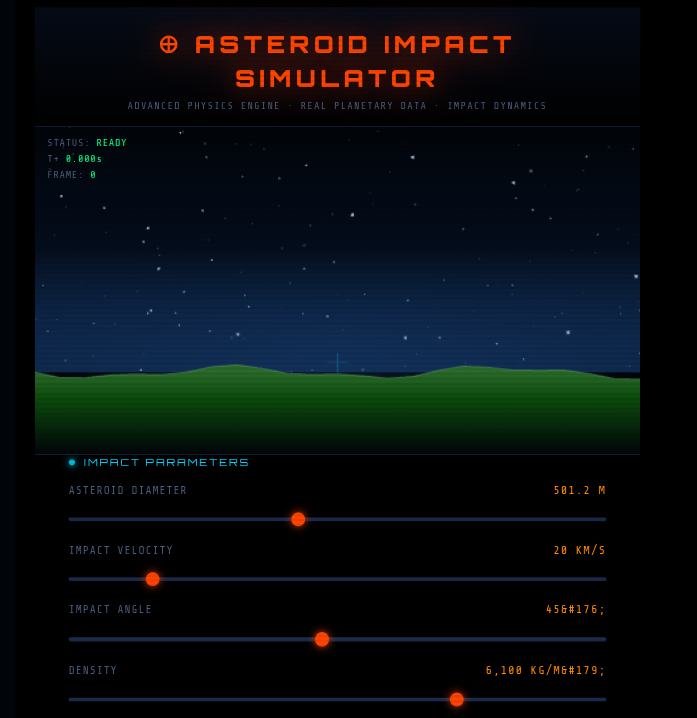
Astrophyzix Planetary Impact Engine: The Most Technically Advanced Academic Module Engineered into a Legacy CMS, Ever. Impossible Made Possible

Introducing the Advanced Multi-Planetary Impact and Airburst Engine


📌 Cited by Cyber-Amber Tech News | 📌 Cited by Aviation Today News


Astrophyzix Impact Engine Screenshot


The Most Technically Advanced, Fully Functioning Academic Module Engineered into a Legacy CMS, Ever

Asteroid and comet impacts are among the most energetic natural processes in the Solar System. From the formation of planetary crusts to the extinction-level events that have reshaped life on Earth, impact physics sits at the intersection of planetary science, geophysics, and atmospheric dynamics. At Astrophyzix, we are introducing a new tool designed to bring this complex, multidisciplinary science into a coherent, interactive framework: the Advanced Multi-Planetary Impact and Airburst Engine.

This system is not a simplified toy model. It is a physics-driven simulation environment grounded in peer-reviewed literature, incorporating validated scaling laws, atmospheric entry models, and planetary datasets sourced from leading scientific institutions. Its purpose is to bridge the gap between abstract equations and intuitive understanding—allowing users to explore impact scenarios across multiple worlds with scientifically credible outputs.


Independent Direct Source Verification
Uncompromised Crossref DOI Resolver · Live and direct meta data fetch
Awaiting DOI input