

Written By: Astrophyzix Science Communication
Article Type: Evidence Check, Explainer, Series, Asteroid Data
Introduction
Asteroid 2015 FQ117 is a small Aten-class near-Earth object and Potentially Hazardous Asteroid. Although it poses no immediate threat, its orbit and characteristics are closely monitored by astronomers. This article explores its size, trajectory, predicted close approaches, and ongoing tracking efforts by international observatories.
Asteroid 2015 FQ117 — In-Depth Profile (2026)
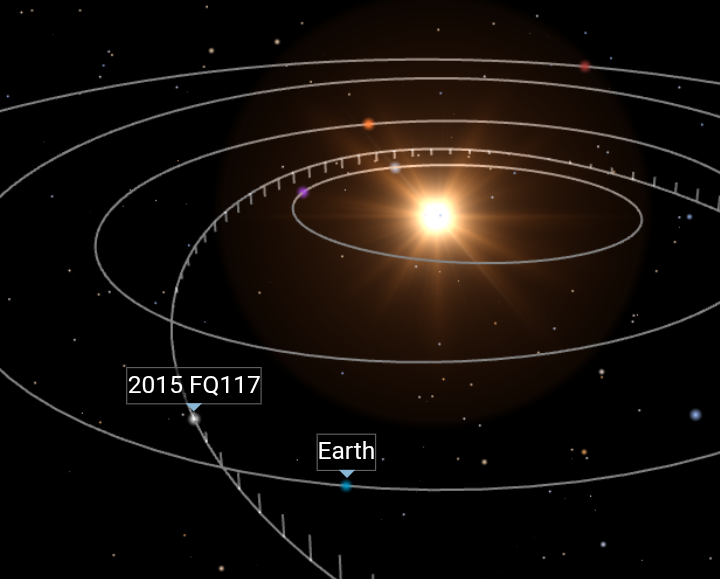
Asteroid 2015 FQ117 is a small near-Earth object (NEO) belonging to the Aten class of asteroids — a population whose orbits bring them close to Earth’s path. It is also classified as a Potentially Hazardous Asteroid (PHA), although current calculations indicate no imminent impact risk. Source: Space Reference
Orbital Classification and Discovery
- Designation: 2015 FQ117
- Classification: Aten-class NEO, PHA
- Discovery & Observations: First observed March 2015, with numerous subsequent observations refining its orbital path. Source
Aten-class asteroids have a semi-major axis <1 2015="" a="" and="" at="" au="" but="" cross="" crosses="" distance.="" earth="" fq117="" from="" href="https://www.spacereference.org/asteroid/2015-fq117" inside.="" orbit="" orbital="" path="" remains="" s="" safe="" target="_blank" the="">Source
Physical Characteristics
- Diameter: ~0.18–0.40 km (football-field scale)
- Absolute Magnitude (H): ~20.87
- Orbital Period: ~292 days (~0.80 years)
- Surface brightness: Magnitude ~20.9 (very faint)
These estimates come from reflected sunlight and brightness. Smaller objects or low-albedo surfaces appear fainter. Source
Orbit and Dynamics
- Semi-major axis: ~0.86 AU
- Eccentricity: ~0.6205
- Inclination: ~4.56°
- Perihelion: ~0.33 AU
- Aphelion: ~1.39 AU
Its orbit is eccentric, crossing Earth’s path at a shallow tilt. Orbital data is continually refined as new observations are made. Source
Predicted Close Approaches
Despite the PHA classification, 2015 FQ117’s minimum distance remains well beyond Earth, posing no current threat.
| Date | Distance from Earth (km) | Relative Speed (km/s) |
|---|---|---|
| 9 Feb 2038 | 25,138,591 | 23.9 |
| 7 Feb 2042 | 19,108,343 | 22.6 |
| 5 Feb 2050 | 9,140,850 | 20.4 |
| 4 Feb 2058 | 4,854,944 | 19.2 |
| 4 Feb 2062 | 4,545,825 | 19.0 |
Even at closest approach, the asteroid remains millions of kilometres away from Earth. Source
Hazard Assessment
The PHA designation indicates potential orbital proximity, not an impact prediction. Monitoring by NASA, CNEOS, and other agencies ensures the asteroid’s trajectory is tracked and refined continually. Source
Observations and Tracking
Hundreds of astrometric observations refine its orbit. The asteroid’s condition code (orbital uncertainty measure) decreases with new observations, allowing accurate predictions decades ahead. Source
Exploration Prospects
Currently, 2015 FQ117 is not considered a candidate for human exploration. Its orbit and relative motion require higher delta-v than other more accessible NEAs. Source
Context in Near-Earth Object Population
2015 FQ117 is part of a monitored population of NEOs. These objects help scientists study Solar System evolution, assess impact risks, and evaluate potential scientific investigation targets. Source
Summary
- Small (~180–400 m) Aten-class near-Earth object: Its semi-major axis is less than 1 AU, and it crosses Earth’s orbit from the inside. Small but trackable, it provides insight into asteroid dynamics and composition
- Potentially Hazardous Asteroid by orbital criteria: Its orbit brings it within the PHA threshold for monitoring, though it does not currently pose an impact risk. Continuous tracking is essential for planetary defense.
- Predicted to make several distant close approaches in the 21st century: Approaches occur millions of kilometres away, allowing for orbit refinement and study of NEO dynamics.
- No current impact threat: Even at closest approach, it remains safely beyond lunar distance. NASA and international observatories maintain precise orbital monitoring.
- Well tracked and continuously modelled by international surveys: Astrometric data reduces uncertainty, allowing long-term predictions and contributing to research and public educational tools.
Learn more and track Asteroid 2015 FQ117
Image Credit: Spacereference.com
© Astrophyzix.com
This article may not be reproduced, narrated, or used in AI-generated media without written permission.