

Astrophyzix Digital Observatory Planetary Defence: Near-Earth Object Close Approach Briefing
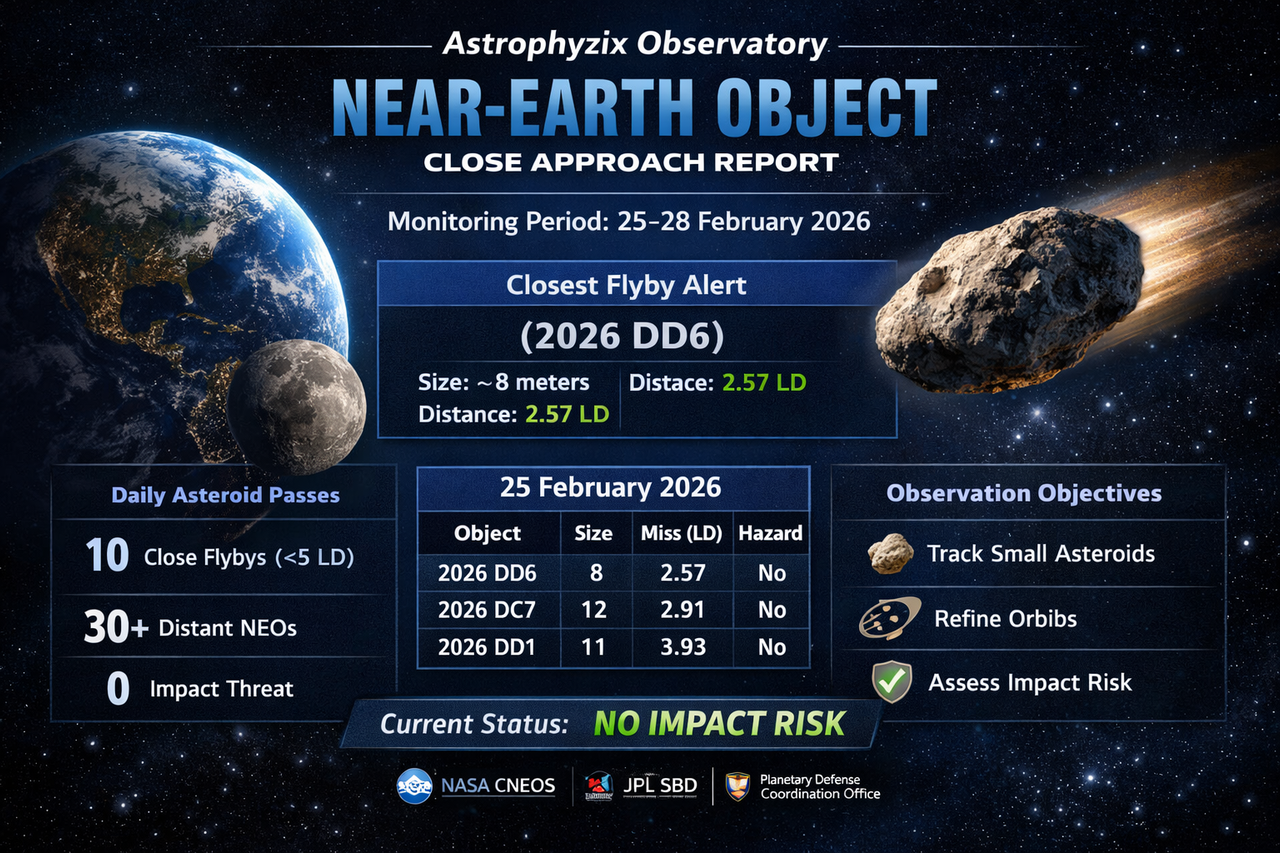
Estimated size: ~8 m
Closest distance: 2.57 Lunar Distances (~0.99 million km)
Status: NO HAZARD
Observatory briefing
Routine orbital surveillance for the final week of February 2026 shows a sequence of small Near-Earth Objects safely transiting the Earth–Moon orbital region. Such passages occur continuously due to the large population of minor bodies whose solar orbits intersect Earth’s neighbourhood.
Several metre-scale asteroids pass within a few lunar distances during this reporting interval. Larger bodies are present in the dataset but remain tens of lunar distances away. None of the objects have any calculated impact probability. These observations contribute to orbit refinement, detection calibration, and long-term planetary-defence modelling.
Reading the data
- Size — approximate diameter derived from brightness modelling
- Speed — relative velocity compared with Earth
- Miss Distance (LD) — closest approach in lunar distances (1 LD ≈ 384,400 km)
- Operational close approach — typically under ~5 LD
25 February 2026
| Object | Size (m) | Speed km/s | Miss Distance LD | Hazard |
|---|---|---|---|---|
| 2026 DD6 | 8 | 15.23 | 2.57 | No |
| 2026 DC7 | 12 | 11.79 | 2.91 | No |
| 2026 DD1 | 11 | 7.63 | 3.93 | No |
| 2017 EE23 | 188 | 11.84 | 33.03 | No |
| 2026 CP | 145 | 18.30 | 61.08 | No |
| 2025 UL3 | 37 | 5.75 | 67.85 | No |
26 February 2026
| Object | Size | Speed | Miss LD | Hazard |
|---|---|---|---|---|
| 2026 CU1 | 53 | 8.41 | 3.20 | No |
| 2018 CP14 | 130 | 11.85 | 35.84 | No |
| 2024 GE3 | 26 | 6.53 | 95.50 | No |
| 2015 OB22 | 203 | 19.76 | 99.99 | No |
| 2014 KO62 | 25 | 9.60 | 104.34 | No |
27 February 2026
| Object | Size | Speed | Miss LD | Hazard |
|---|---|---|---|---|
| 2026 DP6 | 15 | 10.74 | 3.97 | No |
| 2026 CR4 | 65 | 17.29 | 10.51 | No |
| 2011 CL50 | 15 | 4.55 | 13.35 | No |
| 2020 YN4 | 17 | 4.56 | 13.48 | No |
| 2020 FV4 | 36 | 8.71 | 16.25 | No |
| 52340 (1992 SY) | 1036 | 10.80 | 47.70 | No |
| 2025 QM9 | 24 | 11.67 | 53.22 | No |
28 February 2026
| Object | Size | Speed | Miss LD | Hazard |
|---|---|---|---|---|
| 2026 DG1 | 24 | 12.28 | 7.15 | No |
| 2007 DG8 | 39 | 9.92 | 9.92 | No |
| 2026 BQ3 | 39 | 8.09 | 29.24 | No |
| 2025 UC11 | 1 | 2.64 | 36.54 | No |
| 2025 EG | 55 | 11.49 | 48.81 | No |
| 2025 DY67 | 146 | 8.40 | 66.91 | No |
| 2018 ES3 | 51 | 8.74 | 70.68 | No |
Observational significance
The closest objects in this dataset belong to the small-asteroid atmospheric-entry class. Monitoring these bodies helps refine survey detection completeness and improves statistical models of the small-object population. Mid-scale asteroids near fifty metres in diameter remain of particular scientific interest because they represent the transition between harmless airbursts and rarer ground-impact capable objects.
Impact risk assessment
No asteroid in this monitoring window has any calculated impact probability.
All trajectories remain millions of kilometres from Earth.
This represents routine inner-solar-system small-body traffic.