
Weekly Near-Earth Object Flyby Report — 9–12 March 2026
Written by: Astrophyzix Digital Observatory and Planetary Defence Research
The following Near-Earth Object (NEO) monitoring report summarises asteroid flybys recorded between 9 March and 12 March 2026. Data is compiled from the NASA Jet Propulsion Laboratory Small-Body Database and associated planetary defence monitoring systems maintained by the Center for Near-Earth Object Studies (CNEOS).
Distances are expressed in Lunar Distances (LD), where 1 LD = 384,400 km, the average separation between Earth and the Moon. This unit is commonly used in planetary defence reporting because it provides a convenient frame of reference for evaluating close-approach geometry within the Earth–Moon system.
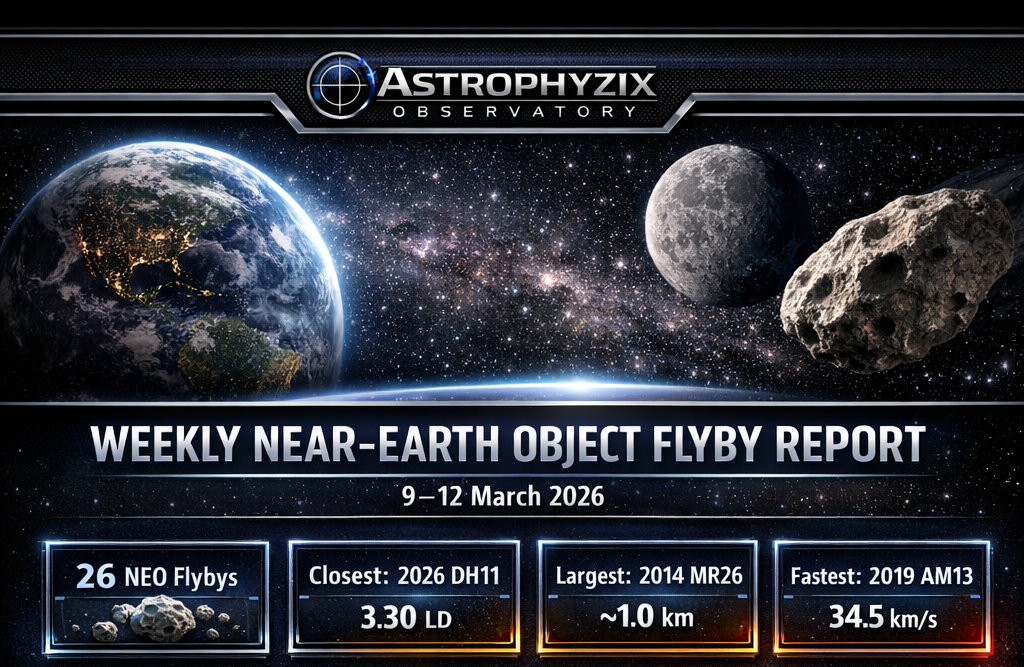
During this monitoring interval a total of 26 catalogued Near-Earth Objects made relatively close passes to Earth. None of the recorded flybys present any impact risk. Several objects are categorised as Potentially Hazardous Asteroids (PHAs) due to their size and orbital characteristics, but all remain well outside distances associated with collision scenarios.
Closest Approach Summary
- Total NEO flybys recorded: 26
- Closest pass: 2026 DH11 at 3.30 LD
- Largest object: 2014 MR26 (~1.0 km)
- Fastest relative velocity: 2019 AM13 at 34.51 km/s
- Potentially Hazardous Asteroids detected: 4
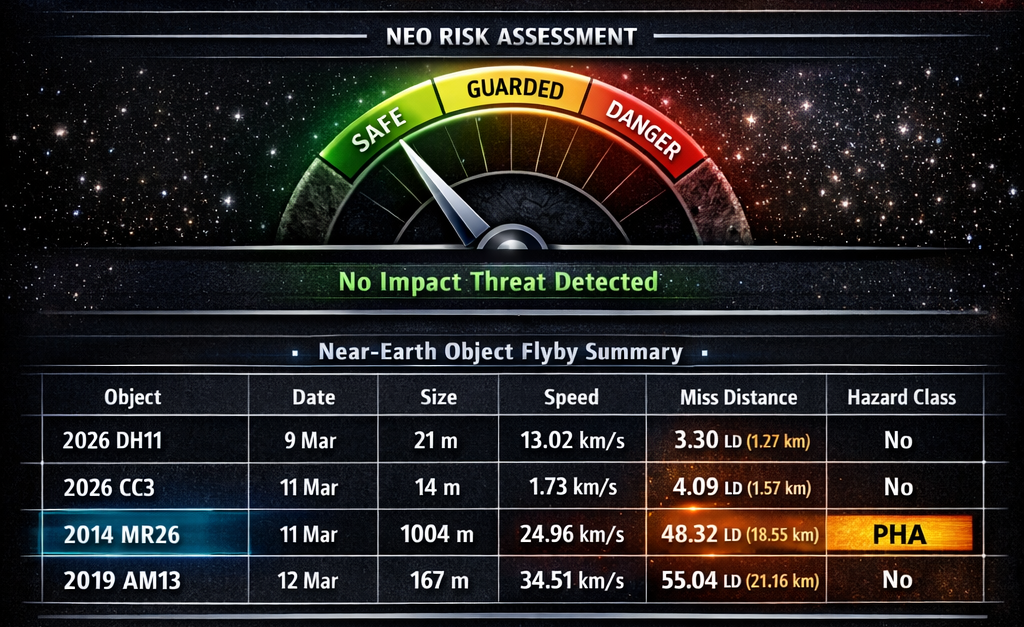
- Impact risk: None
Near-Earth Object Flyby Table
| Object | Date | Estimated Size | Speed | Miss Distance | Hazard Class |
|---|---|---|---|---|---|
| 2026 DH11 | 9 Mar | 21 m | 13.02 km/s | 3.30 LD | No |
| 2026 CC3 | 11 Mar | 14 m | 1.73 km/s | 4.09 LD | No |
| 2023 ET2 | 11 Mar | 3 m | 12.67 km/s | 7.81 LD | No |
| 2025 DP3 | 11 Mar | 33 m | 9.09 km/s | 9.40 LD | No |
Close Approach Analysis
The closest approach recorded during this monitoring period occurred on 9 March 2026 when asteroid 2026 DH11 passed Earth at a minimum distance of approximately 3.30 lunar distances, equivalent to roughly 1.27 million kilometres. While this distance may sound close in planetary terms, it remains more than three times farther than the orbit of the Moon and is therefore well outside any region associated with collision probability.
Asteroids passing within 5 lunar distances are typically highlighted in planetary defence monitoring reports because they enter the broader Earth–Moon gravitational environment. These flybys provide useful opportunities for astronomers to refine orbital solutions, improve radar observations, and validate asteroid detection pipelines used by modern sky surveys.
Several of the smaller objects recorded in this interval — including 2026 CC3 and 2023 ET2 — fall into the size range typically associated with meteoroids capable of producing atmospheric fireballs if they were to intersect Earth's atmosphere. Objects of this scale are commonly detected only shortly before or shortly after close approach, demonstrating the importance of high-cadence sky surveys such as ATLAS and Pan-STARRS.
Larger asteroids within the dataset remain scientifically significant even when their flyby distances are tens of lunar distances from Earth. For example, asteroid 2014 MR26 is estimated to be roughly one kilometre in diameter. Objects of this size represent the upper end of the Near-Earth Object population that planetary defence initiatives prioritise for long-term tracking, as impacts from kilometre-class bodies would have global environmental consequences.
Relative velocities during these encounters vary considerably depending on the orbital inclination and eccentricity of each asteroid's trajectory. The fastest object recorded in this report, 2019 AM13, approached at approximately 34.5 km/s. Such high encounter speeds typically occur when an asteroid crosses Earth's orbit at a steep inclination relative to the ecliptic plane.
Planetary Defence Context
Near-Earth Object detection and orbit monitoring is conducted continuously by a network of automated sky surveys and observatories around the world. Major contributors include the Pan-STARRS telescopes in Hawaii, the Catalina Sky Survey in Arizona, and the ATLAS asteroid impact early warning system.
Orbital calculations and impact probability assessments are maintained by NASA’s Center for Near-Earth Object Studies (CNEOS) and the Jet Propulsion Laboratory Small-Body Database. These systems continuously update orbital solutions as new observations are received from observatories worldwide.
Thanks to these monitoring systems, astronomers can identify potentially hazardous objects decades — and often centuries — before any potential Earth encounter, providing ample time for mitigation strategies should a future impact threat ever be detected.
For the time period covered in this report, no Near-Earth Objects present any impact threat to Earth.
Primary Data Source
-
NASA JPL Small-Body Database
https://ssd.jpl.nasa.gov/tools/sbdb_lookup.html - Astrophyzix Digital Observatory and Planetary Defence Research
