
Article type: News, Forecast, Celestial Events Explainer
March Night Sky: A Month of Lunar Spectacles and Celestial Alignments
March presents stargazers with a series of striking astronomical events, from dramatic lunar phenomena to planetary conjunctions and the shifting of the seasons. The month begins with a celestial highlight that will not be seen again in its entirety for nearly three years: a total lunar eclipse, commonly known as a “Blood Moon.” As winter gradually gives way to spring in the Northern Hemisphere, March offers both novice and experienced observers numerous opportunities to explore the night sky.
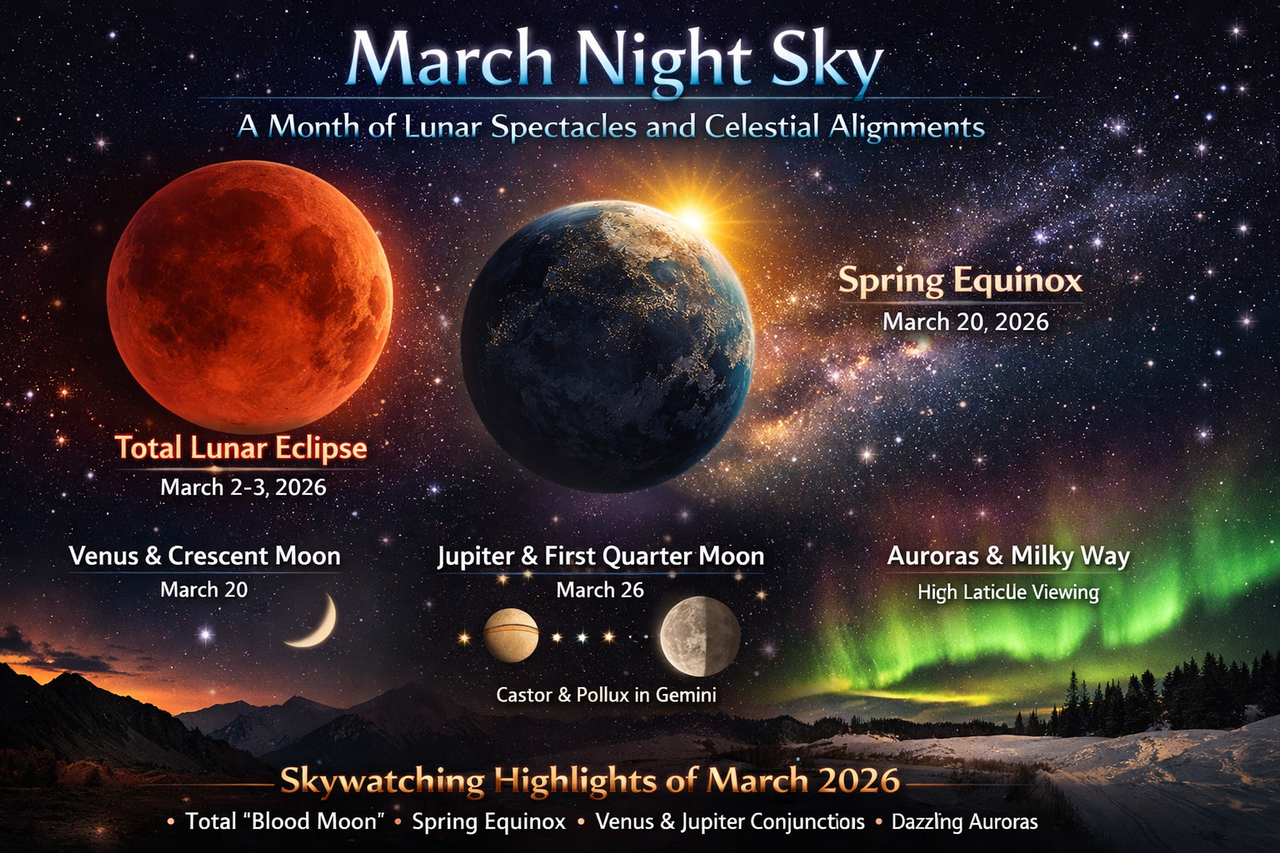
The Blood Moon: Total Lunar Eclipse of March 2–3
On the night of March 2–3, Earth’s shadow will fully cover the Moon, producing a total lunar eclipse. During this event, the Moon will gradually darken as it enters the umbra, the central region of Earth’s shadow. The totality phase, where the Moon takes on a deep red hue, occurs when sunlight is filtered and refracted through Earth’s atmosphere. This natural phenomenon gives the eclipse its dramatic “Blood Moon” appearance.
This eclipse is significant for multiple reasons: it is the first total lunar eclipse of the year and the last one visible until late 2028, making it a rare opportunity for skywatchers. The eclipse will reach its peak at 11:37 UTC, coinciding closely with March’s Full Moon, known as the Worm Moon. This traditional name reflects the seasonal thawing of the ground in early spring, when earthworms begin to emerge, signaling the rebirth of life in temperate regions.
The Equinox: Nature’s Cosmic Reset
March 20 marks the equinox, a pivotal moment in Earth’s orbit around the Sun. At exactly 14:46 UTC, the Sun will cross the celestial equator, resulting in nearly equal hours of day and night across the globe. In the Northern Hemisphere, this event heralds the beginning of spring, while the Southern Hemisphere simultaneously enters autumn.
The equinox is more than a seasonal marker—it has a measurable impact on Earth's geomagnetic environment. The alignment of Earth’s axis relative to the solar wind during this period enhances the likelihood of auroral displays. The combination of the Russell–McPherron effect and the equinoctial effect increases the efficiency with which charged particles from the Sun enter Earth's magnetosphere. The result is more frequent and often brighter auroras, particularly visible at high latitudes in both hemispheres.
Lunar and Planetary Conjunctions
March provides stargazers with a series of visually striking Moon-planet encounters. The first occurs on the evening of March 20, coinciding with the equinox. A slender Waxing Crescent Moon, only one day past New Moon, appears low on the western horizon shortly after sunset. Just beneath it, Venus shines brilliantly, offering a stunning pairing visible even to the unaided eye. Observers should seek a clear horizon for the best view, as the Moon’s crescent will be very thin, making the Venus-Moon conjunction subtle yet captivating.
A second notable event occurs on March 26, when the First Quarter Moon aligns closely with Jupiter. This conjunction takes place in the constellation of Gemini, one of the most recognizable constellations in the northern sky. Jupiter, outshining the stars of Gemini, acts as a natural guide for locating the twin stars Castor and Pollux. Binoculars can enhance this experience by revealing Jupiter’s four largest moons—Io, Europa, Ganymede, and Callisto—lined up alongside the planet, providing a miniature solar system view within our own.
Spotlight on Gemini
Throughout March, the constellation Gemini remains prominent in the evening sky. Positioned high above the horizon after sunset, the constellation’s two brightest stars, Castor and Pollux, are easily visible. Jupiter’s presence among Gemini’s stars further highlights the constellation, offering an anchor point for stargazers to navigate the surrounding night sky. The visibility of Gemini this month makes it an ideal target for both casual skywatchers and amateur astronomers aiming to track planetary movements and identify star patterns. Try the Astrophyzix Live Sky Map to plan your evening's viewing
Auroras and Geomagnetic Activity
The equinox season provides favorable conditions for auroral activity. Two key factors contribute to the likelihood of spectacular northern and southern lights. First, the Russell–McPherron effect occurs when the orientations of the Sun’s and Earth’s magnetic fields allow enhanced interaction, enabling solar particles to penetrate Earth’s magnetosphere more effectively. Second, the equinoctial effect results from Earth’s magnetic axis being nearly perpendicular to the solar wind’s flow, effectively presenting a larger target for charged solar particles.
Together, these mechanisms increase the frequency and intensity of auroras. Observers in high-latitude regions, such as Scandinavia, Canada, and southern Chile, may witness vividly green arcs and shimmering curtains of light stretching across the sky. March’s auroral activity provides both a scientific and aesthetic spectacle, as the interaction of charged solar particles with Earth’s magnetic field generates dynamic, ever-changing displays.
Other Notable Skywatching Highlights
- March Full Moon: The Worm Moon reaches peak illumination on March 3, providing ideal conditions for lunar photography and casual observation. Its rising and setting times are excellent for capturing the Moon against terrestrial landscapes.
- Moon Phases: Following the Full Moon, the Waxing Crescent Moon appears on March 20, while the First Quarter Moon occurs on March 26. Each phase provides unique lighting conditions for lunar observation.
- Planetary Visibility: Jupiter remains highly visible in Gemini, while Venus is easily seen in the western sky after sunset during the latter half of the month. Both planets offer excellent opportunities for naked-eye observation as well as binocular or small telescope study.
Tips for Observing March’s Night Sky
- Timing: Align observation times with key events such as lunar eclipses and planetary conjunctions. Early evening hours often offer the best visibility.
- Location: Seek out dark skies away from urban light pollution. Even modest distances from city lights significantly improve visibility of faint features like auroras and thin lunar crescents.
- Equipment: While many events are visible to the naked eye, binoculars enhance views of planetary moons, star clusters, and the Moon’s surface. Telescopes reveal more intricate lunar and planetary details.
- Photography: Long-exposure settings capture the vibrant colors of auroras and the subtle shading of lunar eclipses. Tripods are essential for stability during extended exposure times.
Conclusion
March 2026 offers a rich palette of celestial events that combine scientific interest with visual beauty. From the rare total lunar eclipse to Moon-planet conjunctions and equinoctial auroras, the month provides something for every sky enthusiast. Observers across the globe can take advantage of the full range of phenomena, whether enjoying a quiet night under the Worm Moon or actively tracking Jupiter’s moons in Gemini. With careful planning and attention to timing and conditions, March promises to be a month of unforgettable experiences for anyone gazing upward.
References & Sources
- NASA: Lunar Eclipses 2021–2030
- NASA JPL Small-Body Database
- NASA Solar System Exploration – Planets
- NOAA Space Weather Prediction Center – Aurora Forecast
- Time and Date: Equinoxes and Solstices
- Russell–McPherron Effect – Journal of Geophysical Research (DOI)
- Equinoctial Effect on Geomagnetic Activity – Journal of Geophysical Research (DOI)