

Article Type: Explainer, Scientific Deep-dive, Evidence-based
Introduction: What Is the South Atlantic Anomaly?
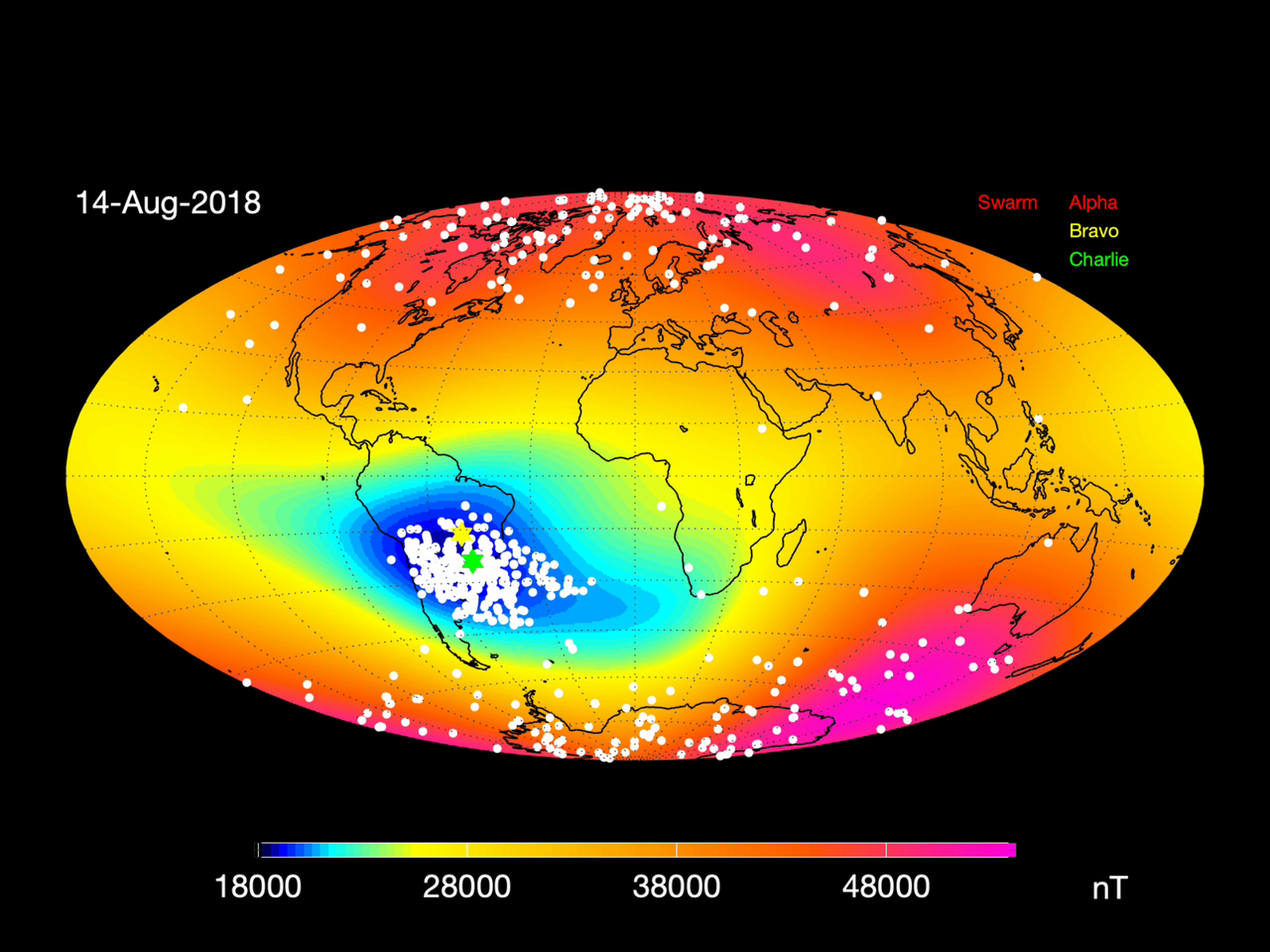
The South Atlantic Anomaly (SAA) is a region of reduced geomagnetic field strength extending over parts of South America and the South Atlantic Ocean. Within this region, the inner Van Allen radiation belt comes unusually close to Earth’s surface, allowing high-energy charged particles—primarily protons—to penetrate to altitudes typically occupied by low-Earth orbit (LEO) satellites. As a result, spacecraft passing through the SAA experience enhanced radiation exposure compared to other regions at similar altitudes.
The anomaly is not a temporary disturbance nor an indicator of imminent geomagnetic reversal. Instead, it is a well-characterized and long-observed feature of Earth’s magnetic field, arising from complex processes within the planet’s outer core. Its evolution, however, is of significant scientific interest because it reflects ongoing changes in Earth’s geodynamo.
Earth’s Magnetic Field and the Geodynamo
Earth’s magnetic field is generated by convective motion of electrically conducting fluid iron alloys in the outer core. This self-sustaining process, known as the geodynamo, produces a predominantly dipolar magnetic field aligned approximately with Earth’s rotation axis. However, the field is not perfectly symmetric or centered.
Two critical factors contribute to the SAA:
- The geomagnetic dipole is offset from Earth’s geographic center by several hundred kilometers.
- Non-dipolar components of the magnetic field significantly distort the overall geometry.
These asymmetries result in a localized region of weaker magnetic intensity over the South Atlantic. Measurements from ground observatories and satellite missions consistently show that total field strength in the SAA region can fall below 22,000 nanotesla (nT), compared to global averages of roughly 30,000–60,000 nT.
The Van Allen Radiation Belts and Their Interaction with the SAA
The Van Allen radiation belts are toroidal zones of trapped charged particles encircling Earth, discovered in 1958. They consist primarily of:
- An inner belt dominated by high-energy protons (tens to hundreds of MeV)
- An outer belt dominated by energetic electrons
Under normal conditions, these belts remain confined by Earth’s magnetic field. However, because the magnetic field is weaker over the South Atlantic, the inner radiation belt dips to altitudes as low as 200–1,000 km in this region. This brings trapped energetic particles into the orbital paths of many satellites.
Radiation flux measurements from missions such as NASA’s SAMPEX and ESA’s Swarm confirm that proton flux intensities are significantly elevated within the SAA compared to other longitudes at similar geomagnetic latitudes.
Discovery and Early Observations
The SAA was first identified during the early space age when satellites experienced unexpected radiation-induced malfunctions while passing over the South Atlantic. Instruments recorded anomalously high particle fluxes, and photographic film aboard spacecraft showed radiation damage.
Subsequent mapping of Earth’s magnetic field revealed a localized intensity minimum corresponding to the region of enhanced radiation. Continued satellite observations have allowed detailed spatial and temporal mapping of the anomaly.
Physical Origin of the South Atlantic Anomaly
The SAA arises from complex, non-dipolar magnetic flux structures at the core–mantle boundary. Geophysical modeling indicates that reversed flux patches—regions where magnetic field lines locally oppose the dominant dipole field—play a significant role in weakening the surface field over the South Atlantic.
Numerical geodynamo simulations and satellite-derived field models demonstrate that the anomaly reflects secular variation—gradual changes in the magnetic field driven by fluid flow in the outer core.
Key findings from geomagnetic field modeling include:
- The anomaly has been expanding westward at a rate of ~0.3° per year.
- Its intensity minimum has been decreasing over recent decades.
- The region has shown signs of bifurcation into two distinct minima.
Temporal Evolution and Secular Variation
Long-term datasets from missions such as Ørsted, CHAMP, and Swarm reveal that the SAA is both deepening and expanding. Between 1970 and the present, the minimum field strength within the anomaly has declined measurably.
Recent analyses suggest that the anomaly may be splitting into two lobes. This bifurcation is consistent with evolving reversed flux patches at the core–mantle boundary and does not necessarily imply imminent geomagnetic reversal.
Paleomagnetic records indicate that geomagnetic intensity fluctuations of comparable magnitude have occurred in the past without leading directly to polarity reversals.
Impacts on Satellites and Spacecraft
The SAA presents operational challenges for satellites in low-Earth orbit. Enhanced proton flux can cause:
- Single-event upsets (SEUs) in microelectronics
- Latch-up events in semiconductor devices
- Degradation of solar panels
- Increased background noise in detectors
Space agencies mitigate these risks through radiation hardening, onboard fault detection systems, and operational strategies such as powering down sensitive instruments during SAA passage.
The Hubble Space Telescope, for example, suspends certain observations while traversing the anomaly. The International Space Station (ISS), which orbits at ~400 km altitude, also experiences elevated radiation exposure when passing through the region, though shielding and operational protocols limit crew risk.
Radiation Environment and Particle Dynamics
The enhanced radiation environment within the SAA is dominated by high-energy protons trapped by Earth’s magnetic field. These particles originate from:
- Cosmic ray albedo neutron decay (CRAND)
- Solar energetic particle injections
The CRAND mechanism produces energetic protons when cosmic rays interact with Earth’s atmosphere, generating neutrons that decay into protons which become magnetically trapped.
Particle drift dynamics cause protons in the inner belt to follow longitudinal paths that intersect the SAA due to magnetic field asymmetry. Consequently, radiation intensities are geographically concentrated in this region.
Is the South Atlantic Anomaly a Sign of Geomagnetic Reversal?
The weakening of Earth’s magnetic field over the past century and the growth of the SAA have prompted speculation about an impending geomagnetic polarity reversal. However, current evidence does not support the conclusion that a reversal is imminent.
Geomagnetic reversals occur irregularly, with intervals ranging from tens of thousands to millions of years. Although field intensity has declined by roughly 9% globally over the past 170 years, this rate remains within the range of historical secular variation.
The SAA is best interpreted as a regional manifestation of core dynamics rather than a definitive precursor to reversal.
Space Weather Interactions
The SAA interacts with space weather phenomena, including geomagnetic storms and solar energetic particle events. During periods of heightened solar activity:
- Radiation belt fluxes can increase.
- Particle precipitation patterns may shift.
- Satellite anomaly rates may rise.
However, the SAA is fundamentally a geomagnetic structure, not a space weather event. Its persistence reflects internal geodynamic processes rather than solar variability.
Monitoring the South Atlantic Anomaly
Modern monitoring relies on satellite magnetometers and particle detectors. ESA’s Swarm constellation provides high-resolution vector magnetic field data, enabling precise mapping of the anomaly’s structure and evolution.
Data assimilation techniques combine satellite measurements with geodynamo modeling to infer fluid flow patterns at the core–mantle boundary. These methods improve predictive capability for secular variation trends.
Implications for Future Space Missions
As satellite constellations proliferate in low-Earth orbit, understanding the SAA becomes increasingly important. Small satellites and CubeSats, often built with commercial off-the-shelf electronics, may be particularly vulnerable to radiation effects.
Future mission planning must account for:
- Orbital inclination relative to the anomaly.
- Radiation shielding requirements.
- Component-level radiation tolerance.
- Operational scheduling to avoid peak flux intervals.
Conclusion
The South Atlantic Anomaly is a scientifically well-characterized region of weakened geomagnetic field strength that allows enhanced radiation belt particle penetration to low altitudes. It arises from complex geodynamo processes within Earth’s outer core and reflects ongoing secular variation in the magnetic field.
Although its growth and evolution are of significant geophysical interest, the anomaly does not constitute evidence of imminent geomagnetic reversal. Its primary practical significance lies in its impact on satellites and space-based instrumentation.
Continued monitoring through satellite missions and geodynamo modeling remains essential for understanding both the anomaly’s future trajectory and the broader dynamics of Earth’s magnetic field.
Sources
- Finlay, C. C., et al. (2016). The CHAOS-6 geomagnetic field model. https://doi.org/10.1186/s40623-016-0486-1
- Tarduno, J. A., et al. (2015). Geodynamo, solar wind, and magnetosphere evolution. https://doi.org/10.1126/science.aaa9119
- Konradi, A., et al. (1994). Spacecraft observations of the South Atlantic Anomaly. https://doi.org/10.1029/94JA00634
- Pavón-Carrasco, F. J., & De Santis, A. (2016). The South Atlantic Anomaly: The key role of reversed flux patches. https://doi.org/10.1002/2016GL068388
- ESA Swarm Mission Overview. https://earth.esa.int/eogateway/missions/swarm
- NASA Goddard Space Flight Center – South Atlantic Anomaly overview. https://www.nasa.gov/mission_pages/sunearth/news/gallery/saa.html
- Image Credit: European Space Agency