

Interstellar Object 3I/ATLAS: Evidence-Based Analysis of Its Mass, Composition, and Physical Properties
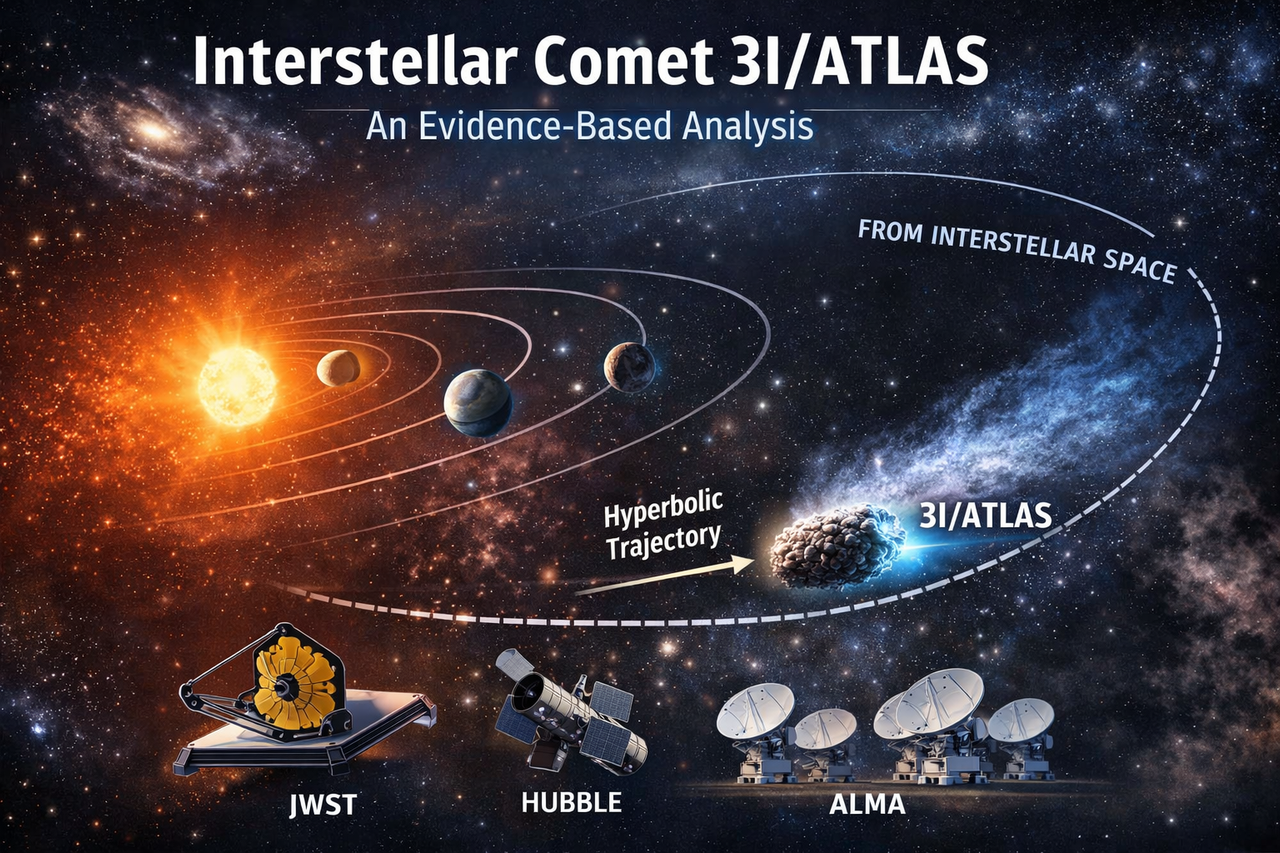
- 3I/ATLAS is the third confirmed interstellar object detected passing through the Solar System.
- Observations from JWST, Hubble, and ALMA confirm that the object displays typical cometary activity.
- Spectroscopy shows a carbon-dioxide-dominated coma with additional water, carbon monoxide, and organic molecules.
- Current models suggest a nucleus diameter likely near the kilometre scale.
- Estimated mass is likely on the order of billions of metric tons, consistent with other comet nuclei.
- Isotopic measurements indicate formation in an extremely cold protoplanetary environment billions of years ago.
Introduction
Interstellar objects are small bodies that formed around other stars before being gravitationally ejected from their original planetary systems. After drifting through interstellar space for millions or billions of years, some eventually pass through the Solar System where they can be observed by modern telescopes.
Less than a handful of these visitors have been detected so far. The first confirmed example was ‘Oumuamua in 2017, followed by the comet 2I/Borisov in 2019. In July 2025 the survey telescope network known as ATLAS detected another hyperbolic object, now designated 3I/ATLAS.
Unlike ‘Oumuamua, which showed little visible activity, 3I/ATLAS displays a well-developed cometary coma and tail. This allows astronomers to study its composition using spectroscopy and to measure its physical behaviour using established cometary models.
Because the object originated in another planetary system, analysing its chemistry and dynamics provides an opportunity to directly compare planet-forming environments beyond the Solar System.
Discovery and Orbital Dynamics
3I/ATLAS was discovered by the Asteroid Terrestrial-impact Last Alert System, a global survey designed to detect near-Earth objects. Shortly after discovery, astronomers measured its position repeatedly using telescopes around the world to determine its orbit.
Orbital solutions revealed that the object travels on a strongly hyperbolic trajectory with eccentricity significantly greater than 1. Such trajectories indicate that the object is not gravitationally bound to the Sun and must therefore originate from outside the Solar System.
Astrometric measurements have since been refined using data from multiple observatories. These measurements confirm that the object's velocity relative to the Sun exceeds the Solar System escape velocity, consistent with an interstellar origin.
Hyperbolic trajectories of this type are expected for small bodies that are ejected from their parent planetary systems during gravitational interactions with large planets.
Observational Techniques Used to Study 3I/ATLAS
A wide range of astronomical instruments have been used to analyse the physical and chemical properties of the comet.
- Optical imaging from ground-based telescopes provides measurements of brightness and dust activity.
- The Hubble Space Telescope provides high-resolution images used to estimate nucleus size limits.
- The James Webb Space Telescope performs infrared spectroscopy that identifies molecular gases in the coma.
- The Atacama Large Millimeter/submillimeter Array measures emission lines from molecules such as methanol.
Each of these observational techniques contributes a different piece of information about the comet’s composition and physical structure.
Nucleus Size Constraints from Imaging
The solid nucleus of a comet is typically surrounded by a cloud of gas and dust produced by sublimating ice. This coma can obscure the nucleus itself, making direct measurement difficult.
High-resolution imaging from the Hubble Space Telescope allows astronomers to estimate an upper limit on the nucleus size by modelling how much of the observed brightness comes from the coma.
These analyses suggest that the nucleus diameter is probably smaller than approximately five kilometres. However, modelling of dust production and photometric brightness suggests that the true size may be closer to the kilometre scale.
This range is consistent with the sizes of many active comet nuclei observed within the Solar System.
Spectroscopic Evidence for Cometary Activity
Spectroscopy allows astronomers to determine which molecules are present in the gas surrounding a comet. When molecules absorb and emit light at specific wavelengths, they create distinctive spectral signatures.
Infrared spectra obtained with the James Webb Space Telescope show strong emission from carbon dioxide molecules in the coma of 3I/ATLAS.
Additional emission features reveal the presence of:
- Water vapour
- Carbon monoxide
- Carbonyl sulfide
- Dust and water-ice grains
The relative abundance of carbon dioxide appears to be significantly higher than that found in most Solar System comets. Measured CO₂ to water ratios approach values near eight, which is among the highest ratios recorded for any comet.
This suggests that the comet formed in a region of its parent planetary system where carbon-dioxide ice was abundant.
Detection of Organic Molecules
Millimetre-wavelength observations using the Atacama Large Millimeter/submillimeter Array have detected the organic molecule methanol within the comet's coma.
Methanol is commonly observed in molecular clouds and in comets, where it forms through chemical reactions on the surfaces of icy dust grains in cold environments.
The abundance of methanol relative to other molecules in 3I/ATLAS appears unusually high compared with many Solar System comets. This difference provides evidence that the comet formed under different chemical conditions than those present in the early Solar System.
Isotopic Measurements and Formation Environment
Isotopes are atoms of the same element that contain different numbers of neutrons. The ratios between isotopes provide clues about the physical conditions under which materials formed.
Spectroscopic measurements of gases in the coma have revealed unusual isotopic ratios of carbon and nitrogen compared with those typically observed in Solar System comets.
These isotopic signatures indicate formation in extremely cold conditions, likely below approximately thirty Kelvin.
Such temperatures occur in the outer regions of protoplanetary disks where volatile molecules freeze onto dust grains.
Models of galactic chemical evolution suggest that the observed isotope ratios may correspond to material that formed early in the history of the Milky Way, potentially more than ten billion years ago.
Estimating the Mass of the Nucleus
The mass of a comet cannot be directly measured by telescopes. Instead it is inferred from models combining size estimates and density measurements.
Spacecraft missions to Solar System comets have shown that comet nuclei typically have extremely low densities, usually between 0.3 and 0.6 grams per cubic centimetre.
This low density reflects the porous mixture of ice and dust that makes up cometary material.
If the nucleus of 3I/ATLAS is roughly one kilometre in diameter and has a density similar to other comet nuclei, its mass would likely fall in the approximate range of:
- 1 trillion to 10 trillion kilograms
- Equivalent to several billion metric tons
These estimates are consistent with typical cometary bodies of similar size.
Non-Gravitational Forces from Outgassing
When gases escape from a comet's surface they produce a small reaction force. This force can slightly alter the comet's orbit and is known as non-gravitational acceleration.
By measuring deviations from purely gravitational motion, astronomers can estimate how strongly the comet is outgassing.
Models incorporating carbon-dioxide and carbon-monoxide jets reproduce the observed motion of 3I/ATLAS when assuming nucleus sizes within the kilometre scale range.
The observed dynamics therefore match the expected behaviour of an actively outgassing comet.
Rotation and Jet Activity
Localized regions on comet surfaces can release gas in narrow jets rather than uniformly across the surface.
Imaging of the coma around 3I/ATLAS reveals asymmetric structures consistent with rotating jets of gas and dust.
Analysis of these features suggests that the nucleus may rotate roughly once every fifteen hours. Such rotation periods are common among cometary nuclei.
What Current Observations Do Not Show
Because interstellar objects are rare and scientifically intriguing, they often attract speculation and sensational interpretations. However, interpreting astronomical observations requires careful comparison with known physical processes and peer-reviewed measurements.
The current dataset for 3I/ATLAS provides strong evidence for standard cometary activity, but it does not support several claims that sometimes appear in online discussions.
-
No evidence of artificial structure.
High-resolution imaging from ground-based observatories and the Hubble Space Telescope shows a diffuse coma and dust emission consistent with natural comet activity. No observations indicate geometric structures or reflective surfaces that would suggest artificial construction. -
No unexplained propulsion.
Comets naturally experience small non-gravitational accelerations caused by the recoil force of escaping gas. Orbital modelling shows that the motion of 3I/ATLAS can be explained by outgassing of carbon-dioxide and carbon-monoxide ice, which are both detected in the coma. -
No unusual radiation or energy signatures.
Spectroscopic measurements show emission lines corresponding to known molecules such as CO₂, CO, and methanol. These spectral features match well-understood molecular transitions and do not indicate unknown energy sources. -
No evidence of unusual materials.
The molecules detected in the coma are common in comets and molecular clouds. Although the relative abundances differ from many Solar System comets, such chemical differences are expected for objects formed around other stars. -
No anomalous orbital behaviour.
The trajectory of 3I/ATLAS follows a hyperbolic orbit consistent with an interstellar object entering the Solar System from the galactic field. Small deviations from purely gravitational motion are consistent with standard comet outgassing models.
It is important to note that unusual chemical compositions or isotopic ratios do not imply unknown physics. Instead, they provide valuable information about the diversity of planetary systems and the range of environments in which small bodies can form.
As more interstellar objects are discovered by next-generation surveys such as the Vera C. Rubin Observatory, astronomers will be able to compare many examples and determine how typical or unusual objects like 3I/ATLAS truly are.
Why Evidence-Based Interpretation Matters
Scientific understanding advances through careful measurement, reproducibility, and comparison with established physical models. Extraordinary interpretations require strong observational evidence that cannot be explained by known processes.
In the case of 3I/ATLAS, all currently available measurements — including spectroscopy, imaging, and orbital modelling — are consistent with a natural comet that formed in another planetary system.
Rather than presenting unexplained anomalies, the observations provide valuable insight into the chemistry and dynamics of planet formation across the Milky Way.
Continued observations and future interstellar discoveries will help place these findings into a broader astrophysical context.
Claim vs Evidence Summary
| Scientific Question | Observational Evidence |
|---|---|
| Is the object interstellar? | Hyperbolic orbit with velocity exceeding Solar escape velocity. |
| Does it behave like a comet? | Presence of gas coma, dust tail, and molecular emissions. |
| What molecules are present? | JWST spectroscopy detects CO₂, H₂O, CO, OCS and dust grains. |
| Does it contain organics? | ALMA observations detect methanol in the coma. |
| How massive is it? | Models using kilometre-scale nucleus sizes and comet densities imply billions of tons. |
Conclusion
Current observations show that 3I/ATLAS behaves like a typical comet that formed around another star. Its activity is driven by the sublimation of volatile ices including carbon dioxide, water, and carbon monoxide.
The comet’s chemical composition differs from many Solar System comets, particularly in its unusually high carbon-dioxide abundance. This difference likely reflects the conditions present in the protoplanetary disk where the comet originally formed.
Mass estimates derived from nucleus size models indicate that the comet likely contains several billion metric tons of material, consistent with kilometre-scale comet nuclei.
Because it formed billions of years ago in another stellar system, 3I/ATLAS provides a rare opportunity to study the composition of planetary building blocks from beyond the Solar System.
Peer-Reviewed Sources
-
Cordiner et al. – JWST detection of carbon-dioxide dominated gas coma around interstellar object 3I/ATLAS
https://doi.org/10.3847/2041-8213/ae0647 -
Cordiner et al. – Isotopic Evidence for a Cold and Distant Origin of the Interstellar Object 3I/ATLAS
https://arxiv.org/abs/2603.06911 -
Opitom et al. – Nitrogen and carbon isotope measurements in the interstellar comet 3I/ATLAS
https://arxiv.org/abs/2603.07187 -
Maggiolo et al. – Spectroscopic evidence for cosmic-ray processing in 3I/ATLAS
https://arxiv.org/abs/2510.26308