

Introducing the Advanced Multi-Planetary Impact and Airburst Engine
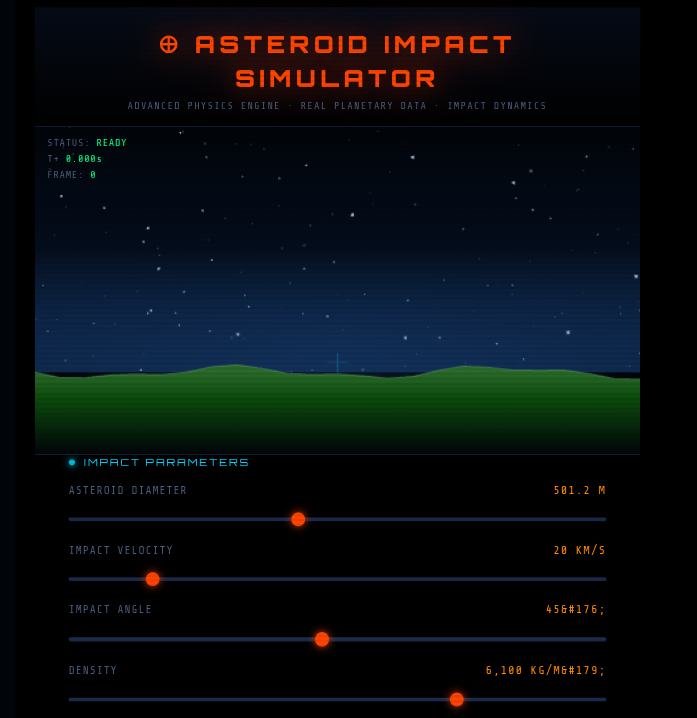
The Most Technically Advanced, Fully Functioning Academic Module Engineered into a Legacy CMS, Ever
Asteroid and comet impacts are among the most energetic natural processes in the Solar System. From the formation of planetary crusts to the extinction-level events that have reshaped life on Earth, impact physics sits at the intersection of planetary science, geophysics, and atmospheric dynamics. At Astrophyzix, we are introducing a new tool designed to bring this complex, multidisciplinary science into a coherent, interactive framework: the Advanced Multi-Planetary Impact and Airburst Engine.
This system is not a simplified toy model. It is a physics-driven simulation environment grounded in peer-reviewed literature, incorporating validated scaling laws, atmospheric entry models, and planetary datasets sourced from leading scientific institutions. Its purpose is to bridge the gap between abstract equations and intuitive understanding—allowing users to explore impact scenarios across multiple worlds with scientifically credible outputs.
Why Impact Simulation Matters in Planetary Science
Impact cratering is one of the dominant geological processes across the Solar System. On bodies such as the Moon and Mercury, it is the primary mechanism shaping the surface. Even on Earth, where erosion and tectonics obscure older features, impact events have played a critical role in both geological evolution and biological history.
Understanding impacts requires integrating several domains:
- Hypervelocity physics – objects typically strike at velocities between 11–72 km/s.
- Shock mechanics – pressures exceed gigapascals, altering material phases instantly.
- Atmospheric dynamics – entry heating, fragmentation, and airbursts.
- Planetary geology – crater morphology varies with gravity and surface composition.
The Advanced Impact Engine consolidates these domains into a single computational framework, enabling scenario-based exploration without requiring users to manually implement complex equations.
Core Physics Architecture
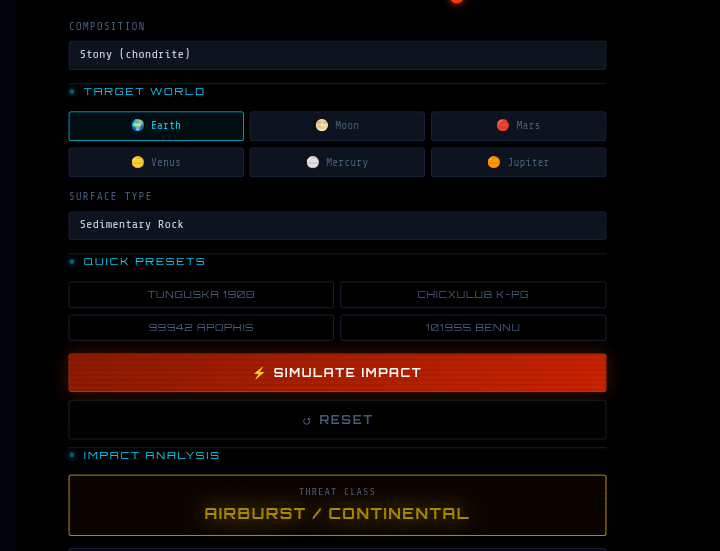
At the heart of the engine lies a set of well-established scaling relationships and physical models drawn from decades of experimental and theoretical work.
Crater formation is computed using Pi-group scaling laws derived from laboratory experiments and dimensional analysis. These relationships allow the model to transition between strength-dominated and gravity-dominated regimes depending on impactor size, velocity, and target properties.
- Crater scaling: Weiss, Wünnemann Bahlburg (2006) in Geophysical Journal International https://doi.org/10.1111/j.1365-246X.2006.02889.x
- Crater morphology: Melosh, H.J. (1989) — Oxford University Press
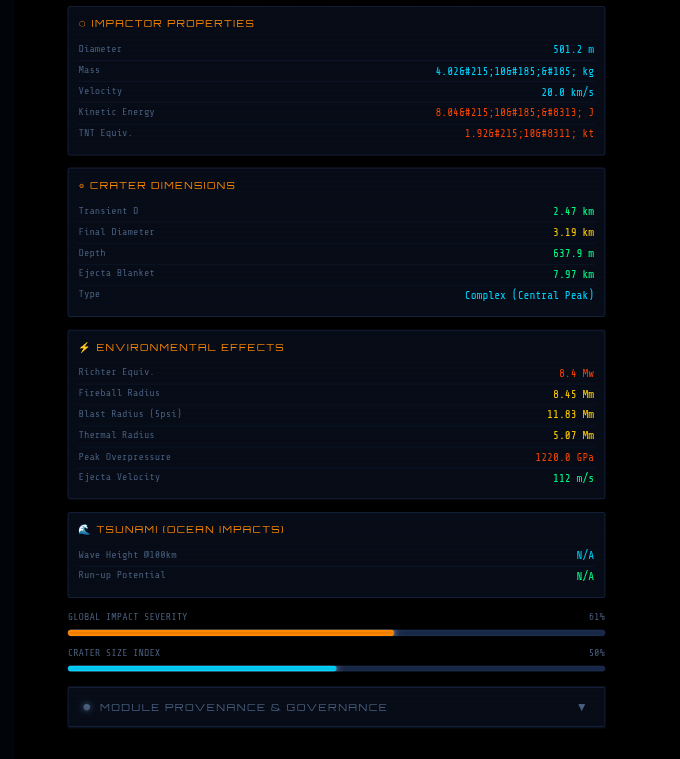
These models determine whether a crater remains simple or transitions into a complex structure with central peaks and terraced walls—a key distinction for interpreting planetary surfaces.
Atmospheric Entry and Airburst Modelling
One of the most critical components of the engine is its treatment of atmospheric entry. Not all impactors reach the ground. Many disintegrate in the atmosphere, releasing energy as airbursts.
The engine incorporates a fragmentation model based on ram-pressure breakup, where the dynamic pressure exceeds the structural strength of the object. This is essential for replicating events like the Tunguska explosion.
- Airburst physics: Chyba, C.F. et al. (1993) — https://doi.org/10.1038/361040a0
The result is a realistic estimation of:
- Airburst altitude
- Energy deposition in the atmosphere
- Surface overpressure effects
- Thermal radiation footprint
This allows users to distinguish between ground impacts and atmospheric explosions—two fundamentally different hazard regimes.
Environmental Effects and Energy Coupling
Once energy is deposited—either at the surface or in the atmosphere—the engine calculates downstream environmental effects using empirically derived relationships.
- Impact effects framework: Collins, G.S. et al. (2005) — https://doi.org/10.1111/j.1945-5100.2005.tb00157.x
Key outputs include:
- Seismic magnitude equivalent
- Blast wave radius (pressure thresholds)
- Thermal radiation radius
- Fireball size
These outputs are not arbitrary visualisations—they are derived from scaling relationships that map impact energy to observable consequences.
Multi-Planet Capability
A defining feature of the engine is its ability to simulate impacts across multiple planetary bodies. Each world has unique physical parameters that fundamentally alter impact outcomes.
- Earth: Dense atmosphere, moderate gravity
- Moon: No atmosphere, low gravity
- Mars: Thin atmosphere, reduced gravity
- Venus: Extremely dense atmosphere
- Mercury: No atmosphere, high impact velocities
- Jupiter: Gas giant—no solid surface
Planetary data is sourced from NASA fact sheets and atmospheric models, ensuring consistency with observational science.
This enables users to directly compare how identical impactors behave under radically different conditions—a powerful educational insight.
Material Science and Composition Handling
Not all impactors are the same. Density, porosity, and structural integrity significantly influence impact dynamics.
- Meteorite densities: Britt, D.T. & Consolmagno, G.J. (2003) — https://doi.org/10.1111/j.1945-5100.2003.tb00305.x
- Cometary structure: A’Hearn, M.F. et al. (2011) — https://doi.org/10.1126/science.1204054
The engine supports multiple compositions:
- Stony (chondritic)
- Iron/metallic
- Carbonaceous (C-type)
- Cometary ice
- Rubble pile aggregates
Each material class modifies entry behaviour, fragmentation, and energy coupling—resulting in distinct outcomes even with identical initial conditions.
Crater Formation and Morphology
When an impactor reaches the surface, crater formation proceeds through a sequence of stages:
- Contact and compression
- Excavation
- Modification
The engine calculates:
- Transient crater diameter
- Final crater diameter
- Crater depth
- Ejecta blanket extent
It also classifies craters as simple or complex, incorporating central peak formation and structural collapse based on scaling thresholds.
Ocean Impacts and Tsunami Generation
For impacts into water, the engine includes a tsunami module based on hydrodynamic scaling relationships.
- Tsunami modelling: Weiss, R. & Wünnemann, K. (2008) — https://doi.org/10.1029/174GM15
Outputs include:
- Wave height at distance
- Run-up potential
- Energy transfer into the ocean
While simplified, this module provides realistic order-of-magnitude estimates of impact-driven ocean disturbances.
What Makes This Engine “Advanced”
Several features distinguish this system from typical impact calculators:
- Multi-planet simulation rather than Earth-only models
- Integrated airburst physics
- Material-dependent behaviour
- Real-time visualisation via HTML5 canvas
- Transparent scientific provenance
Crucially, the engine exposes its assumptions and limitations, allowing users to understand not just the outputs, but the uncertainty behind them.
Known Limitations and Scientific Constraints
No simulation of this type is exact. The engine operates within defined constraints:
- Oblique impacts simplified to vertical velocity components
- No modelling of fragmentation cascades
- Secondary cratering not included
- Simplified atmospheric density profiles
- Order-of-magnitude accuracy (±50% typical)
These limitations are explicitly stated to maintain scientific integrity and prevent misuse.
Educational Value and Science Communication
The primary goal of the Advanced Impact Engine is not prediction—it is understanding.
By allowing users to manipulate parameters and observe outcomes, the system:
- Demonstrates scaling relationships in real time
- Illustrates how energy translates into physical effects
- Highlights differences between planetary environments
- Encourages critical thinking about impact scenarios
For educators, communicators, and enthusiasts, this provides a powerful platform to move beyond static diagrams into interactive exploration.
Governance and Responsible Use
The engine is explicitly designated for:
- Education
- Science communication
- Scenario visualisation
It is not intended for:
- Hazard assessment
- Insurance modelling
- Civil defence planning
This distinction is critical. While grounded in real physics, the model does not replace high-fidelity simulations used by professional agencies.
Conclusion
The Advanced Multi-Planetary Impact and Airburst Engine represents a significant step forward in accessible, transparent, and scientifically grounded simulation tools. By integrating peer-reviewed physics with real planetary data, it provides a robust platform for exploring one of the most fundamental processes in planetary science.
Impact events are not just catastrophic anomalies—they are a natural and ongoing part of Solar System evolution. Understanding them requires both rigorous science and intuitive tools. This engine delivers both.
For Astrophyzix, it is more than a simulator—it is a framework for turning complex physics into clear, interactive insight.