Live Tracable Verifiable Reproducible Free NASA integrated

Astrophyzix Digital Observatory

Trusted for Asteroid News, Research, Data & Analysis

Delivering unpaywalled access to a live computational planetary defence suite, timely evidence-driven analysis, real-time N-Body Orbital Refinements and monitoring and tracking of all asteroids, comets and solar system objects using our unique, precision-built suite of 45+ Float64 modules. Daily asteroid news and reports, close approach analysis and profiles of over 1.57 million solar system objects currently catalogued by NASA systems. Unified in one place, totally free. No downloads or login required.

  • Integrated APIs
  • Scout
  • NEOCP
  • CAD
  • NeoWs
  • SBDB
  • Horizons
  • Sentry II
  • NOAA SWPC
Showing posts with label academic research. Show all posts

Astrophyzix Planetary Impact Engine: The Most Technically Advanced Academic Module Engineered into a Legacy CMS, Ever. Impossible Made Possible

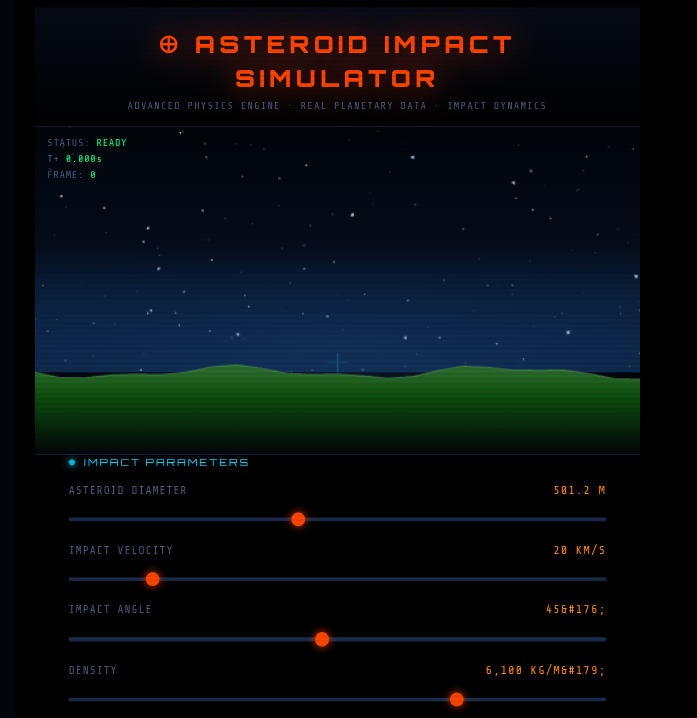
Introducing the Advanced Multi-Planetary Impact and Airburst Engine

📌 Cited by Cyber-Amber Tech News | 📌 Cited by Aviation Today News


Astrophyzix Impact Engine Screenshot


The Most Technically Advanced, Fully Functioning Academic Module Engineered into a Legacy CMS, Ever

Asteroid and comet impacts are among the most energetic natural processes in the Solar System. From the formation of planetary crusts to the extinction-level events that have reshaped life on Earth, impact physics sits at the intersection of planetary science, geophysics, and atmospheric dynamics. At Astrophyzix, we are introducing a new tool designed to bring this complex, multidisciplinary science into a coherent, interactive framework: the Advanced Multi-Planetary Impact and Airburst Engine.

This system is not a simplified toy model. It is a physics-driven simulation environment grounded in peer-reviewed literature, incorporating validated scaling laws, atmospheric entry models, and planetary datasets sourced from leading scientific institutions. Its purpose is to bridge the gap between abstract equations and intuitive understanding—allowing users to explore impact scenarios across multiple worlds with scientifically credible outputs.