Live Independent Verifiable and reproducible Unpaywalled NASA-sourced

Astrophyzix Digital Observatory

Trusted for Asteroid News, Research, Data & Analysis

Delivering unpaywalled, evidence-driven analysis, public research tools, real-time datasets and monitoring and tracking of all PHA/NEO asteroids, comets and solar system objects.

Every tracking console is designed and engineered here. Systems directly ingest multiple NASA datasets covering over 1.57 million objects, then run live, verifiable probabilistic orbital analysis and deliver an instant deterministic summary of close approaches. Used by students, educators, researchers, and the public. Data provenance is traceable, verifiable and transparent. Original research papers are published on Astrophyzix.academia.edu, registered with official DOIs via Zenodo and academically indexed by OpenAIRE.

  • NASA API'S
  • ✅ CNEOS Scout
  • ✅ JPL CAD
  • ✅ NeoWs
  • ✅ SBDB
  • ✅ Horizons
  • ✅ Sentry
Showing posts with label JPL. Show all posts

Official NEO Close Approach Report: Monitoring Window 17-20 March 2026. Astrophyzix Digital Observatory

Astrophyzix Digital Observatory — Near-Earth Object Close Approach Report


📌 Cited by MSN News

Reporting Window: 17–20 March 2026
Data Source: NASA JPL Small-Body Database (SBDB)
Prepared by: Astrophyzix Digital Observatory
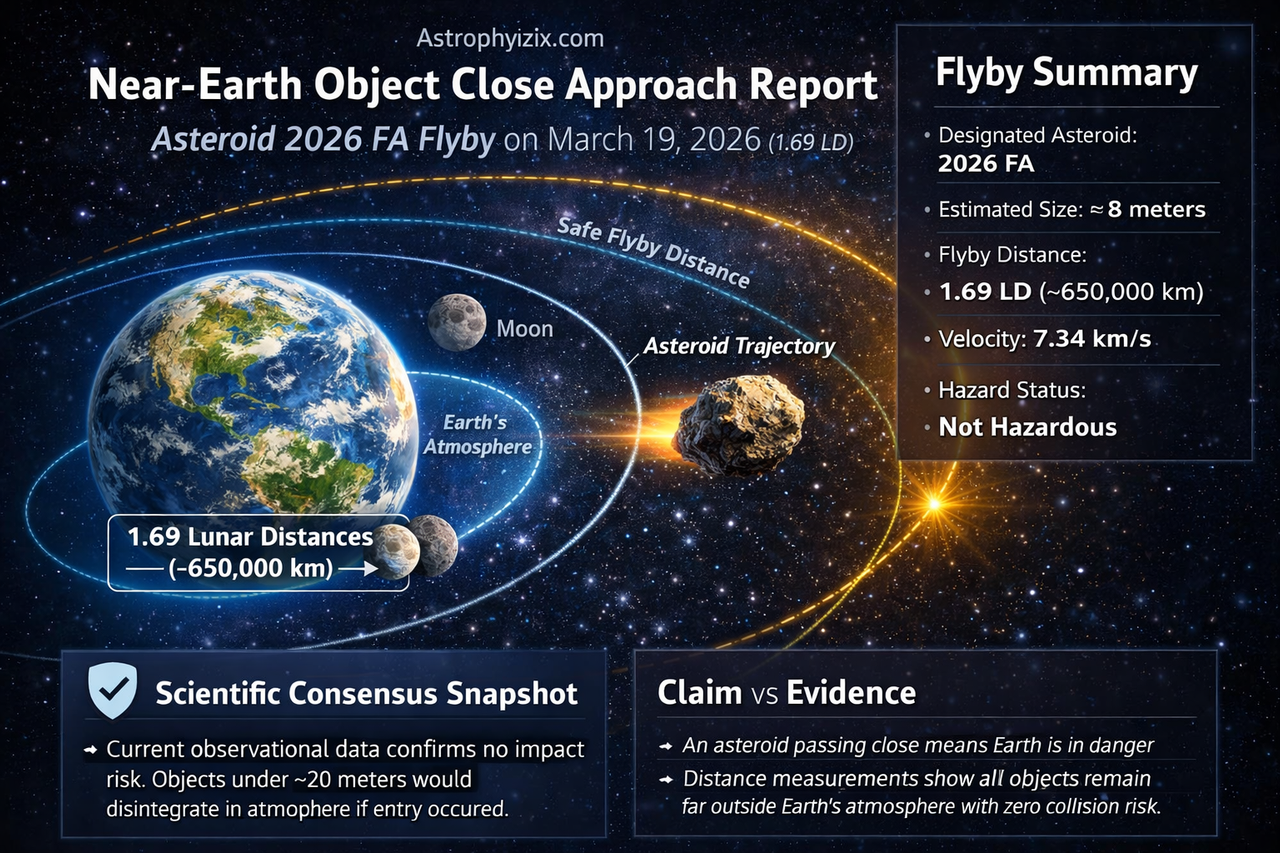
Neomarchreport

Key Takeaways

  • Closest object: 2026 FA at 1.69 lunar distances (LD)
  • No impact threats identified
  • All objects are within safe orbital margins
  • One classified Potentially Hazardous Asteroid (PHA): 2017 VR12, but at a safe distance
  • Majority of objects are small (under 100 m)
  • The 17–20 March 2026 observation window demonstrates a routine cluster of near-Earth object flybys. While several objects pass within a few lunar distances, none present any hazard.

Scientific Consensus Snapshot

Current observational data from NASA and the Jet Propulsion Laboratory (JPL) confirm that all near-Earth objects listed in this report are following well-constrained orbital trajectories with no impact probability for this approach window.

  • All orbital solutions are based on repeated telescope observations and astrometric refinement
  • No objects meet criteria for impact monitoring risk lists (e.g. Sentry system)
  • “Potentially Hazardous” classification is based on size and orbit—not imminent danger
  • Objects under ~20 m would disintegrate in Earth’s atmosphere if entry occurred

This position reflects the consensus of planetary defense programs including NASA’s Center for Near-Earth Object Studies (CNEOS).


ℹ️ Sources / Technical / Mathematical / Scientific / Academic / Integrators / Methods
Sources
  • NASA APIs
  • CNEOS Scout
  • JPL CAD
  • NeoWs
  • SBDB
  • Horizons
  • Sentry
Stack
  • IEEE-754 Float64
  • RKN4
  • Yoshida-4
  • Dormand–Prince / DOPRI5
  • DOPRI8 /DOP853
  • Verlet
  • N-Body
  • Einstein–Infeld–Hoffmann
  • DE441
  • ΛCDM
  • J2
  • Meeus
  • Yarkovsky
  • Schwarzschild GR
  • Simon 1994
  • Holsapple–Schmidt
  • Collins / Pierazzo / Ward–Asphaug
  • AIS-Wide
  • Abyssal 4 km
  • WebGPU
  • DOI Registered
  • Academia.edu
  • Zenodo
  • OpenAIRE
Independent Direct Source Verification
Uncompromised Crossref DOI Resolver · Live and direct meta data fetch
Awaiting DOI input