Astrophyzix Digital Observatory
Asteroid News, Research & Analysis

Astrophyzix.com is the publication of the Astrophyzix Digital Observatory, offering unpaywalled, evidence‑driven analysis and real‑time monitoring of PHAs and NEOs. Our tracking consoles and reporting systems use and provide access to official NASA CNEOS Scout, JPL CAD, NeoWs, JPL SBDB, Horizons and NOAA observational datasets, peer‑reviewed sources, and high‑precision numerical methods (IEEE‑754 Float64, RKN4). Designed for students, educators, researchers, and the public, every console is uniquely designed and engineered by the Astrophyzix Digital Observatory. Our research notes and papers can be found at Astrophyzix.Academia.Edu

Showing posts with label Peer Reviewed Sources. Show all posts

Wednesday, 13 May 2026

Asteroid Apophis 2029 Flyby Updated Frequently Asked Questions — Answered With Real Science by Astrophyzix Digital Observatory

Everything you need to know about Asteroid Apophis and it's 2029 Close Approach to Earth - Evidence-First Asteroid News Without Sensationalism or Hype


Published by: Astrophyzix Digital Observatory — Latest PHA Asteroid News (Data updated: 13 May 2026)


📌 Cited by Bing News 📌 Cited by MSN NEWS 📌 Cited by Microsoft Science News
Responsive image

Introduction 


This FAQ uses verified scientific data from NASA, JPL, ESA, and peer‑reviewed research. It is designed to cut through misinformation and explain the 2029 Apophis flyby using real orbital mechanics, radar measurements, and planetary defence standards


Planetary Defence is a serious subject, it should be reported responsibly and with clarity. Never trust click-bait titles or sensational headlines you see online. Always consult official data from credible, trusted sources. Below are common questions people ask, answered with integrity. 

What is Apophis?

Asteroid (99942) Apophis is a near‑Earth asteroid discovered on 19 June 2004. It is an Aten‑class asteroid, meaning its orbit is smaller than Earth’s but crosses Earth’s orbital path. Apophis is classified as an S‑type stony asteroid with a diameter of roughly 340–370 metres. Radar imaging from NASA’s Goldstone facility shows Apophis has a bi‑lobed “peanut” shape, similar to other rubble‑pile asteroids.


The new V4 Astrophyzix Apophis Tracking and Monitoring tool is considered by Microsoft Bing to be the "best public Apophis tracker available online". It offers the most comprehensive tracking experience with real-time data, including the asteroid's position, speed, and potential encounters with Earth. The tool is integrated with the official NASA API and provides exclusive data sets, making it a valuable resource for both astronomers and the general public interested in the asteroid's trajectory and safety

Is Apophis going to hit Earth in 2029?

No. Astrophyzix can confirm that there is no risk in 2029. Ignore all of the click-bait and sensational headlines. Again, there is no impact risk in 2029 — you're safe. 

NASA’s orbital solutions, refined with radar data from 2020–2021, eliminated all impact trajectories for 2029, 2036, 2068, and the next 100 years. Apophis is now rated Torino Scale 0 and Condition Code 0, meaning its orbit is extremely well known. If NASA had even the slightest doubts the condition code would be higher than zero, and it isn't. 

How close will Apophis come to Earth in 2029?

On Friday 13 April 2029, Apophis will pass about 32,000 km above Earth’s surface — closer than geostationary satellites. This is roughly:

  • 1/10th the distance to the Moon
  • Closer than many communication satellites
  • Visible to the naked eye from parts of Europe, Africa, and Asia

Why was Apophis once considered dangerous?

In 2004, astronomers had only a short observation arc. With limited data, the uncertainty region for Apophis’s orbit was large, and some early solutions intersected Earth. As more data arrived, especially radar ranging, the uncertainty collapsed and all impact scenarios were ruled out.


Sunday, 15 March 2026

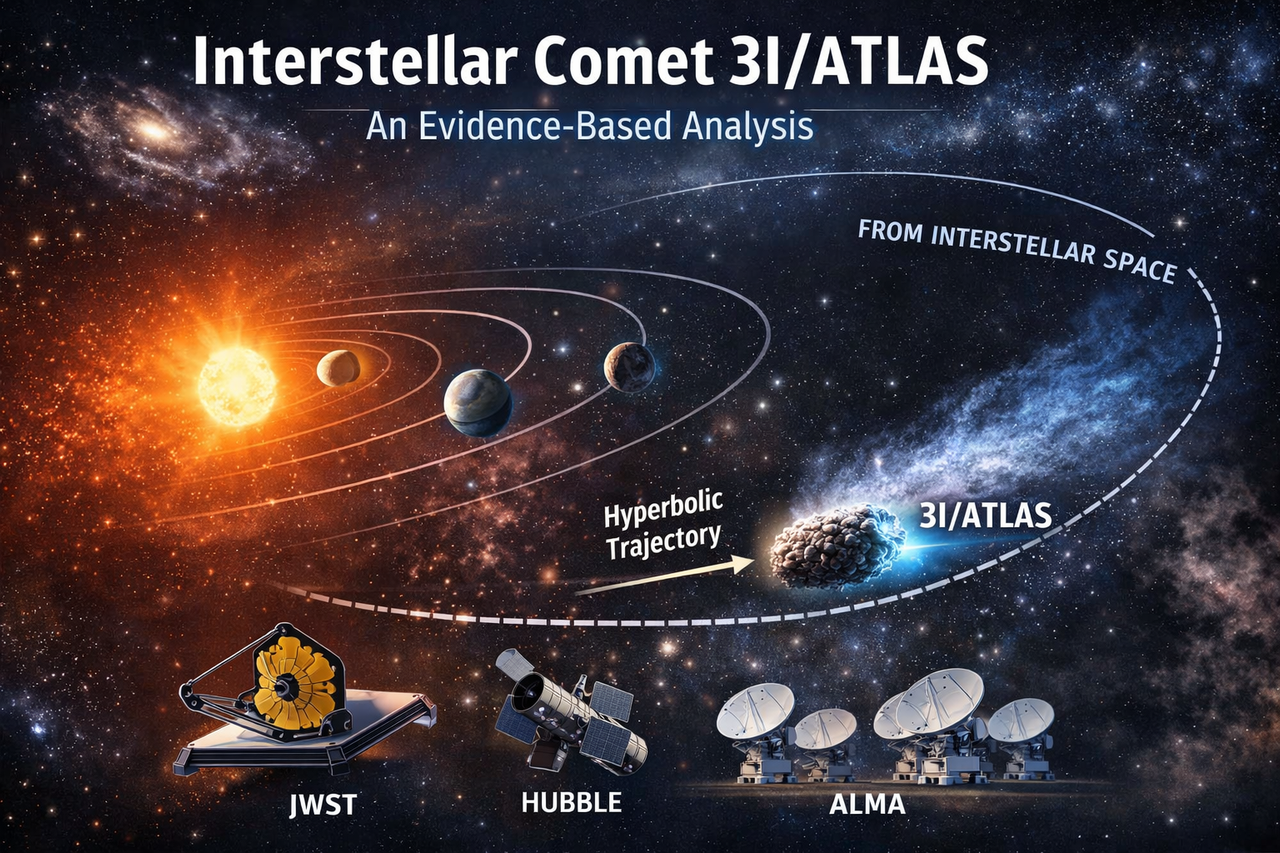
Interstellar Object 3I/ATLAS: Evidence-Based Analysis of Its Mass, Composition, and Physical Properties Using Peer Reviewed Papers, No Hype, No Sensationalism

📌 Cited

Interstellar Object 3I/ATLAS: Evidence-Based Analysis of Its Mass, Composition, and Physical Properties

Written by: Astrophyzix Science Communication
Article Type: Peer-Reviewed Sourced, Explainer, Evidence-First 

3I/ATLAS

 
Key Takeaways
  • 3I/ATLAS is the third confirmed interstellar object detected passing through the Solar System.
  • Observations from JWST, Hubble, and ALMA confirm that the object displays typical cometary activity.
  • Spectroscopy shows a carbon-dioxide-dominated coma with additional water, carbon monoxide, and organic molecules.
  • Current models suggest a nucleus diameter likely near the kilometre scale.
  • Estimated mass is likely on the order of billions of metric tons, consistent with other comet nuclei.
  • Isotopic measurements indicate formation in an extremely cold protoplanetary environment billions of years ago.

Introduction

Interstellar objects are small bodies that formed around other stars before being gravitationally ejected from their original planetary systems. After drifting through interstellar space for millions or billions of years, some eventually pass through the Solar System where they can be observed by modern telescopes.

Saturday, 28 February 2026

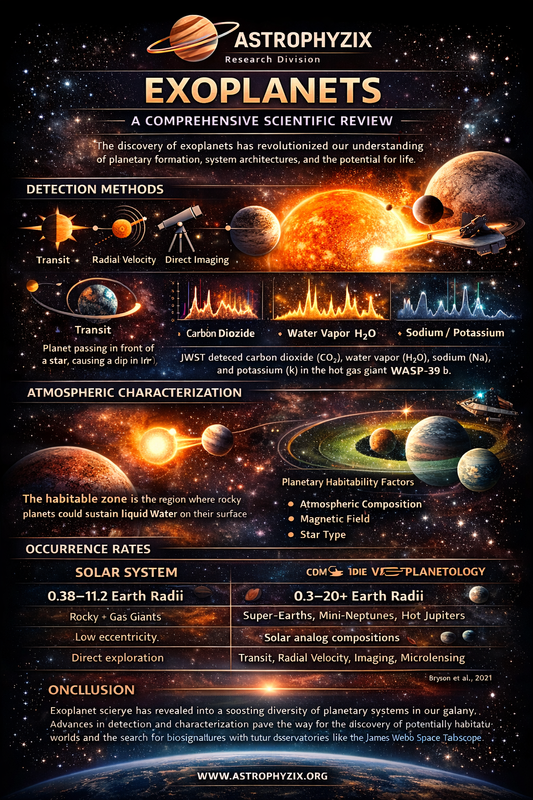
Exoplanets: A Comprehensive Scientific Review

Astrophyzix Digital Observatory Research Dossier

Subject: Exoplanetary Science
Classification: Evidence-First, Peer‑Reviewed Sourced Review
Data Sources: NASA, ESA, ESO, STScI, Nature, PNAS, Annual Reviews

Exoplanets

Exoplanets — A Comprehensive Scientific Review

The detection of planets orbiting stars beyond our Solar System — known as exoplanets — has reshaped astronomy over the past three decades. Prior to 1992, only indirect speculation existed about planets around other stars. Today, nearly 6,000 exoplanets have been confirmed through a variety of observation techniques, revealing planetary systems that challenge traditional theories of formation and habitability. (NASA Exoplanet Archive)

Tuesday, 24 February 2026

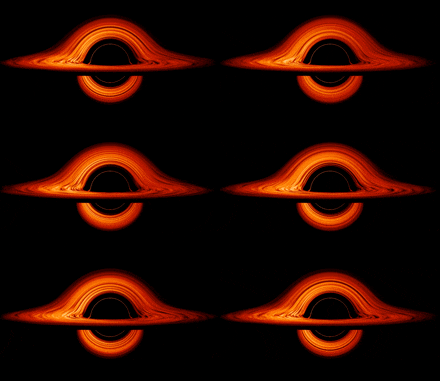
M31-2014-DS1: The Star that Bypassed the Supernova Stage and Collapsed into a Black Hole

Written by: Astrophyzix Digital Observatory and Planetary Defence Research Centre. 
Article Type: Astrophysics, Black Hole Studies, Stellar Collapse, Journal Sources 

✅ Updated: 27 February 2026 (added tags) 

M31-2014-DS1: The Star that Bypassed the Supernova Stage and Collapsed into a Black Hole


Black hole

Introduction

M31‑2014‑DS1 is an extraordinary astrophysical object in the nearby Andromeda Galaxy (Messier 31, ∼2.5 million light‑years from Earth) that has become the focus of intense scientific study because it appears to have “vanished” in a manner inconsistent with standard supernova theory. 

Wednesday, 11 February 2026

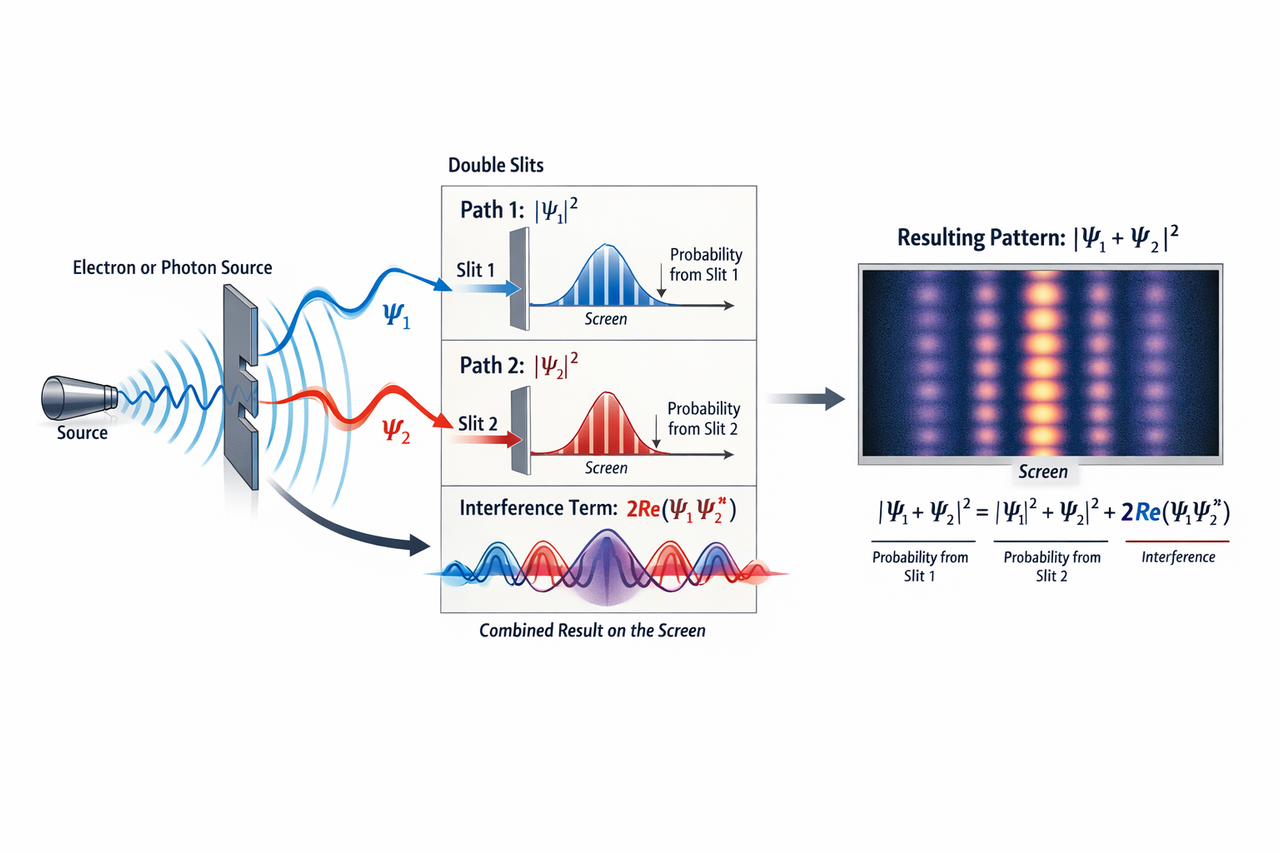
The Double-Slit Experiment Explained: A Detailed Exploration of Quantum Interference and Current Scientific Understanding

Visual explanation: Brian Cox. Professor of Particle Physics at the University of Manchester 
Article written by: Astrophyzix Science Communication
Article type: Explainer, Peer-reviewed Sources, Evidence-based 

Double slit experiment


Introduction

The Double‑Slit Experiment in Modern Science

The double‑slit experiment is one of the most significant empirical foundations of quantum mechanics, demonstrating behavior that defies classical concepts of particles and waves. At its core, it reveals how entities such as photons and electrons exhibit interference patterns that cannot be explained by classical trajectories alone. This experiment, first formulated in the early 19th century and refined through 20th‑ and 21st‑century quantum physics research, continues to unlock conceptual insights into the nature of superposition, measurement, and information in quantum systems.

Independent Direct Source Verification
Uncompromised Crossref DOI Resolver · Live and direct meta data fetch
Awaiting DOI input