
Astrophyzix Digital Observatory
Asteroid News, Research & Analysis

Astrophyzix.com is the publication of the Astrophyzix Digital Observatory, offering unpaywalled, evidence‑driven analysis and real‑time monitoring of PHAs and NEOs. Our tracking consoles and reporting systems use and provide access to official NASA CNEOS Scout, JPL CAD, NeoWs, JPL SBDB, Horizons and NOAA observational datasets, peer‑reviewed sources, and high‑precision numerical methods (IEEE‑754 Float64, RKN4). Designed for students, educators, researchers, and the public, every console is uniquely designed and engineered by the Astrophyzix Digital Observatory. Our research notes and papers can be found at Astrophyzix.Academia.Edu

Showing posts with label No Hype. Show all posts

Thursday, 14 May 2026

Asteroid Apophis 2029 Flyby Scientific Report - What NASA JPL Data Says In 2026 - Asteroid News Without the Hype - Updated 31/05/26

Asteroid (99942) Apophis — 2026 NASA-Verified Scientific Status News Report Update. 
NASA JPL SBDB Solution Date: 2024‑Jun‑25 10:48:08 | Epoch 2461000.5 (2025‑Nov‑21.0) 

Researched, Written and Published by: Astrophyzix Digital Observatory 

ℹ️ No Hype, No Speculation, No Sensationalism - Credible Asteroid News With Clarity - Strict Editorial Standards - Fully Verifiable Sources 

⭐ This report has been featured and cited as a primary source by MSN News and other global media outlets in 39 individual news articles. 

🆙 This report is updated when new agency data is released or updated. 

Responsive image
Reading Time: ~12 min Primary Data: NASA CNEOS / JPL SBDB / JPL Horizons

Classification: Near-Earth Object (Potentially Hazardous Asteroid) Evidence-First Report

📌 Cited by MSN News | Bing Copilot | iAsk Student | Google AI | Google Overview

Apophis 2029 Flyby Key Takeaways

  • No impact risk: NASA’s current orbital solutions for Apophis show zero impact probability for at least the next 100 years.[1]
  • The 2029 flyby: Using official NASA data, Astrophyzix can confirm that on Friday 13 April 2029, Apophis will pass at about 32,000 km above Earth’s surface (about 20,000 miles), closer than geostationary satellites but on a safe, non-impact trajectory.[1],[2]
  • Impact Risk removed: Astrophyzix can conform that high-precision radar observations in 2020–2021 allowed NASA to rule out all impact scenarios for 2029, 2036, and beyond within the 100‑year assessment window.[1],[3]
  • New Science opportunity: The upcoming 2029 encounter is now treated as a science scenario, not a hazard scenario. Astrophyzix Digital Observatory is looking forward to observing and studying this asteroid in 2029 during the flyby event.
  • A Benchmark object: Apophis is used as a reference case in planetary defence simulations, mission design studies, and public‑communication exercises.[4]

Saturday, 25 April 2026

The Buga Sphere Has NOT Been Confirmed to be 12,560 Years Old Using Carbon Dating - Here is What The Science Really Says

The “Buga Sphere” Dating Claim Examined: A Forensic Analysis of the Evidence

📌 Cited by:  - Enigmaticideas.com
Buga Sphere analysis image

Written by: Astrophyzix Digital Observatory


Key Takeaways

  • There is no verifiable scientific evidence that the “Buga Sphere” is 12,560 years old
  • The reported radiocarbon dating applies to organic residue, not the object itself
  • No institutional confirmation from the University of Georgia can be verified
  • No peer-reviewed studies, laboratory reports, or reproducible analyses exist
  • All claims of advanced technology remain unsupported by material evidence

Introduction

In early 2026, renewed attention was directed toward an object commonly referred to online as the “Buga Sphere.” Claims circulated suggesting that the object had been scientifically dated to approximately 12,560 years before present, with references made to testing allegedly conducted by the University of Georgia using Accelerator Mass Spectrometry (AMS).


These claims have been widely shared across non-scientific platforms, often accompanied by interpretations involving advanced technology, lost civilisations, or anomalous origins. This article examines those assertions using established scientific methodology, with particular focus on dating techniques, evidential standards, and verification requirements.

Wednesday, 11 February 2026

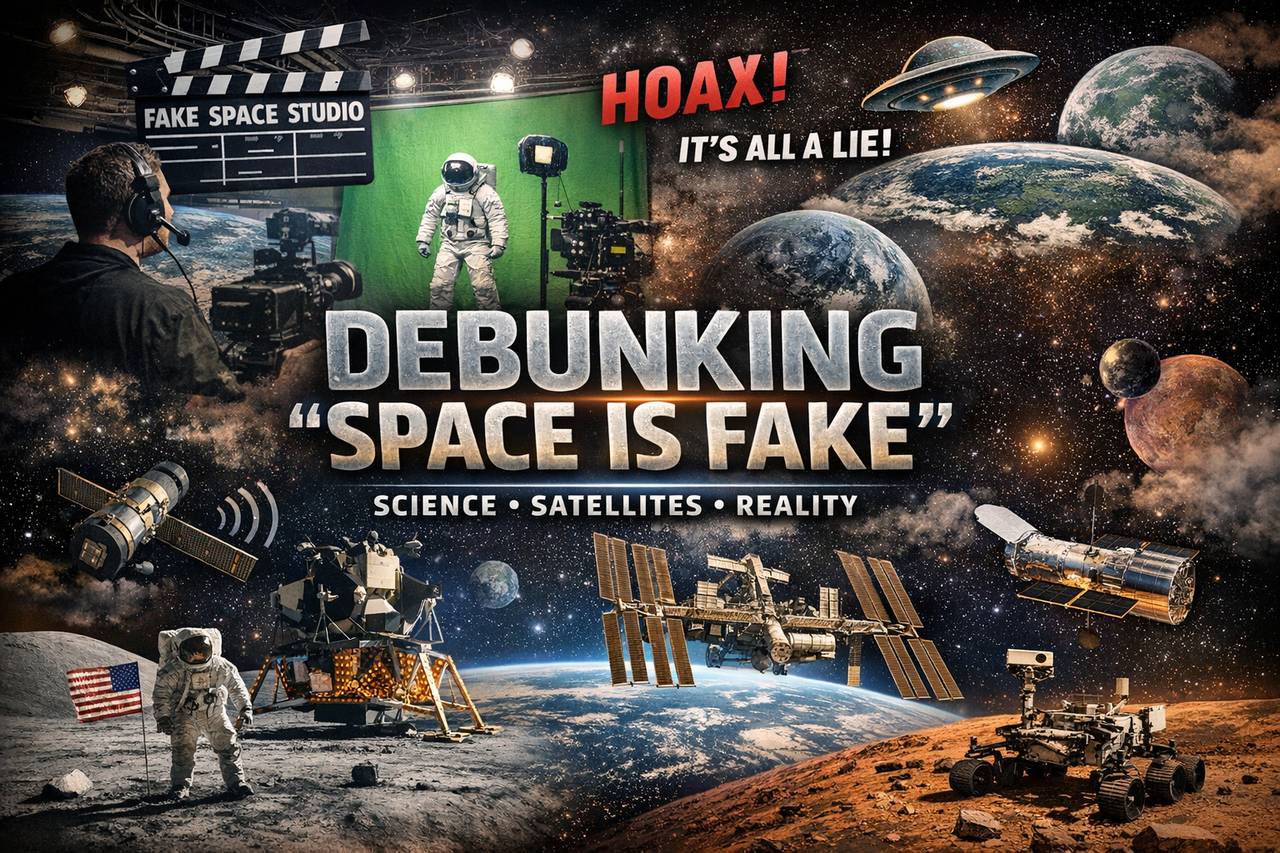
Debunking “Space is Fake”: Science, Satellites, and Conspiracies Explained

Written by: Astrophyzix Science Communication
Article Type: Evidence-Based Myth Correction, Explainer

 
Debunking space is fake


Introduction: Space is what?!?

In recent years, a growing number of online videos, posts, and social media threads have claimed that "space is fake." Proponents of these ideas argue that NASA, ESA, and other space agencies are fabricating images, videos, and scientific data, and that astronauts, satellites, and planetary missions are elaborate hoaxes. While sensational, these claims are not supported by scientific evidence. 

This article examines the psychological, technological, and observational evidence that demonstrates why space exploration is real, and why the so-called "space is fake" narratives fail scientifically.

Independent Direct Source Verification
Uncompromised Crossref DOI Resolver · Live and direct meta data fetch
Awaiting DOI input