
Introduction
For the first time in more than half a century, human beings are travelling beyond low Earth orbit. NASA's Artemis II mission launched on 1 April 2026, carrying four astronauts aboard the Orion spacecraft atop the Space Launch System rocket from Kennedy Space Center in Florida. The mission marks the first crewed flight of Orion, the first time astronauts have ventured into deep space since Apollo 17 in December 1972, and a series of historic personal firsts for its crew.
Artemis II is not a landing mission. Its purpose is to validate the performance of crewed deep-space systems — life support, navigation, thermal control, communication, and re-entry — in the actual conditions of a translunar trajectory. The crew will perform a close lunar flyby on 6 April 2026 before returning to Earth for a Pacific Ocean splashdown, completing an approximately ten-day mission.
The mission depends critically on the European Service Module, built by ESA and prime contractor Airbus, which provides propulsion, power, and life-sustaining resources throughout the flight.
Key Takeaways
- Artemis II launched on 1 April 2026 — the first crewed mission beyond low Earth orbit since Apollo 17 in 1972.
- The mission performs a lunar flyby on 6 April 2026, not a landing.
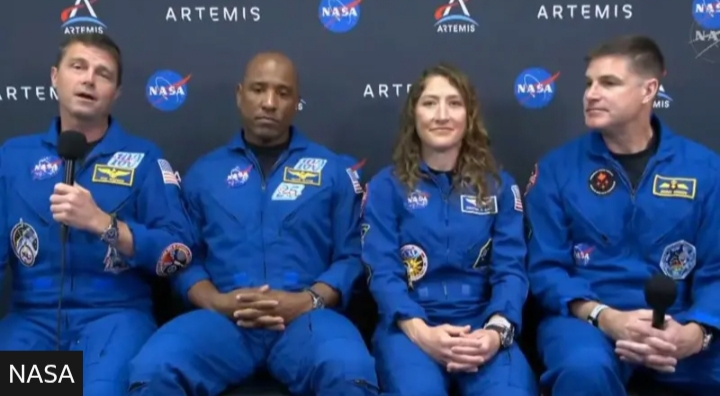
- Crew: Reid Wiseman (Commander), Victor Glover (Pilot), Christina Koch, and Jeremy Hansen (CSA).
- Historic firsts: first person of colour, first woman, and first non-US citizen beyond low Earth orbit.
- Orion uses an active hybrid trajectory — not a free-return trajectory as sometimes reported.
- The European Service Module performs translunar injection and sustains the crew throughout the flight.
- Primary goal is systems validation to reduce risk for Artemis III, the planned lunar landing (ADO) .
Scientific Consensus Snapshot
Within aerospace engineering and space mission design communities, Artemis II is regarded as a necessary intermediate validation mission. Its role is not to produce direct lunar science, but to verify that crewed spacecraft systems perform as required in a genuine deep-space environment. Conditions beyond Earth's magnetosphere — including radiation exposure, communication latency, and thermal extremes — cannot be fully replicated in Earth orbit.
The Crew
Artemis II is crewed by four astronauts selected for their skills, experience, and complementary expertise:
- Reid Wiseman (NASA) — Commander
- Victor Glover (NASA) — Pilot; first person of colour beyond low Earth orbit
- Christina Koch (NASA) — Mission Specialist; first woman beyond low Earth orbit
- Jeremy Hansen (Canadian Space Agency) — Mission Specialist; first non-US citizen beyond low Earth orbit
With four crew members, the mission also sets a new record for the most people beyond low Earth orbit simultaneously.