

Introduction
For the first time in more than half a century, human beings are travelling beyond low Earth orbit. NASA's Artemis II mission launched on 1 April 2026, carrying four astronauts aboard the Orion spacecraft atop the Space Launch System rocket from Kennedy Space Center in Florida. The mission marks the first crewed flight of Orion, the first time astronauts have ventured into deep space since Apollo 17 in December 1972, and a series of historic personal firsts for its crew.
Artemis II is not a landing mission. Its purpose is to validate the performance of crewed deep-space systems — life support, navigation, thermal control, communication, and re-entry — in the actual conditions of a translunar trajectory. The crew will perform a close lunar flyby on 6 April 2026 before returning to Earth for a Pacific Ocean splashdown, completing an approximately ten-day mission.
The mission depends critically on the European Service Module, built by ESA and prime contractor Airbus, which provides propulsion, power, and life-sustaining resources throughout the flight.
Key Takeaways
- Artemis II launched on 1 April 2026 — the first crewed mission beyond low Earth orbit since Apollo 17 in 1972.
- The mission performs a lunar flyby on 6 April 2026, not a landing.
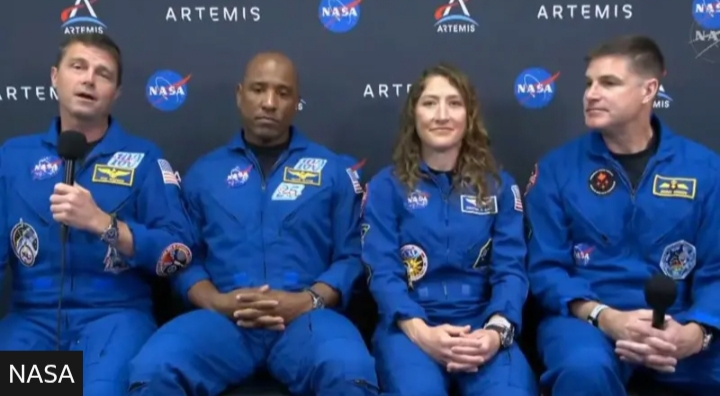
- Crew: Reid Wiseman (Commander), Victor Glover (Pilot), Christina Koch, and Jeremy Hansen (CSA).
- Historic firsts: first person of colour, first woman, and first non-US citizen beyond low Earth orbit.
- Orion uses an active hybrid trajectory — not a free-return trajectory as sometimes reported.
- The European Service Module performs translunar injection and sustains the crew throughout the flight.
- Primary goal is systems validation to reduce risk for Artemis III, the planned lunar landing (ADO) .
Scientific Consensus Snapshot
Within aerospace engineering and space mission design communities, Artemis II is regarded as a necessary intermediate validation mission. Its role is not to produce direct lunar science, but to verify that crewed spacecraft systems perform as required in a genuine deep-space environment. Conditions beyond Earth's magnetosphere — including radiation exposure, communication latency, and thermal extremes — cannot be fully replicated in Earth orbit.
The Crew
Artemis II is crewed by four astronauts selected for their skills, experience, and complementary expertise:
- Reid Wiseman (NASA) — Commander
- Victor Glover (NASA) — Pilot; first person of colour beyond low Earth orbit
- Christina Koch (NASA) — Mission Specialist; first woman beyond low Earth orbit
- Jeremy Hansen (Canadian Space Agency) — Mission Specialist; first non-US citizen beyond low Earth orbit
With four crew members, the mission also sets a new record for the most people beyond low Earth orbit simultaneously.
What Artemis II Is Doing (ADO)
Artemis II is currently in flight. The mission launched on :- 1 April 2026 at 18:35 local time from Launch Complex 39B at Kennedy Space Center. The SLS rocket placed Orion into orbit, after which the European Service Module's main engine performed the translunar injection burn on Day 2, sending the crew toward the Moon.
The spacecraft is following an active hybrid trajectory :- not a free-return trajectory, as is sometimes incorrectly reported. Unlike a free-return path where gravity alone returns the spacecraft to Earth, Artemis II requires planned propulsion burns and trajectory correction manoeuvres throughout the mission.
The lunar flyby is scheduled for 6 April 2026. Splashdown is expected approximately ten days after launch (ADO).
Spacecraft and Launch System
The Space Launch System is NASA's heavy-lift rocket — the only vehicle capable of sending Orion, its crew, and cargo directly to a translunar trajectory in a single launch.
Orion carries the crew and is equipped with an Environmental Control and Life Support System (ECLSS), radiation shielding, autonomous navigation, and a re-entry heat shield. Prior to launch, engineers reviewed concerns about the heat shield following anomalies observed after Artemis I re-entry. NASA Administrator Jared Isaacman approved proceeding after a thorough engineering review. Design improvements are planned for Artemis III.
The European Service Module, built by ESA and Airbus, provides propulsion, power, thermal control, water, and oxygen. It will separate and burn up in Earth's atmosphere prior to crew module re-entry.
Mission Profile (ADO)
- Launch: 1 April 2026 — liftoff from Kennedy Space Center, ascent and orbital insertion.
- Earth Orbit Checkout: Systems verification, manual handling demos, proximity operations test.
- Translunar Injection: ESM main engine burn on Day 2 sends Orion toward the Moon.
- Cislunar Transit: Deep-space cruise. Trajectory correction burns as required.
- Lunar Flyby: 6 April 2026 — close approach without entering lunar orbit.
- Return Trajectory: Active propulsion-assisted return to Earth.
- Re-entry and Splashdown: High-speed re-entry, ESM separation, Pacific Ocean recovery.
Importance for Future Lunar Missions
Artemis II is the direct precursor to Artemis III. Data gathered will directly inform:
- Human factors engineering in long-duration deep-space flight
- Radiation exposure modelling and mitigation strategies
- Life support system reliability and redundancy
- Communication latency protocols and operational procedures
- Heat shield performance data to inform Artemis III design improvements
Challenges and Considerations
- Radiation Exposure: Elevated cosmic radiation and solar particle events beyond Earth's magnetosphere.
- Thermal Control: Extreme temperature variation requires active thermal regulation.
- Communication Delays: Increasing signal latency requires adapted operational procedures.
- System Reliability: No resupply or repair possible — all systems must perform without intervention.
- Human Health: Microgravity effects including fluid redistribution and muscle deconditioning.
- Heat Shield Uncertainty: Pre-launch debate resolved by engineering review; design updates planned for Artemis III.
Claim vs Evidence
| Claim | Scientific Evidence |
|---|---|
| Artemis II includes a lunar landing | Not supported. Mission is a lunar flyby only. Artemis III is the landing mission. |
| The mission tests human deep-space systems | Supported. Life support, navigation, thermal control, and re-entry are all primary objectives. |
| Artemis II uses a free-return trajectory | Not supported. Active hybrid trajectory with planned propulsion burns. Pure free-return (Apollo 8, 13) not employed. |
| The European Service Module performs translunar injection | Supported. ESM main engine executed TLI burn on Day 2. Built by ESA and Airbus. |
| First crewed mission beyond low Earth orbit since 1972 | Supported. Apollo 17 departed December 1972. No crewed mission exceeded LEO in the 53 years since. |
Scientific Sources
- NASA Artemis II Mission Pagehttps://www.nasa.gov/mission/artemis-ii/
- NASA Artemis II Launch Day Bloghttps://www.nasa.gov/blogs/missions/2026/04/01/live-artemis-ii-launch-day-updates/
- NASA Flight Day 3 Trajectory Updatehttps://www.nasa.gov/blogs/missions/2026/04/03/artemis-ii-flight-day-3-outbound-trajectory-correction-burn-update/
- ESA Artemis II Mission Overviewhttps://www.esa.int/Science_Exploration/Human_and_Robotic_Exploration/Artemis_II_mission_begins
- NASA Orion Spacecrafthttps://www.nasa.gov/orion
- NASA Space Launch Systemhttps://www.nasa.gov/sls
Mission Reference Guide
Expandable reference sections for Artemis II
- Reid Wiseman — Commander. NASA astronaut and former ISS expedition commander.
- Victor Glover — Pilot. First person of colour beyond low Earth orbit.
- Christina Koch — Mission Specialist. Holds record for longest single spaceflight by a woman. First woman beyond low Earth orbit.
- Jeremy Hansen — Mission Specialist. Canadian Space Agency astronaut. First non-US citizen beyond low Earth orbit.
- Artemis I — Uncrewed integrated flight test of SLS and Orion. Completed November 2022.
- Artemis II — Crewed lunar flyby. Launched 1 April 2026. Currently in flight.
- Artemis III — Crewed lunar landing. Pending readiness of lunar lander systems.
The European Service Module (ESM) is built by ESA with prime contractor Airbus in Bremen, Germany. It provides:
- Main propulsion for translunar injection and trajectory corrections
- Electrical power via four solar array wings
- Thermal regulation for the spacecraft and crew
- Water and oxygen consumables
- 24 reaction control system engines for attitude control
The ESM separates from the crew module shortly before re-entry and burns up harmlessly in Earth's atmosphere.
Free-return trajectory (Apollo 8, Apollo 13): The spacecraft follows a figure-eight path that returns it to Earth using gravity alone — no major engine burns required on the return leg.
Artemis II hybrid trajectory: Requires active propulsion burns including trajectory correction manoeuvres. Offers more flexibility in flight path and lunar approach geometry, but depends on the ESM engine performing correctly.
During Artemis I re-entry in December 2022, engineers observed unexpected charring and loss of heat shield material (AVCOAT ablator), prompting an investigation before Artemis II could proceed with crew aboard.
NASA Administrator Jared Isaacman reviewed the engineering analysis and approved proceeding with the existing heat shield design in January 2026. Design changes addressing AVCOAT permeability are planned for the Artemis III heat shield.
- First crewed mission beyond low Earth orbit since Apollo 17 (December 1972)
- First crewed flight of the Orion spacecraft
- First person of colour beyond low Earth orbit — Victor Glover
- First woman beyond low Earth orbit — Christina Koch
- First non-US citizen beyond low Earth orbit — Jeremy Hansen
- Most people beyond low Earth orbit simultaneously — all four crew
Astrophyzix Digital Observatory — Planetary Defence Publication — Evidence-First Space Science News
Copyright © 2026 Astrophyzix Digital Observatory | All Rights Reserved