
Article Type: Evidence-Based Myth Correction, Explainer
Introduction: Space is what?!?
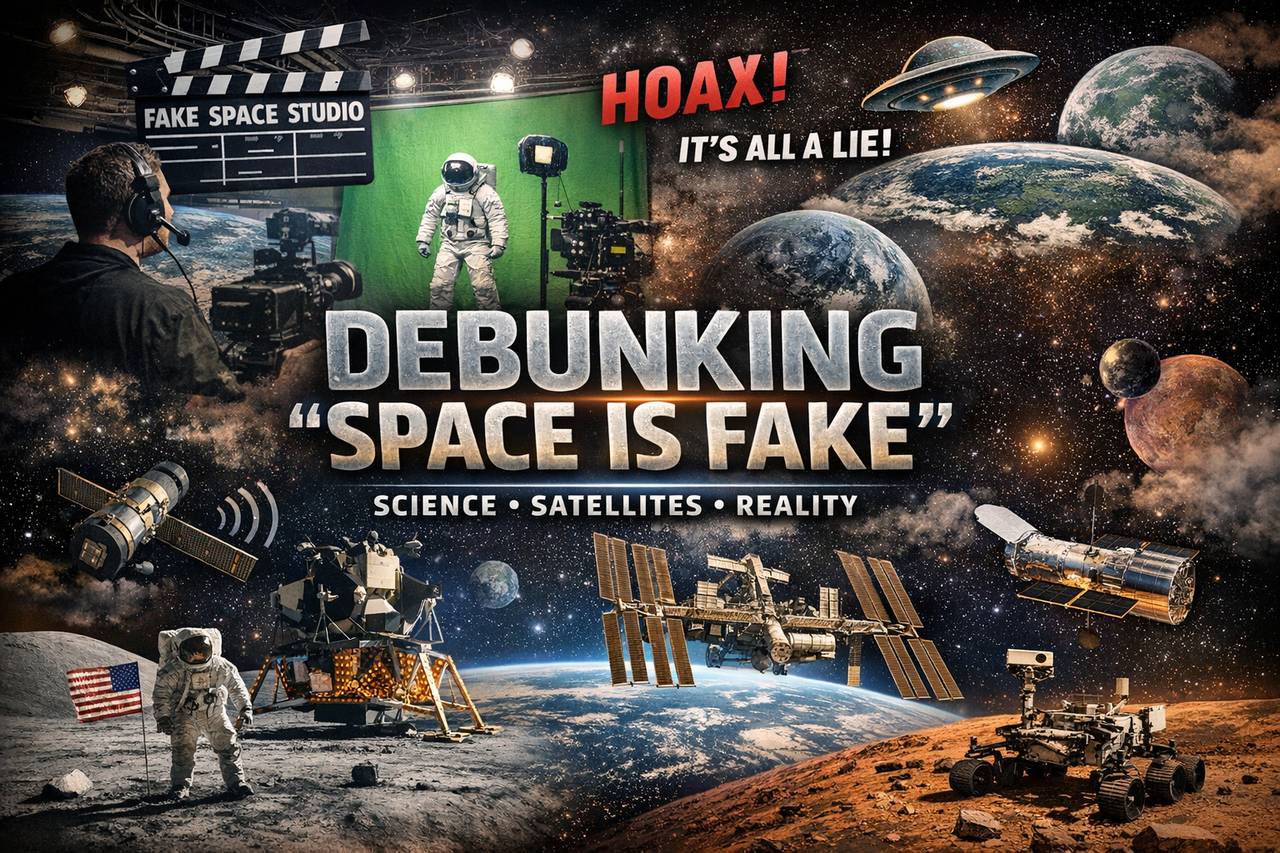
In recent years, a growing number of online videos, posts, and social media threads have claimed that "space is fake." Proponents of these ideas argue that NASA, ESA, and other space agencies are fabricating images, videos, and scientific data, and that astronauts, satellites, and planetary missions are elaborate hoaxes. While sensational, these claims are not supported by scientific evidence.
This article examines the psychological, technological, and observational evidence that demonstrates why space exploration is real, and why the so-called "space is fake" narratives fail scientifically.
Why People Believe Space Is Fake
Understanding the appeal of these conspiracies is critical for debunking them:
- Mistrust of Authority: Some individuals have an ingrained suspicion of governments, scientists, and institutions, making them more receptive to conspiracy narratives.
- Pattern-Seeking Behavior: Humans are wired to see patterns, sometimes where none exist. Conspiracies exploit this tendency by presenting coincidences as intentional deception.
- Confirmation Bias: Once someone doubts official sources, they selectively interpret information to reinforce their existing beliefs.
- Viral Incentives: Outrageous claims perform well online. Platforms like YouTube and TikTok amplify sensational content, regardless of its accuracy.
- Misinterpretation of Science: Complex topics like orbital mechanics, astrophysics, and spacecraft imagery are often misunderstood and misrepresented.
Common “Space is Fake” Claims and Scientific Responses
Claim 1: The Moon Landing Was Staged
Some suggest that the Apollo missions were filmed on Earth, citing perceived anomalies in photos and videos.
- Scientific Reality: Detailed analysis of lunar rock samples, verified by multiple independent laboratories, confirms their extraterrestrial origin. Lunar laser ranging experiments, where lasers are bounced off reflectors left on the Moon, continue to provide precise measurements of Earth-Moon distance.
- Reference: Apollo Lunar Surface Journal and NASA Lunar Laser Ranging
Claim 2: Satellites Are Fake
Conspiracy posts claim that satellite images, weather data, and GPS systems are fabricated.
- Scientific Reality: Thousands of satellites from multiple countries operate in orbit. Real-time satellite tracking websites (e.g., CelesTrak) allow anyone to observe their paths. GPS and satellite communications function reliably worldwide and are tested daily by aviation, shipping, and telecommunications industries.
- References: CelesTrak Satellite Tracking and NASA Earth Science
Claim 3: Images of Planets and the ISS Are CGI
Some argue that images from the Hubble Space Telescope, Mars rovers, or the International Space Station are computer-generated.
- Scientific Reality: Space telescopes and probes capture raw image data that scientists process to create color composites. This processing is standard in photography and does not indicate fabrication. Additionally, live feeds from the ISS and rover telemetry are publicly accessible.
- Reference: Hubble Space Telescope Image Processing and NASA Live ISS Feed
Scientific Methods for Life and Observation in Space
Science relies on reproducible observations and data verification. Space agencies, research institutions, and independent scientists utilize rigorous methods:
- Telescopic Observations: Ground-based and orbital telescopes collect spectra, brightness, and motion data of celestial objects.
- Planetary Missions: Robotic spacecraft, like Mars rovers and orbiters, gather chemical, geological, and atmospheric measurements.
- Remote Sensing: Satellites use multi-spectral imaging to study Earth and other planets, confirming surface features, atmospheric composition, and magnetic fields.
- Cross-Verification: Observations from different instruments and countries are independently verified, providing strong evidence for the reality of space phenomena.
Evidence from Space Exploration
Concrete evidence demonstrates the reality of space beyond doubt:
- Moon and Mars Samples: Over 2,000 kg of lunar rocks and Martian meteorites provide geochemical data consistent with extraterrestrial origins.
- International Observatories: Independent telescopes worldwide observe planets, stars, and satellites, corroborating official space mission findings.
- Live Telemetry: Real-time data from ISS, Mars rovers, and weather satellites is publicly accessible, providing transparency.
- Interplanetary Communication: Signals from spacecraft, including Voyager 1 and 2 beyond the solar system, confirm precise distances and telemetry beyond Earth’s orbit.
Psychology Behind Conspiracy Beliefs
Understanding why people embrace “space is fake” theories helps combat misinformation:
- Conspiratorial thinking often stems from a need for control or certainty in a complex world.
- Viral algorithms amplify sensational claims faster than fact-based content.
- Communities of believers reinforce narratives, discouraging critical evaluation.
Verifying Space Yourself: High-Altitude Balloons
One of the simplest ways for anyone to independently observe evidence of space beyond Earth is through high-altitude balloon experiments. These balloons, often filled with helium or hydrogen, can carry lightweight cameras to the stratosphere—typically 30–40 km above sea level—far above most of Earth's atmosphere.
At this altitude, the curvature of the Earth becomes visible, and the sky transitions from blue to the blackness of space, providing direct, observable evidence of the planet’s spherical shape and the existence of near-space.
Basic steps for a DIY high-altitude balloon project include:
- Balloon Selection: Weather balloons are commonly used, capable of carrying a small payload to the stratosphere.
- Payload Setup: Secure a lightweight camera (GoPro, Raspberry Pi camera, or similar), GPS tracker, and protective casing for the camera and electronics.
- Launch and Recovery: Launch from a safe, legal location, track the balloon using GPS, and recover the payload once it descends using a parachute system.
- Observation: Footage from the high-altitude balloon clearly shows the curvature of the Earth, the thinning atmosphere, and the black sky beyond, providing real-world evidence that contradicts claims that space is fabricated.
These experiments are widely documented and have been performed by students, hobbyists, and educators worldwide, providing verifiable evidence of space that does not rely on government or space agency sources. They demonstrate that independent observation is possible, making the claims of “space is fake” increasingly untenable.
References:
- High-Altitude Balloon Experiments for Education and Observation – IEEE
- NASA High-Altitude Ballooning Guide
Tips to Identify and Avoid Space Misinformation
- Check sources: Rely on peer-reviewed journals, NASA, ESA, or other established institutions.
- Verify claims: Use publicly available satellite trackers, ISS feeds, and telescope observation platforms.
- Be skeptical of sensational language: Words like “hoax,” “hidden truth,” or “they don’t want you to know” are common clickbait tactics.
- Cross-reference information: Independent verification from multiple reputable sources is essential.
Conclusion
Claims that "space is fake" lack scientific basis and ignore overwhelming observational and experimental evidence. Through satellite tracking, planetary missions, telescopic data, and rigorous cross-verification, space science continues to expand human knowledge. Debunking these conspiracies not only protects scientific literacy but reinforces public understanding of real space exploration.
Sources and Further Reading
- Apollo Lunar Surface Journal – NASA
- NASA Lunar Laser Ranging Experiments
- CelesTrak Satellite Tracking
- NASA Earth Science Data
- Hubble Space Telescope Images
- NASA Live ISS Feed
- Astrophyzix Explainer Article Series