

Introduction
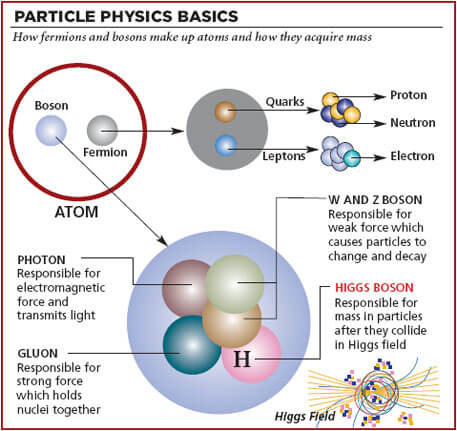
The Higgs boson is one of the most important discoveries in modern physics and represents the experimental confirmation of a mechanism proposed in the 1960s to explain how fundamental particles acquire mass. Its detection in 2012 at CERN's Large Hadron Collider marked the completion of the Standard Model of particle physics, a framework describing the fundamental particles and forces that govern the universe.
The particle itself is not merely another addition to the particle zoo. Instead, it is the observable manifestation of the Higgs field, a quantum field believed to permeate all space. According to electroweak theory, interactions with this field determine the masses of elementary particles. Without it, many particles would behave as if massless, fundamentally altering the structure of matter and preventing atoms from forming.
The discovery of a new boson with a mass near 125 GeV was independently reported by the ATLAS and CMS experiments in July 2012, following proton collision experiments designed to probe high-energy particle interactions.
- Original ATLAS discovery paper DOI: https://doi.org/10.1126/science.1232005
- Historical overview of the search DOI: https://doi.org/10.1126/science.1230827
Theoretical Origins of the Higgs Mechanism
The Standard Model describes three of the four known fundamental forces: electromagnetic, weak nuclear, and strong nuclear interactions. During the early development of electroweak unification, theorists encountered a severe problem. The equations required the carriers of the weak force, the W and Z bosons, to be massless, yet experiments showed they are extremely heavy.
To resolve this contradiction, physicists proposed a spontaneous symmetry breaking mechanism involving a universal scalar field. This became known as the Higgs field. In this model, particles gain inertial mass through their coupling strength to the field.
The quantum excitation of this field is what we observe as the Higgs boson.
The theoretical framework predicted several key properties:
- The Higgs particle must have zero intrinsic spin
- It must be electrically neutral
- It must couple proportionally to particle mass
- It should decay through multiple measurable channels
These predictions guided decades of experimental searches and detector design strategies.
Why Mass Requires a Field-Based Explanation
In classical mechanics, mass is treated as an intrinsic property of matter. However, quantum field theory describes particles as excitations of underlying fields. Within this framework, mass cannot simply be inserted arbitrarily into gauge-invariant equations because doing so breaks mathematical symmetries essential for predictive consistency.
The Higgs mechanism preserves gauge symmetry try while allowing particles to appear massive. When the Higgs field adopts a non-zero vacuum expectation value, electroweak symmetry is broken, separating electromagnetic and weak forces and generating masses for the W and Z bosons.
This symmetry-breaking process is a defining event in early-universe cosmology and is thought to have occurred fractions of a second after the Big Bang.
The Large Hadron Collider and the Experimental Search
The Large Hadron Collider (LHC) was constructed specifically to explore energy scales where the Higgs boson was predicted to exist. Located at CERN near Geneva, the collider accelerates protons to near-light speed and smashes them together at extremely high energies.
The two primary detectors responsible for the Higgs discovery were:
- ATLAS
- CMS (Compact Muon Solenoid)
Both experiments searched for evidence of Higgs production followed by decay into detectable particles. Because the Higgs boson decays almost instantly, it cannot be observed directly. Instead, scientists reconstruct its existence statistically from decay signatures.
Key decay channels included:
- Two photons
- Two Z bosons leading to four leptons
- Two W bosons
- Bottom quark pairs
- Tau lepton pairs
Statistical significance reached the required 5 sigma threshold, meaning the probability of the signal being random noise was extremely small.
The 2012 Discovery Announcement
On July 4, 2012, CERN announced the observation of a new boson consistent with the predicted Higgs particle. The observed mass was approximately 125 GeV.
The CMS collaboration reported an excess of events with a local significance of 5.0 standard deviations, indicating strong evidence for a new particle.
- CMS observation paper: https://arxiv.org/abs/1207.7235
Subsequent analysis confirmed that the particle possessed the expected spin-zero configuration and decay patterns consistent with the Standard Model Higgs.
Precision Measurements Since Discovery
Following the initial detection, researchers focused on determining whether the particle exactly matches the Standard Model prediction or represents part of a broader theoretical structure.
Large datasets collected during later LHC runs enabled precise measurements of:
- Production cross sections
- Decay branching ratios
- Spin and parity
- Coupling strengths to fermions and bosons
A comprehensive 2022 CMS analysis combining many datasets found that all observed Higgs properties remain consistent with Standard Model predictions within experimental uncertainty.
- Nature paper DOI: https://doi.org/10.1038/s41586-022-04892-x
How the Higgs Field Shapes the Structure of Matter
The Higgs field plays a foundational role in determining the structure of the physical universe. Elementary fermions such as quarks and leptons obtain their masses through Yukawa couplings to the field. The strength of these couplings varies dramatically between particles.
For example:
- The top quark interacts extremely strongly with the Higgs field
- The electron interacts much more weakly
- Neutrinos may obtain mass through additional mechanisms beyond the Standard Model
This variation in coupling strengths explains why particles span an enormous mass range.
Importantly, most of the visible mass in everyday matter does not come directly from the Higgs mechanism but from quantum chromodynamics binding energy inside protons and neutrons. The Higgs field primarily sets the masses of the fundamental constituents themselves.
Open Questions in Higgs Physics
Despite the confirmation of the Higgs boson, major unanswered questions remain.
These include:
- Why does the Higgs field have its specific vacuum value?
- Why is the Higgs mass approximately 125 GeV?
- Is the Higgs boson truly elementary or composite?
- Does the Higgs sector connect to dark matter?
- Are there additional Higgs particles?
Many theoretical extensions of the Standard Model predict multiple Higgs bosons or modified coupling behavior. Detecting such deviations would signal new physics.
Royal Society review DOI:
The Higgs Boson and the Stability of the Universe
One of the most intriguing implications of Higgs measurements concerns the stability of the vacuum state of the universe.
Quantum calculations using measured Higgs and top-quark masses suggest the universe may exist in a metastable vacuum. In this scenario, the current vacuum is not the absolute lowest-energy state but could theoretically transition to a lower state.
Such a transition would require extremely high-energy quantum fluctuations and is not expected to occur within cosmological timescales. Nevertheless, the result provides profound insight into fundamental cosmology and particle interactions.
Future Higgs Research Programs
The High-Luminosity Large Hadron Collider upgrade aims to produce vastly larger numbers of Higgs bosons, enabling extremely precise property measurements and rare decay searches.
Future goals include:
- Measuring Higgs self-coupling
- Detecting Higgs pair production
- Testing second-generation fermion couplings
- Searching for invisible Higgs decays
These investigations may reveal whether the Standard Model is merely a low-energy approximation of a deeper theory.
Why the Higgs Boson Matters for Fundamental Physics
The Higgs boson is unique among known particles because it is the only confirmed fundamental scalar particle. Its discovery verified the mechanism responsible for electroweak symmetry breaking and confirmed a central pillar of modern quantum field theory.
Beyond completing the Standard Model, Higgs physics now serves as one of the most sensitive probes for new phenomena. Any deviation from predicted coupling strengths or decay distributions would point directly toward undiscovered physics.
As experimental precision improves, the Higgs boson continues to function not as the endpoint of particle physics but as a gateway to deeper understanding.
Primary Peer-Reviewed Sources
- ATLAS discovery paper: https://doi.org/10.1126/science.1232005
- Science overview of Higgs search: https://doi.org/10.1126/science.1230827
- CMS ten-year precision study (Nature): https://doi.org/10.1038/s41586-022-04892-x
- Royal Society experimental review: https://doi.org/10.1098/rsta.2014.0384
- Scholarpedia technical review: https://doi.org/10.4249/scholarpedia.32413
- Image Credit: https://pmfias.com
This article is based exclusively on peer-reviewed literature and experimental collaboration publications.