

Article Type: Official Space Agency sourced News, Explainer, Evidence-based
NASA’s SPHEREx Mission Tracks Interstellar Comet 3I/ATLAS Through Infrared Eyes
NASA’s SPHEREx mission — the Spectro-Photometer for the History of the Universe, Epoch of Reionization, and Ices Explorer has provided one of the most detailed infrared views yet of the interstellar comet 3I/ATLAS. As this rare visitor passed through our solar system, SPHEREx measured the light emitted by the gases and dust around the comet’s nucleus, revealing how its frozen materials reacted to solar heating and offering insight into the composition of a body formed around another star.
NASA scientists describe these observations as uniquely valuable for understanding how the pristine ices and organic compounds contained in interstellar objects behave as they encounter the Sun’s environment while traversing our solar system.
Discovery and Classification of 3I/ATLAS
Comet 3I/ATLAS was first detected by the NASA-funded Asteroid Terrestrial-impact Last Alert System (ATLAS) survey telescope in Río Hurtado, Chile. The discovery was reported to the Minor Planet Center on July 1, 2025. Follow-up observations quickly established that the object’s trajectory was hyperbolic, meaning it is not gravitationally bound to the Sun and instead entered the solar system from interstellar space. This designation makes 3I/ATLAS the third confirmed interstellar object observed, following 1I/‘Oumuamua and 2I/Borisov.
The SPHEREx Mission: An Infrared Surveyor
Launched in 2025, SPHEREx is NASA’s first space mission designed to perform an all-sky infrared spectral survey. Unlike many telescopes that capture only images, SPHEREx splits incoming infrared light into 102 distinct spectral bands, allowing scientists to determine the physical and chemical composition of observed objects.
SPHEREx’s primary mission goals include mapping the large-scale structure of the universe, tracing the history of galaxy formation, and searching for water ice and complex organic molecules in space. Its infrared capability also enables detailed studies of solar system objects such as comets.
Infrared Observations of 3I/ATLAS’s Coma
As 3I/ATLAS traveled through the inner solar system, SPHEREx observed the comet in December 2025 — about two months after its perihelion in late October 2025. Observations focused on the comet’s coma, the expanding envelope of gas and dust released from the nucleus as the comet warmed and its ices sublimated.
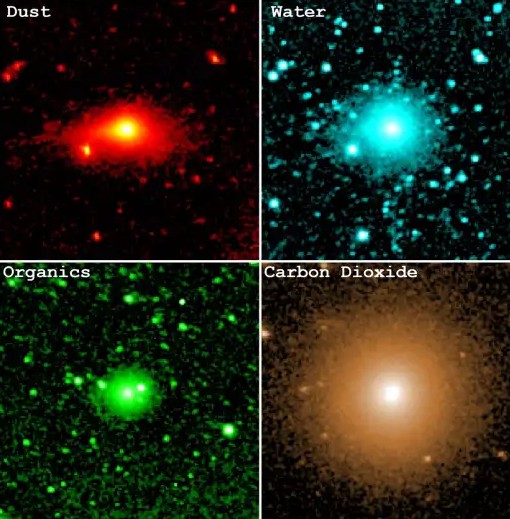
SPHEREx detected infrared emission from several key components:
- Dust particles, which scatter and emit infrared light.
- Water vapor, formed as water ice sublimates from the comet’s surface.
- Organic molecules, including methanol, cyanide, and methane.
- Carbon dioxide, a major volatile contributing to the comet’s activity.
The observed brightening in SPHEREx’s infrared data occurred after perihelion, indicating ongoing sublimation and active venting of materials, which allowed detailed spectral profiling of the comet’s volatile emissions.
Scientific Insights
- Composition Analysis: Infrared spectra provide evidence of the gases and dust released from the comet, including water, carbon dioxide, and organic compounds.
- Comparative Planetology: Comparing 3I/ATLAS’s materials with solar system comets offers insight into chemical environments around other stars.
- Infrared Coma Mapping: Multi-wavelength measurements help quantify how cometary ices respond to solar heating.
Broader Scientific Context
SPHEREx observations contribute to a multi-instrument effort to study 3I/ATLAS, alongside data from TESS, Hubble, and Webb. Combining datasets across wavelengths enables detailed models of the comet’s structure, composition, and activity. The SPHEREx dataset is publicly archived for global scientific research.
Conclusion
NASA’s SPHEREx mission has provided a detailed infrared view of interstellar comet 3I/ATLAS during its passage through the solar system. By capturing emissions from gases, dust, and organic molecules, SPHEREx has offered unique insights into the composition and behavior of a body formed in another star system, enriching our understanding of cometary chemistry and interstellar processes.