
Written By: Astrophyzix Science CommunicationArticle type: Explainer, Deep-Dive, Doi Sourced, Official CERN
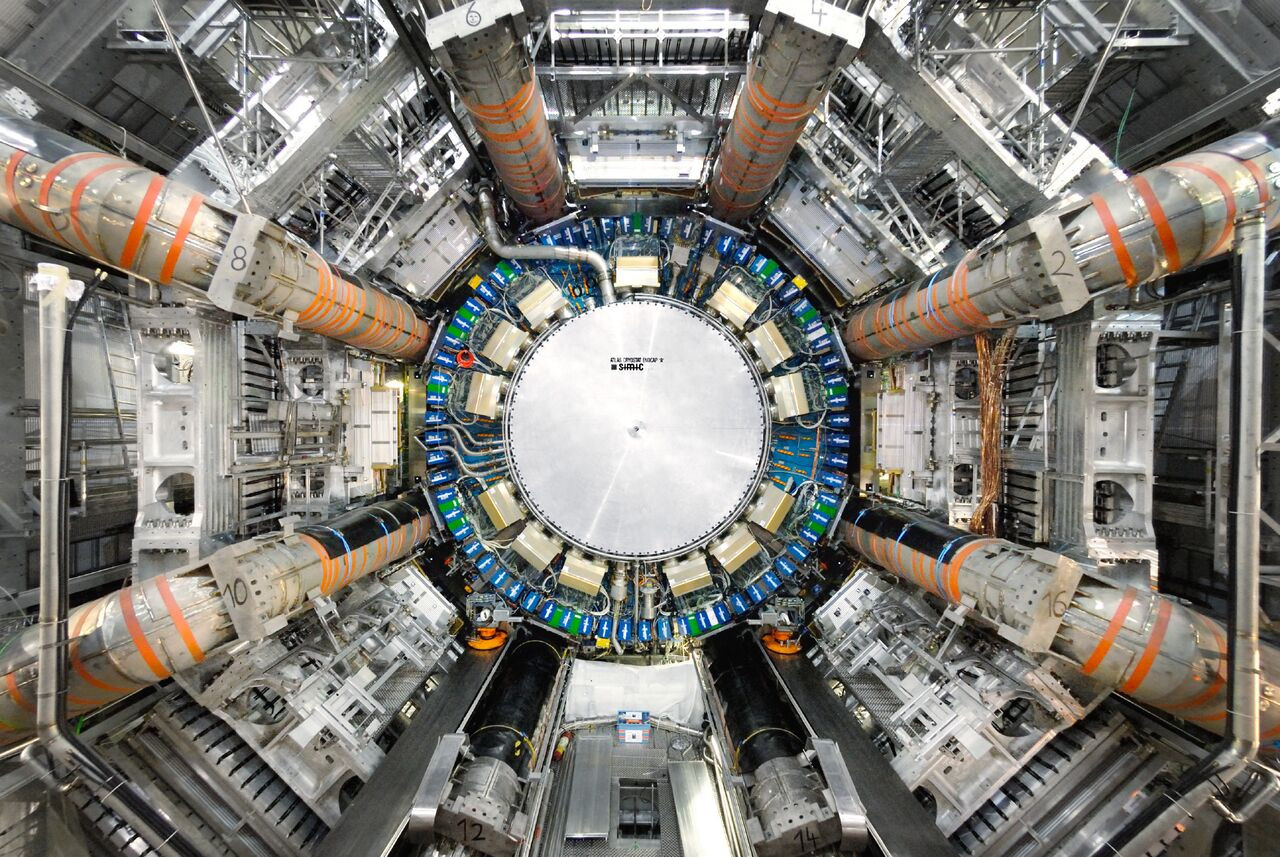
Introduction to The Large Hadron Collider
The Large Hadron Collider operated by the European physics laboratory CERN represents the most advanced experimental instrument ever constructed for studying the fundamental structure of matter. Built to probe energy regimes previously unreachable in controlled laboratory conditions, the collider allows physicists to experimentally test quantum field theory, the Standard Model, and candidate theories describing physics beyond known particles and forces.
The machine is installed in a circular underground tunnel approximately 27 kilometers in circumference beneath the France Switzerland border near Geneva. Within this ring, beams of protons or heavy ions are accelerated to velocities extremely close to the speed of light before being brought into controlled collision inside massive particle detectors.
These collisions reproduce energy densities comparable to those present shortly after the early universe began expanding, allowing direct experimental investigation of high energy particle interactions that shaped the formation of matter.
Scientific Motivation for Building the Large Hadron Collider
By the late twentieth century, particle physics had developed a highly successful theoretical framework known as the Standard Model. While extraordinarily predictive, this model left several fundamental questions unresolved.
These included:
- The physical origin of particle masses
- The nature of dark matter
- The reason gravity is far weaker than other forces
- The asymmetry between matter and antimatter
- The possibility of additional spatial dimensions
Testing these questions required collisions at energy scales exceeding those available from earlier accelerators such as the Tevatron or the Large Electron Positron Collider.
The design study for the new collider specified a proton proton center of mass energy in the tera electron volt regime, combined with extremely high collision luminosity to generate statistically useful datasets.
- LHC design report DOI: https://doi.org/10.5170/CERN-2004-003-V-1
Engineering the Collider: Superconducting Magnets and Cryogenic Systems
Achieving the required beam energies demanded technological advances in large scale superconducting magnet design. The collider uses thousands of dipole magnets capable of producing magnetic fields exceeding eight Tesla in order to bend proton beams along the circular trajectory.
To maintain superconductivity, the entire magnet system is cooled using liquid helium to approximately 1.9 Kelvin. This temperature is lower than the natural background temperature of interstellar space and represents one of the largest cryogenic engineering systems ever built.
The accelerator also maintains an ultra high vacuum inside beam pipes to prevent collisions between protons and residual gas molecules.
Major engineering components include:
- Radiofrequency accelerating cavities delivering repeated energy boosts
- Precision beam focusing quadrupole magnets
- Vacuum systems comparable to deep space conditions
- Continuous beam monitoring instrumentation
Particle Injection and Acceleration Sequence
The Large Hadron Collider does not accelerate particles directly from rest. Instead, protons are progressively accelerated through a chain of smaller machines.
The sequence begins with a linear accelerator, followed by booster rings and intermediate synchrotrons. Each stage increases the beam energy before transferring particles into the main collider ring.
Once injected, two independent proton beams circulate in opposite directions in separate beam pipes. Timing systems synchronize bunch crossings so collisions occur precisely at detector interaction points.
At full operation, each beam contains thousands of tightly packed proton bunches, with billions of protons in each bunch.
The Major Detector Experiments
The collider hosts several enormous detector systems, each designed for specific scientific objectives.
The two general purpose detectors, ATLAS and CMS, are designed to measure a broad range of collision products including photons, leptons, hadrons, and missing transverse energy signals that may indicate invisible particles.
Additional experiments include:
- ALICE, which studies heavy ion collisions and quark gluon plasma
- LHCb, which investigates charge parity violation in heavy quark systems
Each detector is composed of layered sub systems including tracking chambers, calorimeters, and muon spectrometers, allowing reconstruction of particle trajectories and energies.
The Discovery of the Higgs Boson
The most widely recognized achievement of the collider is the experimental discovery of a Higgs boson in 2012. The particle was detected through its decay products rather than direct observation.
Researchers searched for statistically significant excess events in several decay channels predicted by electroweak theory.
These channels included:
- Photon pair production
- Four lepton final states via Z boson decay
- W boson decay chains
Independent confirmation by both ATLAS and CMS reached the five sigma significance threshold required for particle discovery.
- ATLAS discovery DOI: https://doi.org/10.1126/science.1232005
- CMS discovery DOI: https://doi.org/10.1126/science.1230816
Heavy Ion Physics and Quark Gluon Plasma
In addition to proton collisions, the collider accelerates lead nuclei to produce extremely high temperature nuclear matter. These collisions briefly generate quark gluon plasma, a state in which quarks and gluons are no longer confined inside hadrons.
Experimental data shows this plasma behaves as a strongly interacting fluid with very low viscosity rather than an ideal gas.
These findings provide direct insight into quantum chromodynamics and early universe conditions.
Precision Tests of the Standard Model
The collider functions not only as a discovery machine but also as the most precise testing environment for quantum field theory ever constructed.
Experiments measure:
- Particle production cross sections
- Branching ratios for rare decays
- Gauge boson self interactions
- Top quark production dynamics
Combined experimental datasets show remarkable agreement with theoretical predictions, reinforcing the Standard Model as one of the most successful frameworks in scientific history.
- Precision measurement Nature study DOI: https://doi.org/10.1038/s41586-021-03275-y
The Search for New Physics Beyond Known Particles
A central scientific mission of the collider is the search for phenomena not predicted by the Standard Model.
Ongoing research programs investigate:
- Supersymmetric partner particles
- Dark matter production signatures
- Heavy neutral bosons
- Microscopic black hole production models
- Long lived exotic particle decays
Although none of these candidates has yet been confirmed, the collider has placed extremely strong experimental limits on many theoretical models, refining the direction of modern theoretical research.
The Worldwide LHC Computing Grid
The data volume generated by the collider is unprecedented in experimental physics. Raw collision rates reach hundreds of millions of events per second.
Trigger systems filter events in real time, selecting only those potentially containing interesting physics signatures.
Filtered data is distributed through the Worldwide LHC Computing Grid, a globally distributed network of computing centers that collectively process and store experimental datasets.
This infrastructure enables thousands of researchers worldwide to analyze collision data simultaneously.
- Grid infrastructure paper DOI: https://doi.org/10.1088/1742-6596/664/2/022012
The High Luminosity LHC Upgrade
The High Luminosity LHC upgrade is designed to increase collision luminosity by approximately an order of magnitude. Higher luminosity means more collisions per second and therefore improved statistical sensitivity to extremely rare particle processes.
The upgrade includes:
- New high field focusing magnets
- Radiation hardened detector electronics
- Advanced beam shaping technologies
- Enhanced cryogenic and power systems
This program will allow precise measurements of Higgs boson self coupling and improved searches for rare decay modes that could indicate new physics.
- Upgrade overview DOI: https://doi.org/10.5170/CERN-2015-005
Safety Assessments and Natural Cosmic Ray Comparisons
Before operation, extensive safety analyses evaluated hypothetical risks associated with extremely high energy particle collisions.
These studies demonstrated that cosmic rays striking Earth's atmosphere regularly produce collisions at energies equal to or greater than those achieved in the collider. Since such events have occurred naturally throughout planetary history without catastrophic consequences, the collider operates within well understood physical safety margins.
- Safety assessment DOI: https://doi.org/10.1088/0954-3899/36/7/075021
The Scientific Legacy of the Large Hadron Collider
The Large Hadron Collider represents one of humanity's most ambitious scientific projects. It confirmed the Higgs boson, enabled direct study of quark gluon plasma, refined precision tests of quantum field theory, and continues to probe the unknown structure of physical reality.
Rather than marking the end of particle physics, the collider has opened a new era of precision measurement and experimental exploration. As datasets continue to grow and detector sensitivity improves, the collider remains one of the most powerful tools available for investigating the deepest laws governing the universe.
Primary Peer Reviewed Sources
- LHC design report: https://doi.org/10.5170/CERN-2004-003-V-1
- ATLAS Higgs discovery: https://doi.org/10.1126/science.1232005
- CMS Higgs discovery: https://doi.org/10.1126/science.1230816
- Quark gluon plasma review: https://doi.org/10.1146/annurev-nucl-102014-022050
- Precision measurement Nature study: https://doi.org/10.1038/s41586-021-03275-y
- Worldwide computing grid paper: https://doi.org/10.1088/1742-6596/664/2/022012
- LHC safety review: https://doi.org/10.1088/0954-3899/36/7/075021
- Image Credit: https://newscenter.lbl.gov/2020/09/23/lhc-creates-matter-from-light/
This article is based exclusively on peer reviewed publications and official collaboration research.