Live Tracable Verifiable Reproducible Free NASA integrated

Astrophyzix Digital Observatory

Trusted for Asteroid News, Research, Data & Analysis

Welcome to the official website of the Astrophyzix Observatory, Delivering unpaywalled access to a live computational planetary defence suite, timely evidence-driven analysis, real-time N-Body Orbital Refinements and monitoring and tracking of all asteroids, comets and solar system objects using our unique, precision-built suite of 45+ Float64 modules. Daily asteroid news and reports, close approach analysis and profiles of over 1.57 million solar system objects currently catalogued by NASA systems. Unified in one place, totally free. No downloads or login required.

  • Integrated APIs
  • Scout
  • NEOCP
  • CAD
  • NeoWs
  • SBDB
  • Horizons
  • Sentry II
  • NOAA SWPC
Showing posts with label Discovery. Show all posts

Newly Discovered Scout Asteroid P12r4oM (NEOCP)

PHA and NEO Asteroid Close Approach Report 08 October 2026
Asteroid Object Bulletin · JPL Scout NEOCP · UTC

Near-Earth Object (NEO) Candidate Report: Scout Object P12r4oM, October 8, 2026

Single-object report for P12r4oM, an unconfirmed object on the NEO Confirmation Page (NEOCP), compiled from JPL Scout data as listed in the Astrophyzix V9 tracker. This bulletin data was current and correct at time of publication, however due to the continuous dynamics of asteroids - the data may change. This should be deemed a catalogue report, not a "live at time of reading" report. Real time data is available using the Live Multi-watch CAD/Scout/Sentry tracker. To view previous reports click here.

On October 8, 2026 (UTC), JPL Scout lists P12r4oM, an unconfirmed NEOCP candidate last updated 2026-10-07 08:42 UTC. With an absolute magnitude of 19.7 it would be roughly 408 m across (305–682 m, H-derived), but it has only 7 observations over a 22.48-hour arc, so its orbit is poorly known. Scout gives it a NEO score of 3, a PHA score of 0 and an impact rating of 0. No close approach has been computed: the tracker’s 233.5 LD “miss distance” is the 0.6 au MOID, not a predicted flyby.

Unconfirmed NEOCP candidate · JPL Scout
P12r4oM
0.6 au MOID
≈ 233.5 LD · 89,758,722 km · no close approach computed
EARTH SURFACE19.5 LD (FILTER EDGE)
Last Scout run (UTC)
2026-Oct-07 08:42
Est. diameter
0.408 km (H-derived)
Diameter range
0.305 – 0.682 km
Observation arc
22.48 h · 7 obs

Orbit Samples – Scroll Left/Right

Sampleeq (au)Ω (deg)ω (deg)i (deg)H (mag)MOID (au)Impact
00.11601091.7000740256.60073206.5318119.3469019.90.7265false
10.23354991.6122820273.4674718.7654117.8334919.70.6029false
20.05430801.8326640259.07397209.9228219.4507719.70.8571false
30.90391041.1759579299.71856352.4878419.0840119.20.1625false
40.45073661.4333139281.596887.4828618.3228019.40.4181false
50.58205891.3383853288.427303.1633918.1069219.40.3221false
60.16859681.6109784254.23766209.5790619.6415919.90.6431false

First 7 of 1,000 orbit samples from JPL Scout, common epoch JD 2461319.91123 TDB (≈ 2026-Oct-06 09:52 TDB). None of the samples shown is flagged as a geocentric or impacting orbit.


Sampled Orbit Family

P12r4oM

Scout does not give a single orbit or dynamical class for an unconfirmed object. The values below summarise the sampled orbit family shown in the Astrophyzix tracker (300 samples).

Sampled orbits
300 in tracker
Inclination min / median / max
17.12 / 18.05 / 20.62 deg
Eccentricity min / median / max
0.008 / 0.222 / 0.904
Flagged as impactors
0.0% not an impact probability
Position uncertainty
0.06′ now · 0.19′ after 1 day
Orbit sample epoch
JD 2461319.91 TDB
Earth MOID
0.6 au (Scout)
Fit RMS
0.46

JPL Scout record: cneos.jpl.nasa.gov/scout/#/object/P12r4oM


Scout Scores & Ephemeris

NEO score
3
PHA score
0
Impact rating
0
Geocentric score
0
RA / Dec
00:22 / +40 deg
Solar elongation
145 deg
Sky motion
0.7 ″/min
Visual magnitude
22.1 V

Ephemeris for 2026-10-08 00:00 UTC; scores are on Scout’s 0–100 scale (impact rating as listed by Scout).

Astrophyzix analysis · same clock as the feed

P12r4oM is an unconfirmed Scout NEOCP candidate with 7 observations over a 22.48-hour arc (RMS 0.46), last updated 2026-10-07 08:42 UTC. Its H of 19.7 implies roughly 408 m (305–682 m, H-derived). Scout rates it NEO 3, PHA 0 and impact rating 0, and none of the tracker’s 300 sampled orbits is flagged as a potential Earth impactor. The sampled family is broad (e 0.008–0.904, i 17.1–20.6 deg, MOID roughly 0.1–0.95 au in the JPL plots) and most sampled perihelia lie beyond the 1.3 au NEO limit, so whether it is a near-Earth object at all is still unconfirmed. No close approach has been computed, and the tracker’s 233.5 LD figure is the 0.6 au MOID with velocity shown as 0.00 km/s. Treat every value as provisional until follow-up observations confirm or reject the object.

Scout NEO score
3
Scout PHA score
0
Impact rating
0
Est. diameter
408 m
Absolute magnitude
19.7
Earth MOID
0.6 au
Observations
7 22.48 h arc
ARI (risk index)
20 SAFE
Methodology - Click to View

Size estimate

Diameter self-test
D[km] = 1329 / sqrt(pv) × 10(−H/5), pv 0.25–0.05 (Bowell)
Basis
H-derived, not measured: 305 m (pv 0.25), 408 m (pv 0.14), 682 m (pv 0.05)

Miss distance

Close approach
Not computed by Scout (CA distance and v∞ are blank)
Tracker miss distance
233.503 LD = the 0.6 au MOID; velocity shown as 0.00 km/s because none is supplied

Orbit samples

Sampled orbits
Orbits fitted to the current observation arc; the tracker uses 300, the JPL Scout page lists 1,000
Impactor flag share
Share of sampled orbits flagged as potential Earth impactors; not an impact probability

Scoring

PHA-class rule
Scout phaScore ≥ 50 counts as PHA-class; this object scores 0
ARI
Astrophyzix Risk Index (tracker-derived), 20
Trajectory integration
None (catalogue report)

Constants

Astronomical unit
149,597,870.7 km (IAU 2012 Resolution B2)
Lunar distance
384,400 km (JPL/IAU nominal mean)
Earth mean radius
6,371 km (IUGG)
Time scale
Scout times are UTC; sample epochs are JD TDB
Data Provenance - Click to View

Report

Layout
Astrophyzix-NEO-Daily/2.2.0 (single-object Scout report)
Object
P12r4oM (NEOCP, unconfirmed)
Generated (UTC)
Report date

Analysis

Scout NEO score
3
Scout PHA score
0
Impact rating
0
Observations / arc
7 observations over 22.48 h
ARI
20 (SAFE)

Source 1 – JPL Scout object table

Last update (UTC)
Ephemeris time (UTC)
Retrieved

Source 2 – JPL Scout orbit samples

Listing
1,000 orbit samples, common epoch JD 2461319.91123 TDB (≈ 2026-Oct-06 09:52 TDB)
Retrieved

Source 3 – Astrophyzix tracker record

Record
Source SCOUT, unconfirmed; Scout uncertainty panel (300 sampled orbits); derived fields (size, PHA class, ARI)
Retrieved

Primary references: JPL Scout (cneos.jpl.nasa.gov/scout), NASA CNEOS (cneos.jpl.nasa.gov). Scout objects are unconfirmed and can be revised or removed as new observations arrive. For live CNEOS Scout and JPL Close Approach Data use the Dual-watch PHA and NEO Tracking System.

Latest Asteroid News: NEO Asteroid 2026 TU3

PHA and NEO Asteroid Close Approach Report 07 October 2026
Asteroid Object Bulletin · JPL Close Approach Data · TDB

Near-Earth Object (NEO) Close-Approach Report: Asteroid 2026 TU3, October 7, 2026

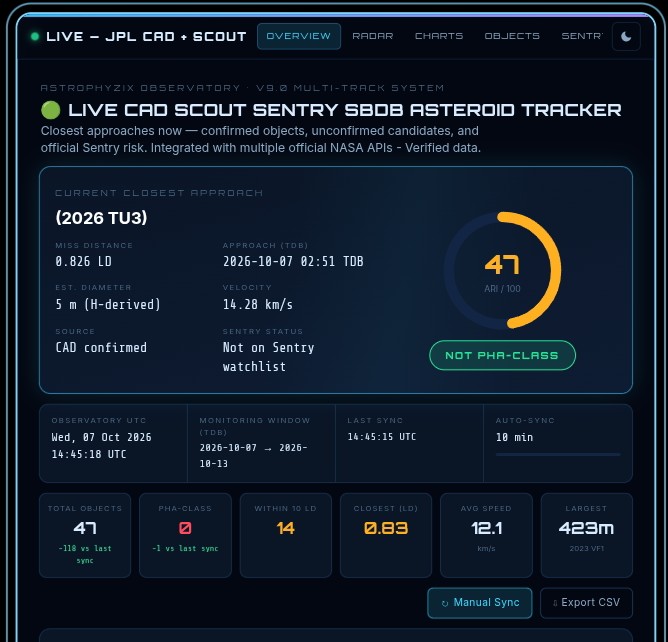
Astrophyzix live asteroid tracker screenshot for asteroid 2026 TU3, linked to the live tracker

Single-object report for asteroid 2026 TU3, compiled from JPL Close Approach Data as listed in the Astrophyzix tracker, with size and risk fields derived by the tracker. This bulletin is a catalogue report, not a live CNEOS CAD/Scout stream. Live Multi-watch CAD/Scout/Sentry tracker.

On October 7, 2026 (UTC), JPL data resolve a close approach by 2026 TU3, an Apollo-class near-Earth asteroid roughly 5 m across. It passed Earth at about 02:51 TDB (≈ 02:50 UTC) on 7 October 2026, at approximately 0.826 lunar distances (317,507 km), inside the Moon’s distance, with a relative velocity near 14.3 km/s. It is the closest of the 47 objects in the tracker’s 7–13 October window. No listed approach is on an impacting trajectory.

Closest catalogued approach to Earth
2026 TU3
0.826 LD
317,507 km · 0.002122 au · v_rel 14.28 km/s
EARTH SURFACE19.5 LD (FILTER EDGE)
Encounter (TDB)
2026-Oct-07 02:51 ± 00:02
Est. diameter
0.005 km (H-derived)
Diameter range
0.004 – 0.008 km
Earth radii
50 RE

Close Approaches (JPL CAD)

BodyEpoch (TDB)Time ±Nominal (au)Min (au)Max (au)v_rel (km/s)
Earth2026-Oct-07 02:5100:020.002120.002110.0021414.28

Source: JPL Close Approach Data (confirmed), as listed in the Astrophyzix tracker. 1 au = 149,597,870.7 km.

Orbital Dossier

2026 TU3

Heliocentric orbit as shown in the Astrophyzix tracker (rounded values). Dynamical class: APO (near-Earth asteroid orbits which cross the Earth’s orbit, similar to that of 1862 Apollo).

Semi-major axis a
1.62 au
Eccentricity e
0.539
Inclination i
3.5 deg
Orbital period
753 d · ≈ 2.06 yr
Perihelion q
0.747 au
Aphelion Q
2.49 au
Earth MOID
0.0016 au
Observations used
14

JPL Small-Body Database record: ssd.jpl.nasa.gov/tools/sbdb_lookup.html#/?sstr=2026 TU3

Encounter & Physical Parameters

Relative velocity
14.28 km/s
Velocity at infinity
14.20 km/s
Miss-distance range
0.00211 – 0.00214 au
Encounter time uncertainty
± 00:02
Absolute magnitude H
29.38
Diameter basis
H-derived
PHA class
No (derived)
Sentry status
Not on watchlist
Astrophyzix analysis · same clock as the feed

2026 TU3 is an Apollo-class near-Earth asteroid roughly 5 m across (H 29.4; 3.5–7.9 m from the H-derived range). JPL lists its closest Earth pass at 0.826 LD at about 02:51 TDB on 7 October 2026, at 14.28 km/s, inside the Moon’s distance. It is the closest of the 47 objects in the tracker’s window (14 inside 10 LD, none PHA-class). It is not a PHA: H 29.4 is far fainter than the H 22 limit for that class, even though its Earth MOID is only 0.0016 au. The listed distance range (0.00211–0.00214 au) is narrow and the time uncertainty only ±2 min, so the pass is tightly constrained. Even its closest listed distance is about 49.5 Earth radii from Earth’s centre, so no listed approach is on an impacting trajectory.

ARI (risk index)
47 SAFE
Earth miss distance
0.826 LD
Relative velocity
14.28 km/s
Est. diameter
4.7 m
Absolute magnitude
29.38
Earth MOID
0.0016 au
Orbit class
Apollo (APO)
Observations used
14
Data Provenance - Click to View

Report

Layout
Astrophyzix-NEO-Daily/2.2.0 (single-object report)
Object
2026 TU3
Generated (UTC)
Report date

Analysis

Closest object
2026 TU3 at 0.826 LD
ARI
47 (SAFE)
PHA class
No (below PHA-class threshold, derived)
Sentry status
Not on Sentry watchlist
Observations used
14

Source 1 – JPL Close Approach Data

Listing
Earth, 2026-10-07 02:51 TDB, source CAD (confirmed), as shown in the Astrophyzix tracker
Retrieved

Source 2 – Astrophyzix tracker record

Record
Orbit & Physical Data panel (rounded values); derived fields (size, PHA class, ARI)
Monitoring window (TDB)
2026-10-07 to 2026-10-13, 47 objects listed
Retrieved

Constants

Astronomical unit
149,597,870.7 km (IAU 2012 Resolution B2)
Lunar distance
384,400 km (JPL/IAU nominal mean)
Earth mean radius
6,371 km (IUGG)
TT − UTC
69.184 s (37 leap seconds + 32.184 s), valid 2026

Methods

Time scale
Close-approach epochs are TDB; UTC ≈ TDB − 69.184 s
Diameter self-test
D[km] = 1329 / sqrt(pv) × 10(−H/5), pv 0.25–0.05 (Bowell)
Trajectory integration
None (catalogue report)

Primary references: JPL Small-Body Database (ssd.jpl.nasa.gov), NASA CNEOS (cneos.jpl.nasa.gov). Object hazard status should be verified against the CNEOS Sentry table. For live CNEOS Scout and JPL Close Approach Data use the Dual-watch PHA and NEO Tracking System.

The Higgs Boson: The Particle That Gives Mass to the Universe - Explained

Written By: Astrophyzix Science Communication 
Article type: Explainer, Peer-reviewed data, real science, Physics Explained

Higgsboson

Introduction 

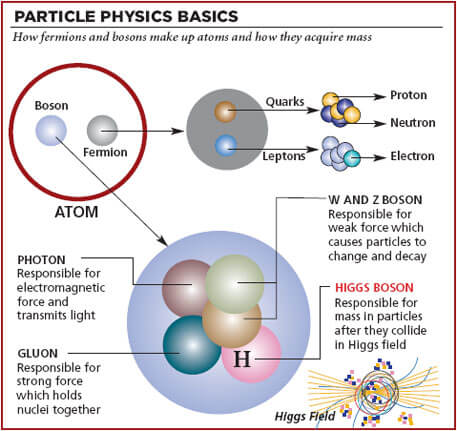
The Higgs boson is one of the most important discoveries in modern physics and represents the experimental confirmation of a mechanism proposed in the 1960s to explain how fundamental particles acquire mass. Its detection in 2012 at CERN's Large Hadron Collider marked the completion of the Standard Model of particle physics, a framework describing the fundamental particles and forces that govern the universe.

What the James Webb Space Telescope Is Revealing About the Early Universe

Written by: Astrophyzix Science News
Published: 31 January 2026

Jwst


Introduction

The James Webb Space Telescope (JWST) has delivered the most detailed observations of the early universe ever achieved. Some online videos have framed these discoveries as objects that “shouldn’t exist,” implying a crisis for modern cosmology. In reality, JWST data is refining existing models of galaxy formation, not overturning them.