

Astrophyzix PHA NEO Close Approach Report and Profile: 837253 (2013 FW13)
What is a Potentially Hazardous Asteroid?
A Potentially Hazardous Asteroid (PHA) is a near-Earth object with an absolute magnitude of 22.0 or brighter (typically larger than ~140 metres) and a minimum orbit intersection distance (MOID) of 0.05 AU or less. This classification does not indicate an impact threat, but identifies objects that require precise orbital monitoring.
Close Approach Event — 27 March 2026
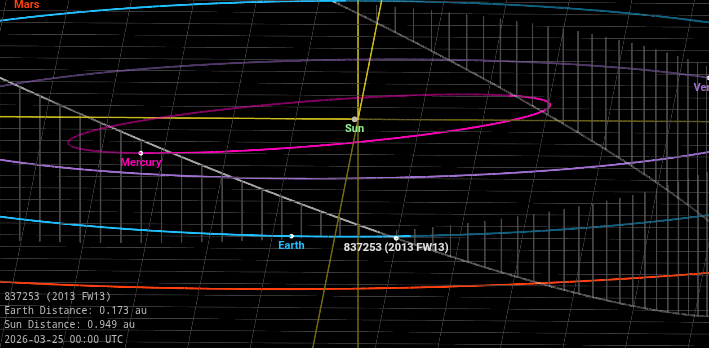
Asteroid 837253 (2013 FW13) undergoes a monitored Earth flyby on 27 March 2026 at approximately 02:27 UTC. This event represents a routine, non-hazardous close approach within the broader Near-Earth Object tracking catalogue, with a miss distance that remains comfortably beyond the Earth–Moon system.
| Parameter | Value |
|---|---|
| Close Approach Date | 27 March 2026 |
| Time (UTC) | 02:27 |
| Nominal Distance | 0.17170 au |
| Distance (km) | ~25,685,800 km |
| Distance (Lunar Distances) | ~66.8 LD |
| Relative Velocity | ~19.8 km/s (~71,100 km/h) |
Dynamical Interpretation
At a nominal separation of 0.17170 astronomical units, this flyby occurs at approximately 66.8 times the average Earth–Moon distance, placing it far outside the regime typically considered a “close” encounter in planetary defence terms.
Despite its classification as a Potentially Hazardous Asteroid, this designation is based on long-term orbital geometry (MOID and size) rather than immediate encounter conditions. The March 2026 passage represents a distant orbital crossing alignment rather than a near-Earth interaction.
Context Within NEO Monitoring Framework
For comparison, objects typically flagged for heightened observational campaigns during close approaches pass within <10 lunar distances, and in some cases within 1–2 LD. In contrast, 2013 FW13 remains well beyond even the outer boundary of the Earth–Moon system during this event.
The significance of this flyby is therefore observational rather than hazardous. Events at this scale are routinely used to refine orbital solutions, validate dynamical models, and maintain continuity in long-arc tracking datasets.
Operational Risk Assessment
| Metric | Assessment |
|---|---|
| Impact Probability | 0 (no risk) |
| Approach Category | Distant flyby |
| Monitoring Priority | Routine (well-characterised object) |
In summary, the 27 March 2026 encounter of asteroid 837253 (2013 FW13) is a predictable, distant, and non-threatening flyby. Its value lies in continued orbital validation rather than any planetary defence concern.
- Asteroid 837253 (2013 FW13) is a Near-Earth Object (NEO) belonging to the Apollo group, characterised by an orbit that crosses Earth's path around the Sun. It is additionally classified as a Potentially Hazardous Asteroid (PHA) due to its Earth Minimum Orbit Intersection Distance (MOID) of 0.0128179 au and its estimated size regime based on absolute magnitude.
Classification and Discovery
| Parameter | Value |
|---|---|
| Object Name | 837253 (2013 FW13) |
| Classification | Apollo-class NEO, Potentially Hazardous Asteroid (PHA) |
| SPK-ID | 20837253 |
| Discovery Date | 2013-03-23 |
| Discovery Survey | Catalina Sky Survey (CSS) |
Osculating Orbital Elements (Epoch 2461000.5 TDB)
| Element | Value | Uncertainty (1σ) | Units |
|---|---|---|---|
| Eccentricity (e) | 0.3618282311466794 | 8.2976E-8 | — |
| Semi-major axis (a) | 1.121305058879581 | 6.0209E-9 | au |
| Perihelion distance (q) | 0.7155852328493593 | 9.6652E-8 | au |
| Inclination (i) | 23.41702788634004 | 4.7465E-6 | deg |
| Longitude of ascending node (Ω) | 175.7961165028227 | 2.8199E-6 | deg |
| Argument of perihelion (ω) | 272.1859186390927 | 9.4061E-6 | deg |
| Mean anomaly (M) | 303.4088824483878 | 4.4803E-6 | deg |
| Orbital period | 433.6946843 | 9.5636E-9 | days |
| Aphelion distance (Q) | 1.527024884909804 | 8.1995E-9 | au |
Orbital Characteristics and Earth Interaction
| Parameter | Value |
|---|---|
| Earth MOID | 0.0128179 au |
| Jupiter MOID | 3.81491 au |
| Tisserand Parameter (Jupiter) | 5.435 |
The low Earth MOID firmly places this object within the Potentially Hazardous category. However, it is critical to emphasise that classification as a PHA does not imply impact risk, but rather prioritisation for continued monitoring.
Physical Properties
| Parameter | Value | Units |
|---|---|---|
| Absolute Magnitude (H) | 21.67 | mag |
An absolute magnitude of 21.67 suggests an approximate diameter in the range of ~120–270 metres depending on assumed albedo.
- This places 837253 (2013 FW13) within the size regime capable of causing regional damage in the event of an Earth impact, reinforcing its classification as a PHA.
Observational Data and Orbit Quality
| Metric | Value |
|---|---|
| Observation Arc | 4199 days (11.50 years) |
| Total Observations | 153 |
| Radar Observations | Delay: 5, Doppler: 2 |
| Condition Code | 0 (well-constrained orbit) |
| RMS Residual | 0.32947 |
The orbit of this object is exceptionally well determined, with a condition code of 0 indicating minimal uncertainty in its trajectory. The inclusion of radar astrometry significantly improves orbital precision, particularly for future trajectory predictions.
Radar Astrometry Summary (2024 Campaign)
| Epoch (UTC) | Measurement | Uncertainty | Units |
|---|---|---|---|
| 2024-09-20 23:10 | 32462231.3 | 0.2 | µs |
| 2024-09-17 23:20 | 21804266.28 | 0.2 | µs |
| 2024-09-17 22:30 | 132271.866 | 0.1 | Hz |
| 2024-09-17 00:00 | 24441576.01 | 0.4 | µs |
Conclusion
Asteroid 837253 (2013 FW13) represents a well-characterised Apollo-class Near-Earth Asteroid with a precisely constrained orbit and robust observational history. While its classification as a Potentially Hazardous Asteroid reflects its orbital proximity to Earth, current data indicates no impact threat. Continued monitoring is standard protocol for objects in this category, particularly those with low MOID values and moderate size estimates.
Source: NASA JPL Small-Body Database