Astrophyzix Observatory
Evidence-First Publication

Astrophyzix.com is an independent digital observatory publication offering unpaywalled, evidence‑driven analysis and real‑time monitoring of PHAs and NEOs. Our tracking consoles and reporting systems use and provide access to official NASA CNEOS Scout, JPL CAD, NeoWs, JPL SBDB, Horizons and NOAA observational datasets, peer‑reviewed sources, and high‑precision numerical methods (IEEE‑754 Float64, RKN4). Designed for students, educators, researchers, and the public, every console is uniquely designed and engineered by the Astrophyzix Digital Observatory.

Showing posts with label close approach report. Show all posts

Saturday, 23 May 2026

Asteroid 2026KW Close Approach Report and Asteroid Profile — Latest Asteroid News & Monitoring by Astrophyzix Observatory

Scientific Close‑Approach & Orbital Report For Asteroid 2026KW — Live Orbital Tracking and Refinement Viewer Integrated With Official NASA API's

Asteroid 2026 KW — Post‑Discovery Orbital Analysis · JPL SBDB Solution JPL 3
✨ Data aligned with: JPL SBDB, CNEOS CAD, NASA Horizons 

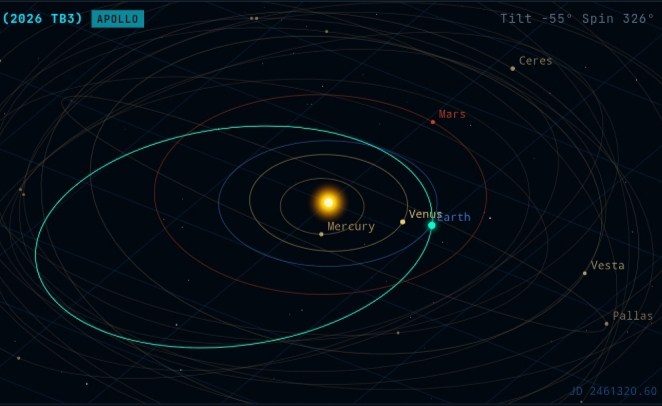
The Orbital Refinement image below and the refined status data within the image is computed by Astrophyzix Digital Observatory using its proprietary Live Asteroid Monitoring and Computational Orbital Refinement System using raw NASA API data. 

asteroid 2026KW orbital refinement by Astrophyzix
Apollo NEO Condition Code 7 2‑Day Data Arc NO IMPACT RISKSee JPL Solution

Key Takeaways of Asteroid 2026 KW (JPL Solution JPL 3)

  • NASA JPL Solution: Solution JPL 3 · Epoch 2461000.5 (2025‑Nov‑21.0 TDB) · SPK‑ID 54630404
  • Orbit class: Apollo NEO — a = 1.4127 au, e = 0.4172, i = 27.65°, orbital period 613.3 days.
  • Earth MOID: 0.0076064 au (~1.14 million km) — close in astronomical terms, but no impact geometry.
  • Size estimate: H = 25.669 → approximate diameter ~20–45 m (albedo‑dependent).
  • Orbit quality: Condition code 7, based on only 28 observations over a 2‑day arc — a very early, still‑refining orbit.
  • Close approaches: • Historical: 1937‑05‑25 Earth at 0.00728 au • Upcoming: 2026‑05‑25 Earth/Moon at 0.00830 au All are non‑impacting.
  • Risk context: Not a PHA — H > 22 and MOID above hazard threshold.
  • Ignore clickbait — Astrophyzix can confirm that no agency lists 2026 KW as a threat.

Scientific Consensus Snapshot of 2026 KW

ParameterStatus
Orbit classApollo NEO (Earth‑crossing)
Epoch2461000.5 TDB (2025‑Nov‑21)
Semi‑major axis (a)1.4127066 au
Eccentricity (e)0.4171896
Inclination (i)27.6521°
Earth MOID0.0076064 au (~1.14 million km)
Jupiter MOID3.46706 au
Absolute magnitude (H)25.669
Condition code7 (high uncertainty; 2‑day arc)
Observations28 (2026‑05‑20 → 2026‑05‑22)
Hazard levelNon‑hazardous; no impact solutions

Wednesday, 20 May 2026

Newly Discovered Asteroid 2026 JH2 Updated JPL Solution Official Data Report - Astrophyzix Digital Observatory Latest Asteroid News

NASA SBDB Data · Astrophyzix Scientific Close‑Approach & Orbital Report

Asteroid 2026 JH2 — Post‑Solution Orbital Analysis · JPL SBDB Solution JPL 9 – (Image: Astrophyzix Orbital Viewer)
📌 Cited/Featured by: MSN News, Gemini, CTRadio, BingCopilot News, Crowdbyte News

Apollo NEO Condition Code 4 10‑Day Data Arc NO IMPACT RISKSee JPL Solution
Responsive Image

Key Takeaways of Asteroid 2026 JH2 (Updated JPL Solution) (see previous solution report) 

  • NASA JPL Solution: Solution JPL 9 · Epoch 2461000.5 (2025‑Nov‑21.0 TDB) · SPK‑ID 54629847 · Producer: Otto Matic
  • Orbit class: Apollo Near‑Earth Object — semi‑major axis a = 2.4187 au, eccentricity e = 0.5822, inclination i ≈ 6.0°, orbital period 3.76 years (1373.9 days).
  • Earth MOID: 0.000734498 au (~110,000 km), meaning the nominal orbit passes well inside the Earth–Moon system, but no impact solution is reported in current JPL risk catalogues.
  • Size estimate: Absolute magnitude H = 26.352 → approximate diameter in the 10–25 m range (albedo‑dependent), consistent with a small NEO capable of airburst‑scale effects only in a hypothetical impact.
  • Orbit quality: Condition code 4, based on 166 observations over a 10‑day data arc (2026‑05‑10 to 2026‑05‑20), with a normalised RMS of 0.34634 — a moderately well‑constrained, still‑refining orbit.
  • Future close approach: JPL SBDB lists a notable Earth encounter on 2090‑05‑14 at a nominal distance of 0.00683 au (~1.0 million km) and relative velocity 9.10 km/s — a close but non‑impacting flyby.
  • Risk context: 2026 JH2 is not a Potentially Hazardous Asteroid (PHA) — its size (H > 22) is far below the PHA threshold, and no impact solutions are listed by NASA CNEOS or JPL SBDB.
  • Ignore clickbait, sensational videos and news reports claiming that “an asteroid is about to hit Earth” — that is not supported by the data. Follow the evidence, not the entertainment.

Saturday, 16 May 2026

Newly Discovered Asteroid 2026 JH2 Pre-approach Report and Asteroid Data Profile & Simulator - Latest Evidence-First PHA NEO Asteroid News By Astrophyzix Digital Observatory

NASA SBDB Horizons Data · Astrophyzix Scientific Close‑Approach Report 

Asteroid 2026 JH2 — Pre‑Close Approach Analysis · 16 May 2026 - (Image: Astrophyzix Orbital Viewer)  

📌 Cited by MSN News (May 2026) alongside NASA and ESA as a confirming source for 2026 JH2 safety assessment
✨ Referenced by: MSN News, Copilot News, AviationToday News, iAsk Student, Mojeek, Perplexity, Ecosia, AI insights, Crowdbyte News 

Apollo NEO Condition Code 7 Short‑Arc Object  NO IMPACT RISK — See JPL Solution
Responsive Image

Key Takeaways of Asteroid 2026 JH2

  • NASA JPL Solution: 2026-May-16 06:48:56 | SPK-ID 54629847 (see updated solution report) 
  • Closest pass: 18 May 2026 at 21:23 UTC — 0.24 LD (~91,500 km), well inside GEO but with No current risk of impact reported. 
  • Size estimate: H = 27.3 → ~9–20 m diameter (albedo‑dependent), below radar detectability.
  • Orbit class: Apollo NEO — highly eccentric (e = 0.582), period 3.76 years.
  • Uncertainty: Condition code 7 from a 5‑day arc; short‑warning discovery (8 days).
  • Risk context: Not a PHA; too small for hazard classification.
  • Ignore clickbait, sensational videos and news reports which claim that "there is a big rock about to hit us" — that's simply not true. Follow the evidence, not the entertainment. 

Scientific Consensus Snapshot of 2026 JH2

ParameterStatus
Closest approach2026‑05‑18 21:23 UTC at 0.000611 AU
Nominal miss distance0.238 LD / 91,500 km
Largest uncertaintyCondition code 7 (47 obs, 5‑day arc)
PHA statusNo (H > 22)
Hazard levelNon‑hazardous size; no impact geometry

Thursday, 14 May 2026

Asteroid Apophis 2029 Flyby Scientific Report - What NASA JPL Data Says In 2026 - Asteroid News Without the Hype - Updated 14/05/26

Asteroid (99942) Apophis — 2026 NASA-Verified Scientific Status News Report
NASA JPL SBDB Solution Date: 2024‑Jun‑25 10:48:08 | Epoch 2461000.5 (2025‑Nov‑21.0) 

Researched, Written and Published by: Astrophyzix Digital Observatory 

ℹ️ No Hype, No Speculation, No Sensationalism - Credible Asteroid News With Clarity - Strict Editorial Standards - Fully Verifiable Sources 

⭐ This report has been featured and cited as the primary source by MSN News in 15 individual news articles. 

🆙 This report is updated when new agency data is released or updated. 

Responsive image
Reading Time: ~12 min Primary Data: NASA CNEOS / JPL SBDB / JPL Horizons

Classification: Near-Earth Object (Potentially Hazardous Asteroid) Evidence-First Report

📌 Cited by MSN News | Bing Copilot | iAsk Student | Google AI | Google Overview

Apophis 2029 Flyby Key Takeaways

  • No impact risk: NASA’s current orbital solutions for Apophis show zero impact probability for at least the next 100 years.[1]
  • The 2029 flyby: Using official NASA data, Astrophyzix can confirm that on Friday 13 April 2029, Apophis will pass at about 32,000 km above Earth’s surface (about 20,000 miles), closer than geostationary satellites but on a safe, non-impact trajectory.[1],[2]
  • Impact Risk removed: Astrophyzix can conform that high-precision radar observations in 2020–2021 allowed NASA to rule out all impact scenarios for 2029, 2036, and beyond within the 100‑year assessment window.[1],[3]
  • New Science opportunity: The upcoming 2029 encounter is now treated as a science scenario, not a hazard scenario. Astrophyzix Digital Observatory is looking forward to observing and studying this asteroid in 2029 during the flyby event.
  • A Benchmark object: Apophis is used as a reference case in planetary defence simulations, mission design studies, and public‑communication exercises.[4]

Monday, 11 May 2026

Latest PHA / NEO Asteroid Close Approach Report - Official Data - Asteroid News by Astrophyzix Digital Observatory - 11 May 2026

No Near-Earth Objects Within 10 Lunar Distances Detected Over Next 7 Days - As of The Time Of Report. 

Published by: Astrophyzix Digital Observatory

Astrophyzix Digital Observatory PHA Monitoring Console

NEO and PHA Asteroid Report - 11th May 2026

At the time of writing, the NASA-integrated Astrophyzix Digital Observatory monitoring console reports that there are currently no known Near-Earth Objects (NEOs) or Potentially Hazardous Asteroids (PHAs) forecast to pass within 10 Lunar Distances (LD) of Earth during the next seven days. New objects are often discovered and the 7 Day Data is a dynamic observation window, so things inevitably do change — that's the beauty of science. 

You can access a real-time NEO/PHA report at any time, totally free on the Astrophyzix Today's NEO/PHA Approaches page. It provides official, live, understandable and comprehensive object data, profiles and original Astrophyzix analysis of each close approach. So you're planetary defence news needs are always met, in real time. Every page load is a fresh, original report with data and analysis grounded on official data. 

Current observational data indicates that all tracked objects remain at safe distances from Earth, with no impact threat identified by NASA or any recognised planetary defence organisation.

Current PHA Monitoring Overview

The observatory console currently identifies four classified Potentially Hazardous Asteroids within the active monitoring window. Although these objects meet the technical criteria for PHA classification due to orbital geometry and estimated size, all four are forecast to remain at substantial and safe distances from Earth.

Potentially Hazardous Asteroid classification does not indicate an imminent collision threat. It is a scientific monitoring designation used for long-term orbital tracking and planetary defence analysis.

Saturday, 9 May 2026

Three Apollo Class Asteroids (NEO) Are Making a Close Approach To Earth Today and All Will Pass Without Drama - Astrophyzix Digital Observatory Latest Asteroid News

NEO Close Approach Report by Astrophyzix Digital Observatory


Introduction 


Earth’s near‑space environment is currently hosting a cluster of scientifically notable—but safely distant—close approaches from three Apollo‑class near‑Earth asteroids: 2004 XA45, 2018 EW1, and 2018 JN1. While none of these objects meet Potentially Hazardous Asteroid criteria, each encounter provides a valuable snapshot of NEO population behaviour across a wide range of sizes, velocities, and orbital histories. Their passages highlight the diversity of objects that routinely move through the inner Solar System: from sub‑30‑meter bodies comparable to the Chelyabinsk airburst to multi‑hundred‑meter asteroids large enough to represent regional‑scale impactors under different orbital circumstances.

Thursday, 7 May 2026

Asteroid (2001 MS3 / 2026 GF) — 2026 Scientific Close‑Approach Report and Asteroid Profile - Official NASA Data - Latest Potentially Hazardous Asteroid News by Astrophyzix Digital Observatory

Near Earth Asteroid (2001 MS3) — 2026 Scientific Close‑Approach Report and Asteroid Profile - Official NASA Data Sources


Responsive image
Apollo [NEO] SPKID: 50092326 JPL Solution 16 Epoch 2461000.5 (2025‑Nov‑21.0 TDB)

Condition Code 0

Asteroid 2001 MS3 Key Takeaways

  • Precisely determined Apollo NEO: (2001 MS3) is an Apollo‑class Near‑Earth Object with semi‑major axis a = 2.139 au and perihelion q ≈ 0.997 au, crossing Earth’s orbital region on a ~3.13‑year cycle.
  • Epoch‑anchored orbit: All osculating elements are referenced to Epoch 2461000.5 (2025‑Nov‑21.0 TDB) in the heliocentric IAU76/J2000 ecliptic frame (JPL Solution 16).
  • 2026 flyby is distant and safe: On 2026‑May‑13, 2001 MS3 passes Earth at a nominal distance of 0.05306 au (~7.94 million km), with minimum and maximum distances identical at the quoted precision.
  • Elite orbit quality: A 24.82‑year data arc (39 observations) with DE441 and SB441‑N16 yields a Condition Code 0 solution and normalized RMS 0.60351.
  • Small, non‑hazardous body: With absolute magnitude H = 24.0, the diameter is of order tens of metres; Earth MOID is 0.0243864 au, and no impact solutions are known.

Scientific consensus snapshot (preliminary)

Parameter Status
Orbit determination quality Excellent — Condition Code 0, long data arc, low RMS
Impact risk No known impact trajectories; not on active risk lists
2026 Earth encounter Distant, dynamically routine, fully non‑hazardous
Long‑term dynamics Moderate secular evolution; weak Jovian perturbations (Tjup = 3.514)
Planetary‑defence relevance Benchmark small Apollo NEO for MOID‑based classification and tracking

Object overview and physical characteristics

Parameter Value
Primary designation (2001 MS3)
Alternate designation 2026 GF
Classification Apollo‑class Near‑Earth Object (NEO)
Absolute magnitude (H) 24.0 (reference: MPO74093)
Estimated diameter (typical NEO albedo) ~40–60 m (order‑of‑magnitude)
Rotation period Not determined
Albedo / spectral type Unknown; no published taxonomy at this solution


Tuesday, 5 May 2026

PHA Asteroid 326290 Akhenaten (1998 HE3) Close Approach Report and Asteroid Profile by Astrophyzix Digital Observatory - Official NASA Sourced DATA

326290 Akhenaten (1998 HE3) — Potentially Hazardous Asteroid Profile and Close Approach Data Report - Verifiable PHA Asteroid News by Astrophyzix

Astrophyzix image

Author: Astrophyzix Digital Observatory — Evidence‑First Asteroid Report

326290 Akhenaten (1998 HE3) is a Potentially Hazardous Asteroid (PHA) belonging to the Aten-class of near‑Earth objects. Its orbit brings it extremely close to Earth’s orbital path, with a Minimum Orbit Intersection Distance (MOID) of just 0.00350906 au — approximately 525,000 km, slightly farther than the distance to the Moon. Despite this close geometry, current NASA/JPL orbital solutions show no impact risk for the foreseeable future.

Asteroid Overview

Asteroid 326290 Akhenaten was discovered on 21 April 1998 by R. A. Tucker at the Goodricke‑Pigott Observatory. It is named after the Egyptian pharaoh Akhenaten of the 18th Dynasty, known for attempting to shift Egypt toward monotheistic worship of the Aten — the visible surface of the Sun.

Akhenaten is classified as:

  • Aten asteroid — semi-major axis < 1 au
  • NEO — Near‑Earth Object
  • PHA — Potentially Hazardous Asteroid
  • SPK-ID: 20326290

The asteroid has been observed for over 33 years, giving it a Condition Code 0 — the highest possible confidence in its orbit.


Upcoming Close Approach of 326290 Akhenaten (1998 HE3)


Asteroid 326290 Akhenaten will make its next notable close approach to Earth on 2026‑May‑10. According to the latest JPL orbit solution (JPL 84), the asteroid will pass Earth at a nominal distance of 0.07355 au, which is approximately:

  • 11 million km
  • ~28.6 × the Earth–Moon distance

This encounter is classified as a safe, non‑hazardous flyby. The orbit is extremely well constrained, with a Condition Code of 0, meaning the uncertainty in the asteroid’s predicted position is effectively negligible.


Approach Velocity

During the 2026 flyby, Akhenaten will be traveling at a relative velocity of:

  • 10.81 km/s (relative to Earth)

This is typical for Aten‑class NEOs, which often have Earth‑crossing orbits and moderate encounter speeds.


Tuesday, 28 April 2026

Newly discovered NEO Asteroid 2026 HZ3 Close Approach Report and NEO Profile by Astrophyzix Digital Observatory

Asteroid (2026 HZ3) — 2026 NASA-Linked Preliminary Scientific Status Report
NASA JPL SBDB Solution 5 (2026-Apr-28 06:20:37)


Researched, Written and Published by: Astrophyzix Digital Observatory

Original, Timely, Verifiable Asteroid News and Planetary Defence Monitoring by Astrophyzix.com & Astrophyzix.org


📌 Cited by MSN News | Bing Copilot News Image
Reading Time: ~8 min Primary Data: NASA JPL SBDB / CNEOS

Classification: Apollo Near-Earth Object (NEO) SPK-ID: 54613601

Asteroid 2026 HZ3 Key Takeaways

  • Newly discovered NEO: (2026 HZ3) is a recently observed Apollo-class near-Earth asteroid with a short data-arc (4 days) and a relatively high orbital uncertainty (condition code 7).
  • Small object: With an absolute magnitude H ≈ 25.3, (2026 HZ3) is likely a small asteroid, on the order of a few tens of metres in diameter, depending on its surface reflectivity.
  • Close approach in 2026: A nominal close approach to Earth occurs on 1 May 2026 at a distance of about 0.010 au (around 1.5 million km), well outside any impact scenario under current solutions.
  • Earth MOID: The current Minimum Orbit Intersection Distance (MOID) with Earth is about 0.00497 au (~745,000 km), indicating close-approach potential but not an imminent threat.
  • Preliminary orbit: Because the orbit is based on only 38 observations over 4 days, all risk and trajectory assessments are considered preliminary and will be refined as more data are collected.

Scientific consensus snapshot (preliminary)

ParameterStatus (NASA JPL SBDB Solution 5 | 2026-Apr-28 06:20:37)
Impact risk (100-year context)No confirmed impact solution; orbit still under refinement (condition code 7).
Orbital uncertaintyModerate–high (short 4-day data-arc, condition code 7).
2026 close approachNominal miss distance ~0.010 au (~1.5 million km) — a safe flyby under current solutions.
Hazard classificationNEO (Apollo). Not formally classified as a Potentially Hazardous Asteroid (PHA) at this time.
Scientific priorityMonitoring and orbit refinement; representative of small NEOs that frequently pass near Earth.

Wednesday, 22 April 2026

Weekly Potentially Hazardous Asteroid and NEO Close Approach Report 22 April to 28 April Official NASA Planetary Defence Data

Astrophyzix Dynamic 7 Day NEO and PHA Close Approach Report and Forecast

Astrophyzix Weekly Near-Earth Object (NEO) & Potentially Hazardous Asteroid (PHA) Close Approach Report

Written by: Astrophyzix Digital Observatory
Astrophyzix Planetary Defence Systems NEO Monitoring Visual
Credit: Astrophyzix Planetary Defence Systems

Observatory Status & Data Integrity

Astrophyzix Planetary Defence reports are written using a fully dynamic, on-demand data retrieval pipeline linked directly to NASA's CNEOS NeoWs API infrastructure.

The monitoring interval is calculated at runtime and spans seven days forward from the exact timestamp of system access.

No caching layers, pre-processing, or static datasets are used. Every value presented is sourced from the most recent orbital solutions available within NASA systems at the time of query execution by the Astrophyzix Planetary Defence System.


Certain data is computed through the Astrophyzix Risk Index and presented alongside the raw data to give readers an easy to visualise scale of how notable an object is an a clear interpretation of the data.


UTC Timestamp Wed, 22 Apr 2026 20:10:55
Monitoring Window 2026-04-22 → 2026-04-28
Data Source NASA CNEOS NeoWs API (Live Stream)

Monitoring Overview

  • Total NEOs tracked: 87
  • Potentially Hazardous Asteroids: 8
  • Objects within 10 Lunar Distances: 6
  • Closest recorded approach: 2.956 LD
  • Mean relative velocity: 13.7 km/s
  • Largest object: 54071 (2000 GQ146) — 1418 m

Thursday, 16 April 2026

Potentially Hazardous Asteroid and Near-Earth Object (NEO) Close Approach Report & Asteroid Profile for Asteroid 2026 BK2

Astrophyzix Near-Earth Object (NEO) Close Approach Report & Asteroid Profile: (2026 BK2)

Written by: Astrophyzix Digital Observatory

📌 Cited by MSN News 📌 Referencd by Copilot News
Astrophyzix NEO Image
Image Credit: NASA JPL SBDB

Introduction


Asteroid (2026 BK2) is an Apollo-class near-Earth object (NEO) classified as a Potentially Hazardous Asteroid (PHA). Its orbit intersects Earth's orbital region, and its size exceeds the threshold used in hazard classification frameworks.


The close approach on 2026-Apr-22 12:36 (TDB) represents a relatively close but well-understood encounter. Despite its classification, no impact risk is identified based on current orbital solutions.


Potentially Hazardous Asteroid (PHA) news refers to verified reports of near-Earth asteroids that meet specific size and orbital proximity thresholds. Despite the classification, the vast majority of PHAs pose no impact threat during observed close approaches.

Key Takeaways


  • Close approach on 2026-Apr-22 12:36 (TDB).
  • Miss distance: 0.02569 AU (~10.0 LD / ~3.84 million km).
  • Relative velocity: 8.13 km/s.
  • Estimated diameter: ~160–350 meters (derived from H=21.05).
  • Condition code 0 (extremely well constrained orbit).
  • No impact threat identified.
  • ARI Score: 50/100 - Notable Approach 


Scientific Consensus Snapshot


The orbital solution for (2026 BK2) is based on 125 observations spanning 2096 days (2020-07-18 to 2026-04-14). The condition code of 0 indicates a highly reliable trajectory solution. The timing uncertainty for the 2026-Apr-22 12:36 (TDB) close approach is less than one minute, confirming extremely high positional certainty.


Saturday, 11 April 2026

Potentially Hazardous Asteroid Close Approach Report For Asteroid 192559 (1998 VO) April 2026 Official NASA Data

Astrophyzix Near-Earth Object (NEO) Close Approach Report & Asteroid Profile: 192559 (1998 VO)

Written by: Astrophyzix Digital Observatory

📌 Cited by iAsk Student

Astrophyzix Image

Image Credit: NASA JPL SBDB

Introduction


Asteroid 192559 (1998 VO) is a well-characterised Apollo-class near-Earth object (NEO) classified as a Potentially Hazardous Asteroid (PHA). With a data arc spanning over two decades and hundreds of observations, its orbit is extremely well constrained, allowing for precise modelling of its trajectory across both past and future epochs.

The close approach on 2026-Apr-14 10:04 (TDB) represents a routine, distant flyby with no impact risk. Its PHA classification reflects orbital geometry (Earth-crossing potential) and size thresholds, not an immediate threat.


Potentially Hazardous Asteroid (PHA) news refers to verified reports of near-Earth asteroids that meet specific size and orbital proximity thresholds. Despite the classification, the vast majority of PHAs pose no impact threat during observed close approaches.

Key Takeaways


  • Close approach on 2026-Apr-14 10:04 (TDB).
  • Miss distance: 0.32726 AU (~127.3 LD / ~48.9 million km).
  • Relative velocity: 17.60 km/s.
  • Estimated diameter: ~300–700 meters.
  • Condition code 0 (orbit extremely well constrained).
  • No impact threat identified.
  • Astrophyzix Risk Index® Notibility score: 48 (Elevated).


Scientific Consensus Snapshot


The orbit of 192559 (1998 VO) is derived from 575 observations spanning 1998-11-10 to 2018-11-13, producing a condition code of 0—the highest confidence level in orbit determination. The timing uncertainty for the 2026-Apr-14 10:04 (TDB) encounter is less than one minute, indicating negligible positional uncertainty.


Potentially Hazardous Asteroid 2026GU Close Approach Report and Asteroid Profile Latest Near Earth Object News

Near-Earth Object (NEO) Close Approach Report & Asteroid Profile Potentially Hazardous Asteroid 2026 GU

Written by: Astrophyzix Digital Observatory

📌 Cited by iAsk Student

Astrophyzix Image
Image Credit: NASA JPL SBDB

Introduction


A Potentially Hazardous Asteroid (PHA)  is a near-Earth object with an absolute magnitude of 22.0 or brighter (typically larger than ~140 metres) and a minimum orbit intersection distance (MOID) of 0.05 AU or less. This classification does not indicate an impact threat, but identifies objects that require precise orbital monitoring.

Asteroid (2026 GU) is an Amor-class near-Earth object (NEO) classified as a Potentially Hazardous Asteroid (PHA) based on its size and orbital proximity to Earth. The object was observed over a short 5-day arc in this week and its orbit is currently defined by the initial JPL solution (Solution 1 on 09 April 2026.) 


Despite its PHA classification, current orbital solutions indicate a relatively distant Earth flyby on 14 April 2026. Continued observations are required to refine its trajectory due to the limited observational baseline and elevated uncertainty level.

Key Takeaways


  • Close approach on 2026-Apr-14 at ~0.09884 AU.
  • Equivalent to approximately 38.4 lunar distances (~14.8 million km).
  • Classified as a Potentially Hazardous Asteroid (PHA).
  • Estimated diameter: ~150–300 meters (based on H magnitude).
  • Orbit currently constrained using 90 observations over 5 days.
  • Condition code 8 indicates high orbital uncertainty.
  • No impact threat identified.


Scientific Consensus Snapshot


The current orbital solution for (2026 GU) is based on a short observational arc and remains subject to refinement. While the object's classification as a PHA reflects its long-term orbital geometry, the 14 April 2026 encounter is well outside any hazardous threshold. Future observations will reduce uncertainties and improve long-term trajectory modelling.


Saturday, 28 March 2026

Newly Discovered NEO 2026 FG6: Orbital Refinement Update Astrophyzix Digital Observatory

Astrophyzix Follow-Up Report: 2026 FG6 — Orbital Refinement and Close Approach Confirmation

Updated URL Due to Permalink Error


📌 Cited by NewsBreak
Astrophyzix image


NEO 2026 FG6 Update

Following its initial identification on March 25, 2026, asteroid 2026 FG6 has undergone rapid orbital refinement based on additional observations extending the data arc to 3 days. The updated solution (JPL Solution 3, dated March 28, 2026) incorporates 29 observations, resulting in reduced uncertainties across all orbital elements while maintaining a condition code of 7. This reflects a typical early-stage solution for newly discovered small Near-Earth Objects (NEOs), where continued tracking is required to achieve long-term orbital certainty.


Updated Orbital Solution (JPL 3)

Element Previous (JPL 2) Updated (JPL 3) Change
Eccentricity (e) 0.228165 0.228035 Refined (-0.00013)
Semi-major axis (a) 1.067528 au 1.067428 au Refined
Inclination (i) 13.8936° 13.8866° Minor adjustment
Orbital Period 402.872 days 402.816 days Refined
Earth MOID 0.000450813 au 0.000451072 au Stable


Thursday, 26 March 2026

NEO PHA Profile: Asteroid 413989 (2007 EL88) Astrophyzix Digital Observatory NEO Close Approach Reports

Astrophyzix Object Profile: 413989 (2007 EL88)

Written by: Astrophyzix Digital Observatory for Planetary Defence 
Astrophyzix visual
Image Credit: NASA JPL Small Body Database 


Introduction

Asteroid 413989 (2007 EL88) is an Apollo-class Near-Earth Object (NEO) with a dynamically evolved, moderately high-eccentricity orbit that intersects the orbital path of Earth. It is classified as a Potentially Hazardous Asteroid (PHA) based on its size and orbital proximity, though current orbital solutions confirm no impact risk.

  • Current long‑term solutions show no impact scenarios within the next 100 years.


Classification and Discovery

Parameter Value
Object Name 413989 (2007 EL88)
Classification Apollo-class NEO, Potentially Hazardous Asteroid (PHA)
SPK-ID 20413989
Discovery Date 2007-03-14
Discovery Survey Siding Spring Survey


Wednesday, 25 March 2026

Potentially Hazardous Asteroid 837253 (2013 FW13) Close Approach 27 March 2026 - Astrophyzix Digital Observatory

Astrophyzix PHA NEO Close Approach Report and Profile: 837253 (2013 FW13)

Written by: Astrophyzix Digital Observatory for Planetary Defence and NEO Reporting

Astrophyzix visual
Image Credit: NASA JPL Small Body Database 

What is a Potentially Hazardous Asteroid? 


A Potentially Hazardous Asteroid (PHA)  is a near-Earth object with an absolute magnitude of 22.0 or brighter (typically larger than ~140 metres) and a minimum orbit intersection distance (MOID) of 0.05 AU or less. This classification does not indicate an impact threat, but identifies objects that require precise orbital monitoring.


Close Approach Event — 27 March 2026


Asteroid 837253 (2013 FW13) undergoes a monitored Earth flyby on 27 March 2026 at approximately 02:27 UTC. This event represents a routine, non-hazardous close approach within the broader Near-Earth Object tracking catalogue, with a miss distance that remains comfortably beyond the Earth–Moon system.


Parameter Value
Close Approach Date 27 March 2026
Time (UTC) 02:27
Nominal Distance 0.17170 au
Distance (km) ~25,685,800 km
Distance (Lunar Distances) ~66.8 LD
Relative Velocity ~19.8 km/s (~71,100 km/h)


Dynamical Interpretation


At a nominal separation of 0.17170 astronomical units, this flyby occurs at approximately 66.8 times the average Earth–Moon distance, placing it far outside the regime typically considered a “close” encounter in planetary defence terms.


Despite its classification as a Potentially Hazardous Asteroid, this designation is based on long-term orbital geometry (MOID and size) rather than immediate encounter conditions. The March 2026 passage represents a distant orbital crossing alignment rather than a near-Earth interaction.


Context Within NEO Monitoring Framework


For comparison, objects typically flagged for heightened observational campaigns during close approaches pass within <10 lunar distances, and in some cases within 1–2 LD. In contrast, 2013 FW13 remains well beyond even the outer boundary of the Earth–Moon system during this event.

The significance of this flyby is therefore observational rather than hazardous. Events at this scale are routinely used to refine orbital solutions, validate dynamical models, and maintain continuity in long-arc tracking datasets.


Independent Direct Source Verification
Uncompromised Crossref DOI Resolver · Live and direct meta data fetch
Awaiting DOI input