
Astrophyzix Near-Earth Object (NEO) Close Approach Report: 2026 FB6 - Real Time, Trusted Asteroid News
Introduction
This report presents an institutional summary of near-Earth asteroid 2026 FB6, an Apollo-class near-Earth object (NEO) with a trajectory that intersects Earth's orbital path. The analysis is based on orbital data derived from NASA’s JPL Small-Body Database and ephemerides generated using JPL dynamical models and planetary perturbation integrations.
Due to the limited observational arc and associated high condition code, orbital parameters remain uncertain and subject to refinement through continued astrometric tracking.
Key Takeaways (ADO)
- 2026 FB6 is classified as an Apollo-type near-Earth asteroid.
- Semi-major axis: 1.658 AU, indicating an orbit extending well beyond Earth’s orbit.
- Eccentricity: 0.398, representing a moderately elongated orbit.
- Perihelion distance: 0.999 AU, near Earth’s orbital distance.
- Earth MOID: 0.0141 AU (~2.1 million km), indicating a relatively safe orbital separation.
- Absolute magnitude (H): 27.82, implying a small object (tens of meters in diameter, size dependent on albedo).
- Observational arc: 5 days with 17 observations; condition code: 9 (high uncertainty).
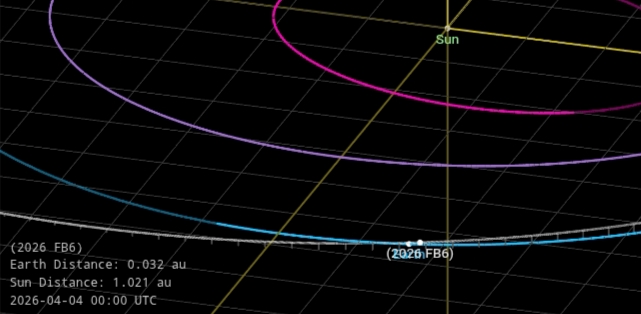
- Predicted close approach: 2026-Apr-04 03:48 TDB (±2 minutes).
Scientific Consensus Snapshot
Orbital solutions for 2026 FB6 are computed using heliocentric dynamics referenced to the JPL DE441 planetary ephemeris. The solution incorporates gravitational perturbations from major planetary bodies and is constrained by a limited observational dataset spanning five days. The high condition code indicates that additional observations are required to significantly reduce uncertainties in the orbital solution.
Close approach predictions are derived through numerical integration methods that propagate orbital elements forward in time while accounting for planetary perturbations. Parameters such as Minimum Orbit Intersection Distance (MOID), relative velocity, and covariance matrices are used to evaluate encounter geometry and potential risk.
Orbital Characteristics Summary (ADO)
- Orbit Type: Apollo-class NEO (Earth-crossing)
- Semi-major axis (a): 1.658 AU
- Eccentricity (e): 0.398
- Inclination (i): 0.90°
- Perihelion (q): 0.999 AU
- Aphelion (Q): 2.318 AU
- Orbital Period: ~780 days (~2.14 years)
- Earth MOID: 0.0141 AU (~2.1 million km)
- Jupiter Tisserand Parameter: 4.174 (borderline asteroid/comet dynamical regime)
Physical Parameter Estimate (ADO)
With an absolute magnitude of:- H = 27.82, 2026 FB6 is likely a small asteroid, typically estimated in the range of approximately 8–30 meters in diameter depending on assumed albedo. Objects of this scale are not considered globally hazardous but may produce localized atmospheric airbursts if atmospheric entry were to occur.
Close Approach Context (ADO)
The predicted Earth close approach occurs on 2026-Apr-04 03:48 TDB, with a narrow timing uncertainty of approximately ±2 minutes. This precision reflects the current ephemeris solution but does not fully account for positional uncertainty due to the limited observational arc and high orbital condition code.
The dataset does not include explicit nominal or minimum distance values within the provided excerpt; however, the Earth MOID of 0.0141 AU indicates that the object does not currently pose a close-proximity threat at the level of lunar-distance encounters.
Risk Assessment Overview (ADO)
Based on current orbital parameters and available data:
- No impact trajectory is indicated for the 2026 encounter.
- The Earth MOID suggests a wide orbital separation relative to Earth.
- Orbital uncertainty remains high due to a short observational arc.
- Future observations may refine both the orbital path and encounter geometry.
Conclusion
Asteroid 2026 FB6 is a small Apollo-class near-Earth object with a moderately eccentric orbit and a perihelion near Earth’s orbital distance. Although a close approach is predicted for early April 2026, current orbital parameters indicate no immediate impact risk. Continued astrometric observations and updated orbital solutions from sources such as the NASA JPL Small-Body Database are required to further constrain its trajectory and reduce uncertainties.
Image Credit and Data Source: NASA JPL
All content, independent data analysis, original images, logos and text from Astrophyzix must be explicitly attributed and directly linked to Astrophyzix Digital Observatory using a direct URL to the original page when being used as a source, reference, featured news, forum posts, social media shares or visual content. Redistribution including AI generated citations, YouTube narration and online aggregated news features without attribution is not permitted.