
Astrophyzix Near-Earth Object (NEO) (PHA) Close Approach Report and Object Profile: Asteroid 2006 GC1
Introduction
A Potentially Hazardous Asteroid (PHA) is a near-Earth object with an absolute magnitude of 22.0 or brighter (typically larger than ~140 metres) and a minimum orbit intersection distance (MOID) of 0.05 AU or less. This classification does not indicate an impact threat, but identifies objects that require precise orbital monitoring.
Asteroid (2006 GC1) is a well-characterised Apollo-class near-Earth object (NEO) and is formally classified as a Potentially Hazardous Asteroid (PHA). This designation is based on its size and its Minimum Orbit Intersection Distance (MOID) with Earth. Unlike recently discovered objects with short observational arcs, (2006 GC1) benefits from a long-term observational dataset spanning over 15 years, resulting in a highly constrained and reliable orbital solution.
This report provides a detailed orbital, physical, and close-approach analysis using data derived from the NASA JPL Small-Body Database and associated dynamical models. All values presented reflect current best-fit solutions and should be interpreted within the context of continuous observational refinement.
Key Takeaways
- (2006 GC1) is classified as both an Apollo NEO and a Potentially Hazardous Asteroid (PHA).
- Extremely well-constrained orbit (condition code 0) based on 92 observations over 15.3 years.
- Highly eccentric orbit (e = 0.817) with a perihelion deep inside Mercury’s orbital region.
- Estimated size range: ~200–400 meters (based on H = 20.5).
- Earth MOID: 0.00914 AU (~1.37 million km), within the PHA threshold.
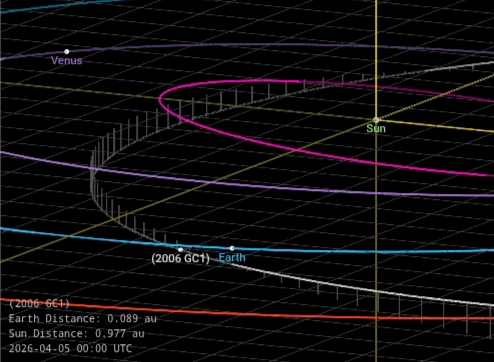
- Next notable Earth close approach: 2026-Apr-05 at 0.08876 AU (~13.3 million km).
- Relative velocity during Earth encounter: ~30.66 km/s.
- No impact risk indicated for any known approach in current orbital solutions.
Scientific Consensus Snapshot
The orbital solution for (2006 GC1) is derived using high-precision numerical integrations incorporating the DE441 planetary ephemeris and perturbations from major solar system bodies. With a condition code of 0 and a multi-decade observation arc, the orbit is considered highly reliable. Uncertainty margins in orbital elements are extremely low, allowing for precise long-term trajectory propagation and close-approach prediction.
Orbital Profile of 2006 GC1
- Orbit Type: Apollo-class (Earth-crossing)
- Semi-major axis (a): 1.707 AU
- Eccentricity (e): 0.817 (highly elongated orbit)
- Inclination (i): 5.97°
- Perihelion (q): 0.312 AU (inside Mercury’s orbit)
- Aphelion (Q): 3.101 AU (extending into the inner asteroid belt)
- Orbital Period: ~814 days (~2.23 years)
- Earth MOID: 0.00914 AU (~1.37 million km)
- Tisserand Parameter (Jupiter): 3.705
Physical Characteristics of 2006 GC1
The absolute magnitude (H = 20.5) places (2006 GC1) in the mid-size asteroid category for NEOs. Based on standard albedo assumptions, the object is estimated to be approximately 200–400 meters in diameter. Objects of this scale are capable of causing regional to continental-scale damage in the unlikely event of an Earth impact, which is why it meets the criteria for classification as a Potentially Hazardous Asteroid.
Close Approach Analysis of 2006 GC1
| Date (TDB) | Body | Distance (AU) | Distance (LD) | Velocity (km/s) |
|---|---|---|---|---|
| 2021-Jul-26 | Earth | 0.12499 | ~48.6 LD | 30.27 |
| 2026-Apr-05 | Earth | 0.08876 | ~34.5 LD | 30.66 |
| 2035-Mar-16 | Earth | Data not provided | Data not provided | Data not provided |
Dynamical Behaviour of 2006 GC1
The highly eccentric orbit of (2006 GC1) results in extreme variations in heliocentric distance, bringing the asteroid from well within Mercury’s orbit out to the inner asteroid belt. This type of orbit is characteristic of dynamically evolved Apollo objects, often influenced by long-term gravitational perturbations and resonances with Jupiter.
The object’s relatively low inclination (~6°) means it frequently intersects the ecliptic plane, increasing the frequency of planetary encounters over long timescales. Despite this, current orbital solutions show no resonant behaviour that would significantly increase short-term impact probability.
Risk Assessment of 2006 GC1
Although (2006 GC1) meets the formal criteria for a Potentially Hazardous Asteroid, this classification does not indicate an imminent threat. Instead, it reflects:
- A size large enough to cause significant damage in an impact scenario.
- An orbit that can approach Earth within 0.05 AU under certain configurations.
- A requirement for continued long-term monitoring.
Current orbital solutions, supported by a condition code of 0, indicate no impact risk for all known future encounters, including the April 2026 approach.
Conclusion
Asteroid (2006 GC1) represents a well-characterised example of a dynamically evolved Apollo-class NEO with a highly eccentric orbit and a long observational history. Its classification as a Potentially Hazardous Asteroid is based on geometric criteria rather than any identified impact trajectory.
The upcoming Earth approach on April 5, 2026, at approximately 0.08876 AU will occur at a safe distance, with no impact risk. Continued monitoring by planetary defence networks ensures that any future orbital evolution will be detected and analysed with high precision.
2026 Relevance: It illustrates the orbital configuration of near-Earth objects during the April 2026 close-approach window.
Primary Sources
NASA JPL Small-Body Database (SBDB)
JPL Horizons Ephemeris System
CNEOS Close Approach Data
Data processed and analysed via the Astrophyzix Digital Observatory using official NASA CNEOS and JPL SBDB datasets.
All Sources
- Astrophyzix CNEO Tracking Observatory
- NASA JPL Small-Body Database (SBDB) – https://ssd.jpl.nasa.gov/tools/sbdb_lookup.html#/?sstr=2006%20GC1
- JPL Horizons Ephemeris System – https://ssd.jpl.nasa.gov/horizons/app.html#/?spk=3329371
- NASA CNEOS Close Approach Data – https://cneos.jpl.nasa.gov/ca/
- NASA Planetary Defense Coordination Office (PDCO) – https://www.nasa.gov/planetarydefense/
- JPL DE441 Planetary Ephemeris Documentation – https://ssd.jpl.nasa.gov/planets/eph_export.html