
Astrophyzix Digital Observatory's
Evidence-First Asteroid Reporting

Astrophyzix.com is the publication of the Astrophyzix Digital Observatory, offering unpaywalled, evidence‑driven analysis and real‑time monitoring of PHAs and NEOs. Our tracking consoles and reporting systems use and provide access to official NASA CNEOS Scout, JPL CAD, NeoWs, JPL SBDB, Horizons and NOAA observational datasets, peer‑reviewed sources, and high‑precision numerical methods (IEEE‑754 Float64, RKN4). Designed for students, educators, researchers, and the public, every console is uniquely designed and engineered by the Astrophyzix Digital Observatory. Our research notes and papers can be found at Astrophyzix.Academia.Edu

Showing posts with label Factual Report. Show all posts

Saturday, 25 April 2026

The Buga Sphere Has NOT Been Confirmed to be 12,560 Years Old Using Carbon Dating - Here is What The Science Really Says

The “Buga Sphere” Dating Claim Examined: A Forensic Analysis of the Evidence

📌 Cited by:  - Enigmaticideas.com
Buga Sphere analysis image

Written by: Astrophyzix Digital Observatory


Key Takeaways

  • There is no verifiable scientific evidence that the “Buga Sphere” is 12,560 years old
  • The reported radiocarbon dating applies to organic residue, not the object itself
  • No institutional confirmation from the University of Georgia can be verified
  • No peer-reviewed studies, laboratory reports, or reproducible analyses exist
  • All claims of advanced technology remain unsupported by material evidence

Introduction

In early 2026, renewed attention was directed toward an object commonly referred to online as the “Buga Sphere.” Claims circulated suggesting that the object had been scientifically dated to approximately 12,560 years before present, with references made to testing allegedly conducted by the University of Georgia using Accelerator Mass Spectrometry (AMS).


These claims have been widely shared across non-scientific platforms, often accompanied by interpretations involving advanced technology, lost civilisations, or anomalous origins. This article examines those assertions using established scientific methodology, with particular focus on dating techniques, evidential standards, and verification requirements.
Saturday, 4 April 2026

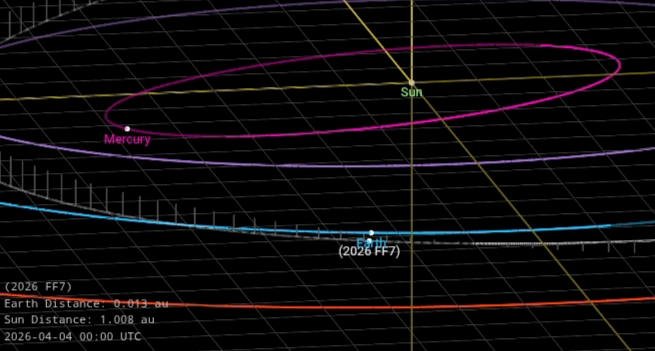
Near Earth Object (NEO) Close Approach Report Asteroid 2026 FF7 Official Data - Real Time NEO News

Astrophyzix Near-Earth Object (NEO) Close Approach Report: Asteroid 2026 FF7 - Credible Planetary Defence News


📌 Referenced by iAsk Student

NEO close approach visual

Introduction

This report summarizes the orbital characteristics and Earth close-approach context for the near-Earth asteroid 2026 FF7, an Apollo-class object classified as a near-Earth object (NEO). The analysis is derived from publicly available data provided by the NASA JPL Small-Body Database and associated ephemerides generated through NASA and JPL orbital computation systems operated by the Jet Propulsion Laboratory.


The dataset reflects a short observational arc and therefore carries significant orbital uncertainty. As such, all derived predictions should be interpreted within the context of ongoing refinement through additional astrometric observations.

Key Takeaways (ADO) 

  • 2026 FF7 is classified as an Apollo-type near-Earth asteroid with an Earth-crossing orbit.
  • Estimated semi-major axis: 1.236 AU, indicating an orbit extending beyond Earth's orbital path.
  • Orbital eccentricity of ~0.418 suggests a moderately elongated trajectory.
  • Perihelion distance: 0.720 AU; aphelion distance: 1.753 AU.
  • Earth MOID: 0.00494 AU (~739,000 km), indicating a potentially close orbital intersection.
  • Absolute magnitude (H): 27.47, implying a small object on the order of tens of meters in diameter (size estimate dependent on albedo assumptions).
  • Observational arc is limited to 2 days with 14 observations, resulting in a high condition code (9), indicating substantial orbital uncertainty.


Scientific Consensus Snapshot (ADO) 


Orbital parameters for 2026 FF7 are computed using heliocentric reference frames and the JPL DE441 planetary ephemeris. The solution is based on a limited observational dataset and therefore exhibits elevated uncertainty. Continuous follow-up observations are required to reduce uncertainties in orbital elements such as semi-major axis, eccentricity, and mean anomaly.


Monday, 9 March 2026

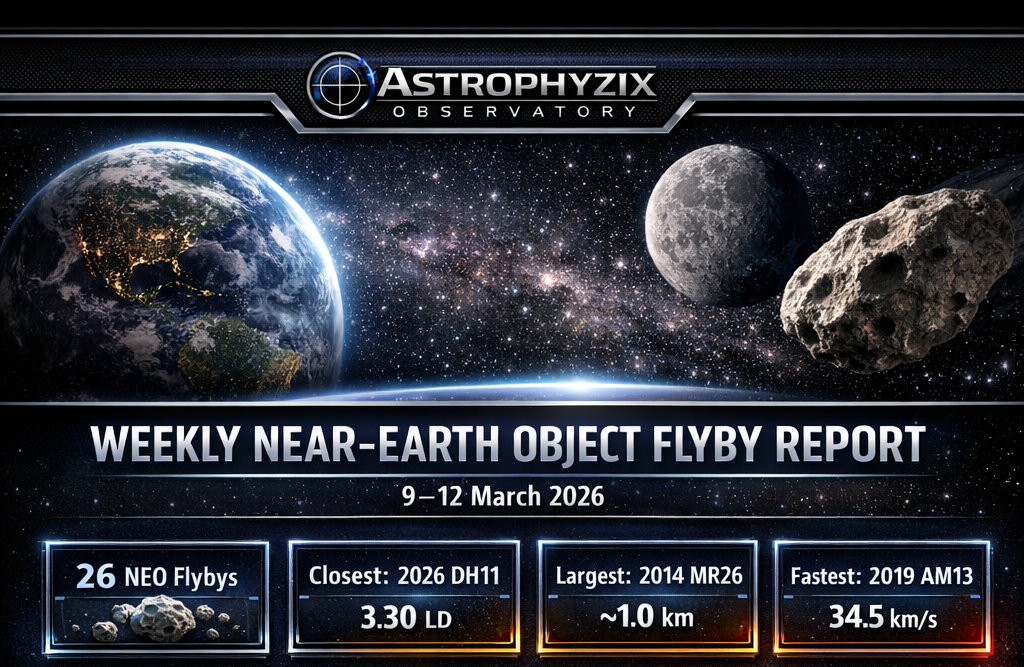
Weekly Near-Earth Object Flyby Report — 9–12 March 2026

Weekly Near-Earth Object Flyby Report — 9–12 March 2026


Written by: Astrophyzix Digital Observatory and Planetary Defence Research

The following Near-Earth Object (NEO) monitoring report summarises asteroid flybys recorded between 9 March and 12 March 2026. Data is compiled from the NASA Jet Propulsion Laboratory Small-Body Database and associated planetary defence monitoring systems maintained by the Center for Near-Earth Object Studies (CNEOS).

Friday, 6 February 2026

SOLAR NEWS: What Official Space Agencies Are Actually Reporting on Solar Flares, Sunspots and the Sun’s Behaviour - February 2026

Written by: Astrophyzix Science Communication
Article type: News, Explainer, Factual Report, Official Sources

February 2026 Solar Activity: What Official Space Agencies Are Actually Reporting on Solar Flares, Solar Wind, CMEs and Sunspots

Recent increases in solar activity have drawn public attention, particularly on social media where dramatic claims about unusual solar behavior have circulated. To separate speculation from evidence, it is important to rely on official space weather monitoring agencies that continuously observe and model the Sun’s activity.

Are we in danger of Solar Flares and Solar Storms? 

We are protected by Earth's magnetic field. Most solar emissions are diverted around the Earth. A percentage of solar emissions are funneled to Earth’s North and South poles. Satellites are vulnerable but life on earth is safe. Learn about the physics behind Solar flares in our educational article

Independent Direct Source Verification
Uncompromised Crossref DOI Resolver · Live and direct meta data fetch
Awaiting DOI input