
Live Independent Verifiable and reproducible Unpaywalled NASA-sourced

Astrophyzix Digital Observatory

Trusted for Asteroid News, Research, Data & Analysis

Delivering unpaywalled, evidence-driven analysis, public research tools, real-time datasets and monitoring and tracking of all PHA/NEO asteroids, comets and solar system objects.

Every tracking console is designed and engineered here. Systems directly ingest multiple NASA datasets covering over 1.57 million objects, then run live, verifiable probabilistic orbital analysis and deliver an instant deterministic summary of close approaches. Used by students, educators, researchers, and the public. Data provenance is traceable, verifiable and transparent. Original research papers are published on Astrophyzix.academia.edu, registered with official DOIs via Zenodo and academically indexed by OpenAIRE.

  • NASA API'S
  • ✅ CNEOS Scout
  • ✅ JPL CAD
  • ✅ NeoWs
  • ✅ SBDB
  • ✅ Horizons
  • ✅ Sentry
Showing posts with label planetary defense reporting. Show all posts

Weekly Potentially Hazardous Asteroid and NEO Close Approach Report 22 April to 28 April Official NASA Planetary Defence Data

Astrophyzix Dynamic 7 Day NEO and PHA Close Approach Report and Forecast

Astrophyzix Weekly Near-Earth Object (NEO) & Potentially Hazardous Asteroid (PHA) Close Approach Report

Written by: Astrophyzix Digital Observatory
Astrophyzix Planetary Defence Systems NEO Monitoring Visual
Credit: Astrophyzix Planetary Defence Systems

Observatory Status & Data Integrity

Astrophyzix Planetary Defence reports are written using a fully dynamic, on-demand data retrieval pipeline linked directly to NASA's CNEOS NeoWs API infrastructure.

The monitoring interval is calculated at runtime and spans seven days forward from the exact timestamp of system access.

No caching layers, pre-processing, or static datasets are used. Every value presented is sourced from the most recent orbital solutions available within NASA systems at the time of query execution by the Astrophyzix Planetary Defence System.


Certain data is computed through the Astrophyzix Risk Index and presented alongside the raw data to give readers an easy to visualise scale of how notable an object is an a clear interpretation of the data.


UTC Timestamp Wed, 22 Apr 2026 20:10:55
Monitoring Window 2026-04-22 → 2026-04-28
Data Source NASA CNEOS NeoWs API (Live Stream)

Monitoring Overview

  • Total NEOs tracked: 87
  • Potentially Hazardous Asteroids: 8
  • Objects within 10 Lunar Distances: 6
  • Closest recorded approach: 2.956 LD
  • Mean relative velocity: 13.7 km/s
  • Largest object: 54071 (2000 GQ146) — 1418 m
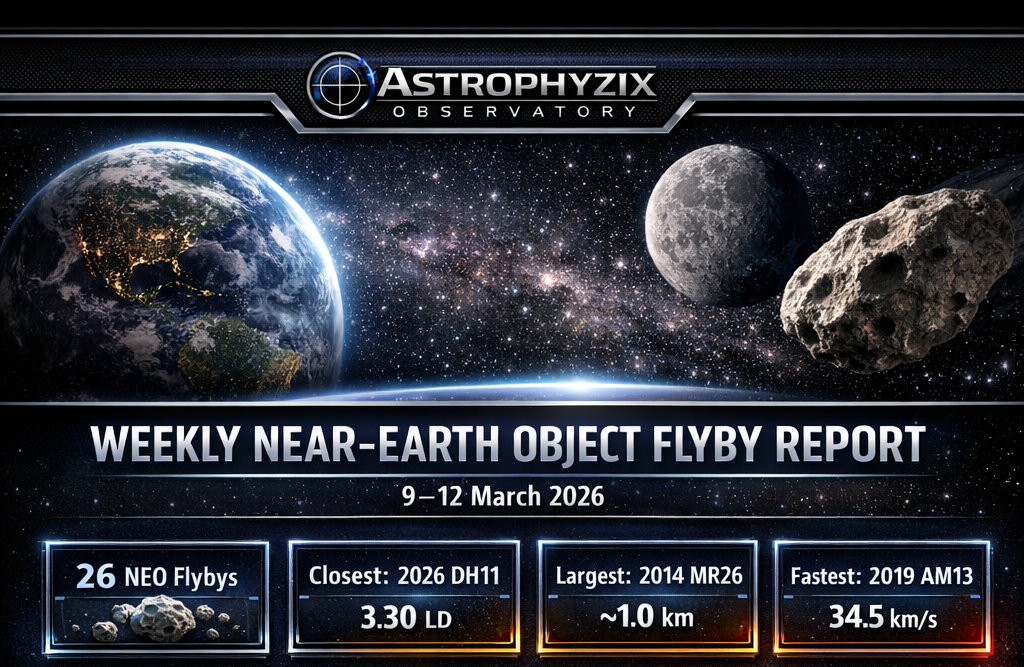
Weekly Near-Earth Object Flyby Report — 9–12 March 2026

Weekly Near-Earth Object Flyby Report — 9–12 March 2026


Written by: Astrophyzix Digital Observatory and Planetary Defence Research

The following Near-Earth Object (NEO) monitoring report summarises asteroid flybys recorded between 9 March and 12 March 2026. Data is compiled from the NASA Jet Propulsion Laboratory Small-Body Database and associated planetary defence monitoring systems maintained by the Center for Near-Earth Object Studies (CNEOS).

ℹ️ Sources / Technical / Mathematical / Scientific / Academic / Integrators / Methods
Sources
  • NASA APIs
  • CNEOS Scout
  • JPL CAD
  • NeoWs
  • SBDB
  • Horizons
  • Sentry
Stack
  • IEEE-754 Float64
  • RKN4
  • Yoshida-4
  • Dormand–Prince / DOPRI5
  • DOPRI8 /DOP853
  • Verlet
  • N-Body
  • Einstein–Infeld–Hoffmann
  • DE441
  • ΛCDM
  • J2
  • Meeus
  • Yarkovsky
  • Schwarzschild GR
  • Simon 1994
  • Holsapple–Schmidt
  • Collins / Pierazzo / Ward–Asphaug
  • AIS-Wide
  • Abyssal 4 km
  • WebGPU
  • DOI Registered
  • Academia.edu
  • Zenodo
  • OpenAIRE
Independent Direct Source Verification
Uncompromised Crossref DOI Resolver · Live and direct meta data fetch
Awaiting DOI input