Astrophyzix Digital Observatory's
Evidence-First Asteroid Reporting

Astrophyzix.com is the publication of the Astrophyzix Digital Observatory, offering unpaywalled, evidence‑driven analysis and real‑time monitoring of PHAs and NEOs. Our tracking consoles and reporting systems use and provide access to official NASA CNEOS Scout, JPL CAD, NeoWs, JPL SBDB, Horizons and NOAA observational datasets, peer‑reviewed sources, and high‑precision numerical methods (IEEE‑754 Float64, RKN4). Designed for students, educators, researchers, and the public, every console is uniquely designed and engineered by the Astrophyzix Digital Observatory. Our research notes and papers can be found at Astrophyzix.Academia.Edu

Showing posts with label Referenced. Show all posts

Monday, 9 February 2026

Newly Discovered Asteroid (2026 BX4) and Its February 2026 Close Approach to Earth

MONITORING ACTIVE
Astrophyzix Asteroid Close Approach Series
Information and Data Updated: 10 February 2026
Written by: Astrophyzix Science Communication
 
📌 Cited

Bx4


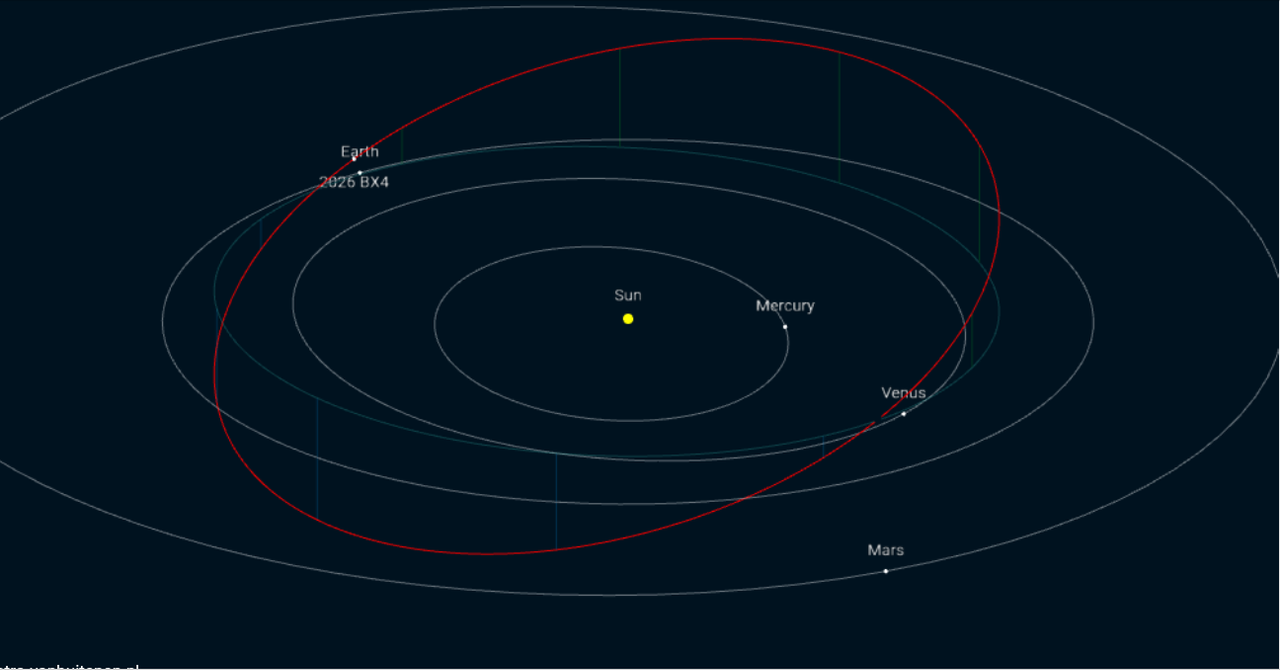
Newly Discovered Asteroid 2026 BX4

Asteroid 2026 BX4 is a near-Earth asteroid (NEA) identified in early 2026 whose orbital trajectory brings it into relatively close proximity with Earth on 16 February 2026. Near-Earth asteroids are remnants of the early Solar System whose paths have been altered over time by gravitational interactions with planets, particularly Jupiter and Earth. 

Will Asteroid BX4 Hit Earth? No, this asteroid poses no threat to Earth. 

Tuesday, 20 January 2026

Asteroid 2002 LX and Its 2026 Flyby: A Cosmic Near-Miss on 27 January 2026

MONITORING ACTIVE
Astrophyzix Asteroid Close Approach Series
Information and Data Updated: 9 February 2026

Asteroid 2002 LX Orbit chart

Written by: Astrophyzix Science News on 20/01/2026


Asteroid 2002 LX Overview

Asteroid 2002 LX is a near-Earth object belonging to the Apollo group of asteroids, meaning its orbit crosses Earth’s path around the Sun. It was discovered in 2002 and has been observed regularly since then, allowing astronomers to build a well-defined orbital model. Because its orbit brings it relatively close to Earth on occasion, it is classified as a Potentially Hazardous Asteroid, a technical designation based on proximity rather than any imminent danger.

Wednesday, 14 January 2026

Asteroid 242708 (2005 UK1) 2026 Observational Study Notes

MONITORING ACTIVE

Close-Approach of Asteroid 2005 UK1 - Astrophyzix Asteroid Close Approach Series 

Written by: Astrophyzix Science Communication
Date published:: 14 January 2026
Date Modifed
: 11 February 2026

Orbital chart of asteroid 242708 (2005 UK1) showing its trajectory relative to Earth and the Sun, with close approach on 12 January 2026.
Figure 1. Orbit of 242708 (2005 UK1) relative to Earth and the Sun, showing its close approach on 12 January 2026.


Abstract

This article provides a detailed overview of asteroid 242708 (2005 UK1), an Apollo-class near-Earth object that made a safe close approach to Earth on 12 January 2026. The article summarizes its discovery, orbital characteristics, size estimates, and monitoring status, providing context for near-Earth object research and planetary defense efforts.

Independent Direct Source Verification
Uncompromised Crossref DOI Resolver · Live and direct meta data fetch
Awaiting DOI input