Astrophyzix Digital Observatory's
Evidence-First Asteroid Reporting

Astrophyzix.com is the publication of the Astrophyzix Digital Observatory, offering unpaywalled, evidence‑driven analysis and real‑time monitoring of PHAs and NEOs. Our tracking consoles and reporting systems use and provide access to official NASA CNEOS Scout, JPL CAD, NeoWs, JPL SBDB, Horizons and NOAA observational datasets, peer‑reviewed sources, and high‑precision numerical methods (IEEE‑754 Float64, RKN4). Designed for students, educators, researchers, and the public, every console is uniquely designed and engineered by the Astrophyzix Digital Observatory. Our research notes and papers can be found at Astrophyzix.Academia.Edu

Showing posts with label NEO Profile. Show all posts

Saturday, 23 May 2026

Asteroid 2026KW Close Approach Report and Asteroid Profile — Latest Asteroid News & Monitoring by Astrophyzix Observatory

Scientific Close‑Approach & Orbital Report For Asteroid 2026KW — Live Orbital Tracking and Refinement Viewer Integrated With Official NASA API's

Asteroid 2026 KW — Post‑Discovery Orbital Analysis · JPL SBDB Solution JPL 3
✅ Data aligned with: JPL SBDB, CNEOS CAD, NASA Horizons 

The Orbital Refinement image below and the refined status data within the image is computed by Astrophyzix Digital Observatory using its proprietary Live Asteroid Monitoring and Computational Orbital Refinement System using raw NASA API data. 

asteroid 2026KW orbital refinement by Astrophyzix
Apollo NEO Condition Code 7 2‑Day Data Arc NO IMPACT RISKSee JPL Solution

Key Takeaways of Asteroid 2026 KW (JPL Solution JPL 3)

  • NASA JPL Solution: Solution JPL 3 · Epoch 2461000.5 (2025‑Nov‑21.0 TDB) · SPK‑ID 54630404
  • Orbit class: Apollo NEO — a = 1.4127 au, e = 0.4172, i = 27.65°, orbital period 613.3 days.
  • Earth MOID: 0.0076064 au (~1.14 million km) — close in astronomical terms, but no impact geometry.
  • Size estimate: H = 25.669 → approximate diameter ~20–45 m (albedo‑dependent).
  • Orbit quality: Condition code 7, based on only 28 observations over a 2‑day arc — a very early, still‑refining orbit.
  • Close approaches: • Historical: 1937‑05‑25 Earth at 0.00728 au • Upcoming: 2026‑05‑25 Earth/Moon at 0.00830 au All are non‑impacting.
  • Risk context: Not a PHA — H > 22 and MOID above hazard threshold.
  • Ignore clickbait — Astrophyzix can confirm that no agency lists 2026 KW as a threat.

Scientific Consensus Snapshot of 2026 KW

ParameterStatus
Orbit classApollo NEO (Earth‑crossing)
Epoch2461000.5 TDB (2025‑Nov‑21)
Semi‑major axis (a)1.4127066 au
Eccentricity (e)0.4171896
Inclination (i)27.6521°
Earth MOID0.0076064 au (~1.14 million km)
Jupiter MOID3.46706 au
Absolute magnitude (H)25.669
Condition code7 (high uncertainty; 2‑day arc)
Observations28 (2026‑05‑20 → 2026‑05‑22)
Hazard levelNon‑hazardous; no impact solutions

Tuesday, 28 April 2026

Newly discovered NEO Asteroid 2026 HZ3 Close Approach Report and NEO Profile by Astrophyzix Digital Observatory

Asteroid (2026 HZ3) — 2026 NASA-Linked Preliminary Scientific Status Report
NASA JPL SBDB Solution 5 (2026-Apr-28 06:20:37)


Researched, Written and Published by: Astrophyzix Digital Observatory

Original, Timely, Verifiable Asteroid News and Planetary Defence Monitoring by Astrophyzix.com & Astrophyzix.org


📌 Cited by MSN News | Bing Copilot News Image
Reading Time: ~8 min Primary Data: NASA JPL SBDB / CNEOS

Classification: Apollo Near-Earth Object (NEO) SPK-ID: 54613601

Asteroid 2026 HZ3 Key Takeaways

  • Newly discovered NEO: (2026 HZ3) is a recently observed Apollo-class near-Earth asteroid with a short data-arc (4 days) and a relatively high orbital uncertainty (condition code 7).
  • Small object: With an absolute magnitude H ≈ 25.3, (2026 HZ3) is likely a small asteroid, on the order of a few tens of metres in diameter, depending on its surface reflectivity.
  • Close approach in 2026: A nominal close approach to Earth occurs on 1 May 2026 at a distance of about 0.010 au (around 1.5 million km), well outside any impact scenario under current solutions.
  • Earth MOID: The current Minimum Orbit Intersection Distance (MOID) with Earth is about 0.00497 au (~745,000 km), indicating close-approach potential but not an imminent threat.
  • Preliminary orbit: Because the orbit is based on only 38 observations over 4 days, all risk and trajectory assessments are considered preliminary and will be refined as more data are collected.

Scientific consensus snapshot (preliminary)

ParameterStatus (NASA JPL SBDB Solution 5 | 2026-Apr-28 06:20:37)
Impact risk (100-year context)No confirmed impact solution; orbit still under refinement (condition code 7).
Orbital uncertaintyModerate–high (short 4-day data-arc, condition code 7).
2026 close approachNominal miss distance ~0.010 au (~1.5 million km) — a safe flyby under current solutions.
Hazard classificationNEO (Apollo). Not formally classified as a Potentially Hazardous Asteroid (PHA) at this time.
Scientific priorityMonitoring and orbit refinement; representative of small NEOs that frequently pass near Earth.

Saturday, 11 April 2026

Potentially Hazardous Asteroid Close Approach Report For Asteroid 192559 (1998 VO) April 2026 Official NASA Data

Astrophyzix Near-Earth Object (NEO) Close Approach Report & Asteroid Profile: 192559 (1998 VO)

Written by: Astrophyzix Digital Observatory

📌 Cited by iAsk Student

Astrophyzix Image

Image Credit: NASA JPL SBDB

Introduction


Asteroid 192559 (1998 VO) is a well-characterised Apollo-class near-Earth object (NEO) classified as a Potentially Hazardous Asteroid (PHA). With a data arc spanning over two decades and hundreds of observations, its orbit is extremely well constrained, allowing for precise modelling of its trajectory across both past and future epochs.

The close approach on 2026-Apr-14 10:04 (TDB) represents a routine, distant flyby with no impact risk. Its PHA classification reflects orbital geometry (Earth-crossing potential) and size thresholds, not an immediate threat.


Potentially Hazardous Asteroid (PHA) news refers to verified reports of near-Earth asteroids that meet specific size and orbital proximity thresholds. Despite the classification, the vast majority of PHAs pose no impact threat during observed close approaches.

Key Takeaways


  • Close approach on 2026-Apr-14 10:04 (TDB).
  • Miss distance: 0.32726 AU (~127.3 LD / ~48.9 million km).
  • Relative velocity: 17.60 km/s.
  • Estimated diameter: ~300–700 meters.
  • Condition code 0 (orbit extremely well constrained).
  • No impact threat identified.
  • Astrophyzix Risk Index® Notibility score: 48 (Elevated).


Scientific Consensus Snapshot


The orbit of 192559 (1998 VO) is derived from 575 observations spanning 1998-11-10 to 2018-11-13, producing a condition code of 0—the highest confidence level in orbit determination. The timing uncertainty for the 2026-Apr-14 10:04 (TDB) encounter is less than one minute, indicating negligible positional uncertainty.


Potentially Hazardous Asteroid 2026GU Close Approach Report and Asteroid Profile Latest Near Earth Object News

Near-Earth Object (NEO) Close Approach Report & Asteroid Profile Potentially Hazardous Asteroid 2026 GU

Written by: Astrophyzix Digital Observatory

📌 Cited by iAsk Student

Astrophyzix Image
Image Credit: NASA JPL SBDB

Introduction


A Potentially Hazardous Asteroid (PHA)  is a near-Earth object with an absolute magnitude of 22.0 or brighter (typically larger than ~140 metres) and a minimum orbit intersection distance (MOID) of 0.05 AU or less. This classification does not indicate an impact threat, but identifies objects that require precise orbital monitoring.

Asteroid (2026 GU) is an Amor-class near-Earth object (NEO) classified as a Potentially Hazardous Asteroid (PHA) based on its size and orbital proximity to Earth. The object was observed over a short 5-day arc in this week and its orbit is currently defined by the initial JPL solution (Solution 1 on 09 April 2026.) 


Despite its PHA classification, current orbital solutions indicate a relatively distant Earth flyby on 14 April 2026. Continued observations are required to refine its trajectory due to the limited observational baseline and elevated uncertainty level.

Key Takeaways


  • Close approach on 2026-Apr-14 at ~0.09884 AU.
  • Equivalent to approximately 38.4 lunar distances (~14.8 million km).
  • Classified as a Potentially Hazardous Asteroid (PHA).
  • Estimated diameter: ~150–300 meters (based on H magnitude).
  • Orbit currently constrained using 90 observations over 5 days.
  • Condition code 8 indicates high orbital uncertainty.
  • No impact threat identified.


Scientific Consensus Snapshot


The current orbital solution for (2026 GU) is based on a short observational arc and remains subject to refinement. While the object's classification as a PHA reflects its long-term orbital geometry, the 14 April 2026 encounter is well outside any hazardous threshold. Future observations will reduce uncertainties and improve long-term trajectory modelling.


Wednesday, 8 April 2026

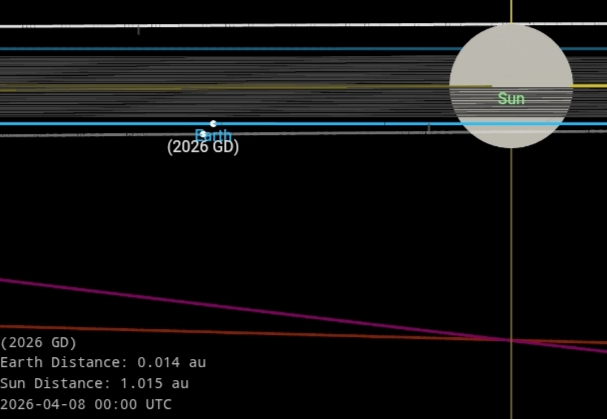
Near Earth Object NEO Close Approach Report: Asteroid (2026 GD) Updated Solution JPL 2

Astrophyzix Near-Earth Object (NEO) Close Approach Report: (2026 GD) — Updated Solution (JPL 2) - Real Time NEO News

Written by: Astrophyzix Digital Observatory

📌 Cited by DiscoverWildScience 📌 Cited by MSN News 📌 Cited by Bing Copilot News
Astrophyzix Image
Image Credit: NASA JPL SBDB

Introduction


Asteroid (2026 GD) is an Apollo-class near-Earth object (NEO) currently undergoing rapid orbital refinement following its recent discovery in April 2026. This report is a follow-up of our initial report and is based on the updated JPL solution (Solution 2), incorporating an expanded observational dataset and improved orbital constraints.


The object is notable for an exceptionally close Earth flyby occurring on April 9, 2026, within lunar distance. Although the orbit remains classified with moderate uncertainty, current data provides a consistent and stable close-approach solution with no indication of impact risk.

Key Takeaways


  • Very close Earth approach on 2026-Apr-09 at 22:59 (TBD) at ~0.00168 AU.
  • Equivalent to approximately 0.65 lunar distances (~251,000 km).
  • Relative velocity: ~12.66 km/s.
  • Small object (~20–30 meters estimated diameter).
  • Earth MOID: 0.000525 AU (very low orbital intersection distance).
  • Orbit refined using 117 observations over 2 days.
  • Condition code remains 7 (moderate uncertainty).
  • No impact threat identified. 


Scientific Consensus Snapshot


The updated orbital solution reflects improved constraint quality due to an increased number of observations and an extended data arc. While uncertainties have decreased across all orbital parameters, the orbit remains in an early refinement stage. 


Close approach predictions are now more precise, particularly in timing, but continued observation is required to fully stabilise the solution.


Newly Discovered NEO Asteroid (2026 GD) Exclusive Close Approach Report and Object Profile Astrophyzix Digital Observatory NASA Data

Astrophyzix Near-Earth Object (NEO) Close Approach Report: (2026 GD) Newly Discovered Asteroid Will Pass Closer than the Moon. 

Written by: Astrophyzix Digital Observatory

📌 Cited by DiscoverWildScience 📌 Cited by MSN News 📌 Cited by Bing Copilot News
NEO close approach visualisation

Introduction

New updates found in our JPL Solution 2 Report


Asteroid (2026 GD) is a recently observed Apollo-class near-Earth object (NEO) identified in April 2026. With a short observational arc of just 1 day, its orbital solution remains preliminary and subject to refinement. Despite this, current data indicates an exceptionally close Earth approach occurring on 09 April 2026.


The object’s very low Earth Minimum Orbit Intersection Distance (MOID) and near-term encounter geometry place it within the category of close-approach monitoring priority objects, although no confirmed impact risk is currently established based on available solutions at this time. Astrophyzix will update you as new data comes in. 

Key Takeaways


  • Apollo-class near-Earth asteroid with Earth-crossing orbit.
  • Very close Earth approach on 2026-Apr-09 at ~0.00168 AU.
  • Equivalent to approximately 0.65 lunar distances (~251,000 km).
  • Estimated relative velocity: ~12.66 km/s.
  • Small object (~20–30 meters estimated diameter range).
  • Extremely low Earth MOID: 0.000525 AU.
  • Orbit uncertainty remains high (condition code 7).
  • No confirmed impact risk in current datasets at the time of this report. 


Scientific Consensus Snapshot


The orbital parameters for (2026 GD) are based on a limited observational dataset spanning approximately one day. As a result, uncertainties remain significant, reflected in its condition code of 7. (Explanation of Code 7 below


Additional observations are required to refine its trajectory and reduce positional uncertainty. Close-approach predictions at this stage should be treated as provisional.


Monday, 6 April 2026

Potentially Hazardous Asteroid PHA 363599 (2004 FG11) Close Approach Report and PHA NEO Profile Official Data - Real Time Asteroid News

Astrophyzix Near-Earth Object (NEO) Close Approach Report: 363599 (2004 FG11)  Official Data, Real Time Reporting

Written by: Astrophyzix Digital Observatory

NEO orbital or close approach image

Image Credit: NASA JPL SBDB

2026 Relevance: Illustrates orbital geometry and Earth-approach context for monitored near-Earth objects during the 2026 observation window.

Introduction

A Potentially Hazardous Asteroid (PHA)  is a near-Earth object with an absolute magnitude of 22.0 or brighter (typically larger than ~140 metres) and a minimum orbit intersection distance (MOID) of 0.05 AU or less. This classification does not indicate an impact threat, but identifies objects that require precise orbital monitoring.


Asteroid 363599 (2004 FG11) is a well-studied Apollo-class near-Earth object (NEO) and is formally classified as a Potentially Hazardous Asteroid (PHA). This classification arises from its size and orbital proximity to Earth, specifically its Minimum Orbit Intersection Distance (MOID). The object has been extensively observed since its discovery in 2004, resulting in a highly refined orbital solution with exceptionally low uncertainty.


Notably, (2004 FG11) is a binary system with a confirmed satellite, making it scientifically significant for studies of asteroid mass, density, and internal structure. Its repeated close approaches to Earth make it a key object in long-term planetary defence monitoring.

Key Takeaways


  • Binary Apollo-class NEO and Potentially Hazardous Asteroid (PHA).
  • Highly reliable orbit (condition code 0) based on 22+ years of observations.
  • Estimated diameter: ~152 meters with relatively high albedo (0.306).
  • Rotation period: ~7.02 hours.
  • Earth MOID: 0.0203 AU (~3.04 million km).
  • Regular Earth close approaches approximately every 2 years.
  • Next significant Earth approach: 2026-Apr-11 at 0.05652 AU (~8.46 million km).
  • No impact risk identified in current orbital solutions.


Scientific Consensus Snapshot


The orbital solution for (2004 FG11) is based on 507 optical observations and radar astrometry spanning over 22 years. The inclusion of radar delay and Doppler measurements significantly enhances orbital precision, resulting in a condition code of 0. This allows for highly accurate forward propagation of the orbit and reliable close-approach predictions.


Saturday, 28 March 2026

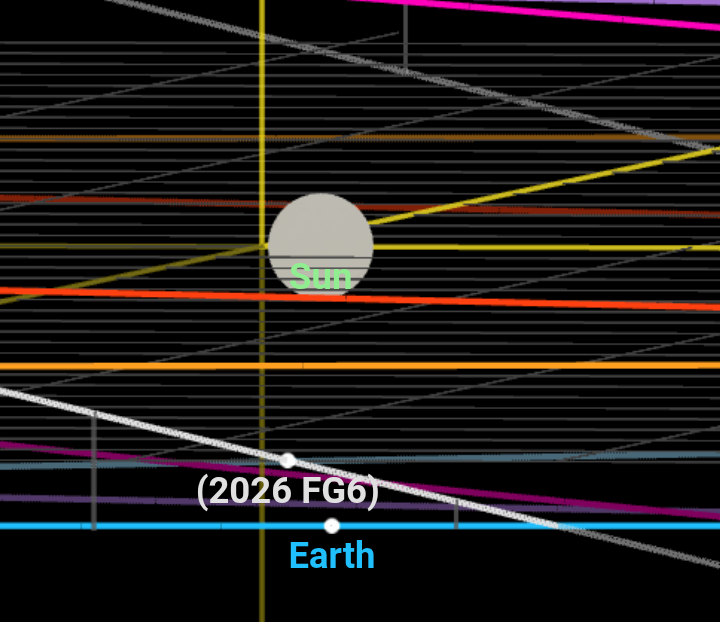
Newly Discovered NEO 2026 FG6: Orbital Refinement Update Astrophyzix Digital Observatory

Astrophyzix Follow-Up Report: 2026 FG6 — Orbital Refinement and Close Approach Confirmation

Updated URL Due to Permalink Error


📌 Cited by NewsBreak
Astrophyzix image


NEO 2026 FG6 Update

Following its initial identification on March 25, 2026, asteroid 2026 FG6 has undergone rapid orbital refinement based on additional observations extending the data arc to 3 days. The updated solution (JPL Solution 3, dated March 28, 2026) incorporates 29 observations, resulting in reduced uncertainties across all orbital elements while maintaining a condition code of 7. This reflects a typical early-stage solution for newly discovered small Near-Earth Objects (NEOs), where continued tracking is required to achieve long-term orbital certainty.


Updated Orbital Solution (JPL 3)

Element Previous (JPL 2) Updated (JPL 3) Change
Eccentricity (e) 0.228165 0.228035 Refined (-0.00013)
Semi-major axis (a) 1.067528 au 1.067428 au Refined
Inclination (i) 13.8936° 13.8866° Minor adjustment
Orbital Period 402.872 days 402.816 days Refined
Earth MOID 0.000450813 au 0.000451072 au Stable


Friday, 27 March 2026

EXCLUSIVE NEO REPORT: Newly Discovered NEO Asteroid 2026 FG6 and it's Current Close Approach March 2026

Exclusive Report: Asteroid 2026 FG6 (SPK-ID 54606975) Newly Discovered Near-Earth Object Which Was Discovered Just Two Days Before it's Close Approach


Published on: 27 March 2026

📌 Cited by iAsk Student

Descriptive Alt Text
Image Credit: NASA JPL SBD


Introduction (Latest update here


2026 FG6 (SPK-ID 54606975) is an Apollo-class Near-Earth Object (NEO) recently discovered on March 25, 2026 by automated surveys cataloged by JPL’s Solar System Dynamics team. This asteroid was identified following routine scanning of near-Earth space, and its extremely small Earth Minimum Orbit Intersection Distance (MOID) immediately marked it as noteworthy. Observations over just two days have provided preliminary orbital data, though with high uncertainty (Condition Code 7), emphasizing the need for continued tracking to refine its orbit and assess any potential hazard.


Despite its short observation arc, 2026 FG6’s Earth MOID of 0.00045 au (~67,000 km) makes it one of the closest-passing NEOs identified in recent weeks. Its absolute magnitude of H = 27.369 suggests a very small object, likely only a few meters in diameter, but its proximity highlights the importance of rapid follow-up for newly discovered NEOs. - It poses no impact risk.


Thursday, 26 March 2026

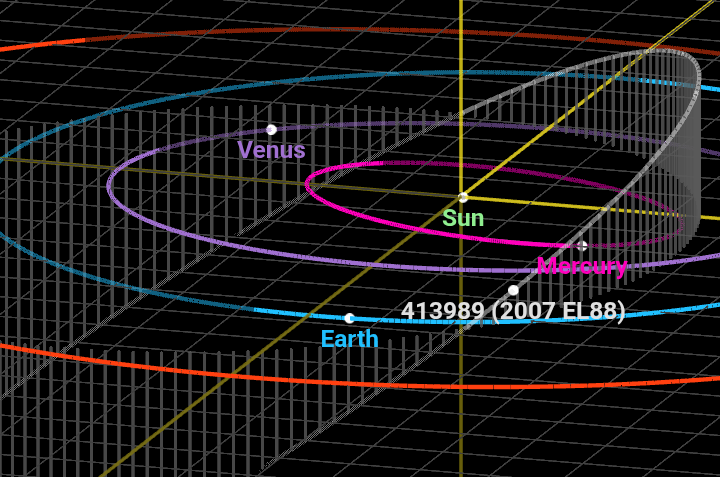
NEO PHA Profile: Asteroid 413989 (2007 EL88) Astrophyzix Digital Observatory NEO Close Approach Reports

Astrophyzix Object Profile: 413989 (2007 EL88)

Written by: Astrophyzix Digital Observatory for Planetary Defence 
Astrophyzix visual
Image Credit: NASA JPL Small Body Database 


Introduction

Asteroid 413989 (2007 EL88) is an Apollo-class Near-Earth Object (NEO) with a dynamically evolved, moderately high-eccentricity orbit that intersects the orbital path of Earth. It is classified as a Potentially Hazardous Asteroid (PHA) based on its size and orbital proximity, though current orbital solutions confirm no impact risk.

  • Current long‑term solutions show no impact scenarios within the next 100 years.


Classification and Discovery

Parameter Value
Object Name 413989 (2007 EL88)
Classification Apollo-class NEO, Potentially Hazardous Asteroid (PHA)
SPK-ID 20413989
Discovery Date 2007-03-14
Discovery Survey Siding Spring Survey


Wednesday, 18 March 2026

Asteroid (PHA/NEO) 879537 (2014 AF51) 19 March 2026 Close Approach and Profile by Astrophyzix Digital Observatory

Close Approach Data and Official NEO Profile 
Written by: Astrophyzix Digital Observatory 

📌 Cited by NewsBreak

Neo


2026 Close Approach to Earth

Asteroid 879537 (2014 AF51) will make a notable close approach to Earth on 19 March 2026 at 21:10 TDB. This object is classified as an Amor-type Near-Earth Object (NEO) and a Potentially Hazardous Asteroid (PHA), although its orbit remains safely exterior to Earth's path at perihelion, and no impact risk is associated with this encounter.
Parameter Value Units
Close Approach Date (TDB) 2026-03-19 21:10 UTC / TDB
Nominal Distance from Earth 0.11658 AU (~17.4 million km)
Relative Velocity 8.94 km/s
Minimum Orbit Intersection Distance (MOID) 0.0222536 AU
Classification Amor, NEO, PHA

Although classified as potentially hazardous due to its size and orbital proximity thresholds, this March 2026 approach occurs at a distance more than 45 times the average Earth–Moon separation, placing it well outside any collision scenario. Its Amor-type orbit ensures that it does not currently cross Earth's orbital path, instead approaching from just beyond 1 AU at perihelion.


Tuesday, 17 March 2026

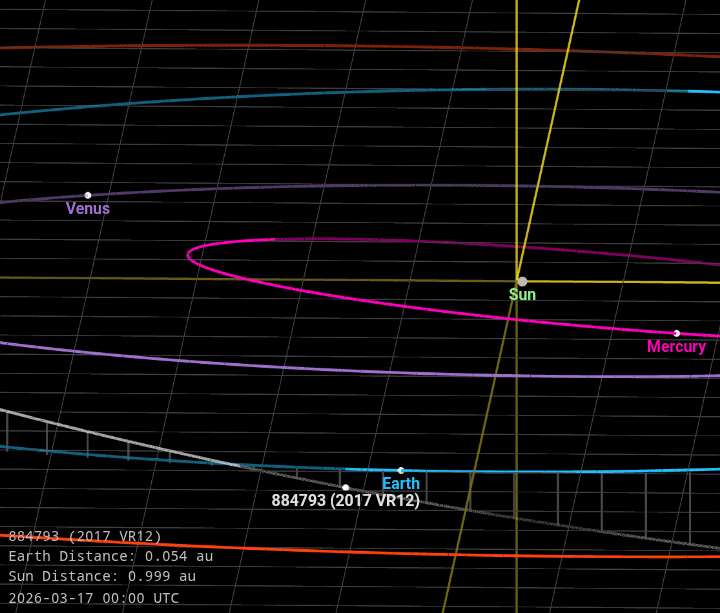
2026 Close Approach to Earth of Asteroid 884793 (2017 VR12) and Full Asteroid Profile

2026 Close Approach to Earth of Asteroid 884793 (2017 VR12)

NEO Close Approach Report - Official Data

📌 Cited


Neo


Close Approach 19 March 2026

Asteroid 884793 (2017 VR12) is scheduled for a significant close approach to Earth on 19 March 2026 at 17:39 TDB. This encounter is part of its routine orbit as an Apollo-class Near-Earth Object (NEO) and a Potentially Hazardous Asteroid (PHA), though it poses no immediate impact risk.

Parameter Value Units
Close Approach Date (TDB) 2026-03-19 17:39 UTC / TDB
Nominal Distance from Earth 0.05352 AU (~8.0 million km)
Relative Velocity 6.44 km/s
Minimum Orbit Intersection Distance (MOID) 0.00684174 AU
Classification Apollo, NEO, PHA

This approach, while closer than many main-belt asteroids, remains well outside any impact risk threshold. Observatories worldwide are tracking 2017 VR12 to refine its orbital elements and monitor future encounters. Radar and optical observations will help confirm its precise trajectory, rotation state, and physical characteristics in preparation for its 2026 flyby.

For real-time updates and precise ephemerides, refer to the JPL Small-Body Database entry for 884793 (2017 VR12).

Saturday, 28 February 2026

Potentially Hazardous Asteroid 2011 WV134 (500080) Close Approach Planetary Defence Profile

MONITORING ACTIVE

Written by: Astrophyzix Digital Observatory and Planetary Defence Research centre
Image: Copyright © Astrophyzix Science Network

500080

Discovery & Designation

(500080) 2011 WV134 is a numbered near-Earth asteroid (NEA) first detected on 30 November 2011 by the Catalina Sky Survey, a NASA-funded asteroid detection program based in Arizona. Following confirmation and orbital refinement, the object received its permanent minor planet number 500080 from the International Astronomical Union Minor Planet Center (MPC).

The asteroid’s provisional designation “2011 WV134” follows the standard MPC naming convention, indicating discovery in the second half of November 2011.

Saturday, 14 February 2026

Near-Earth Asteroid 2017 XA1: Full Scientific, Data Packed Profile

MONITORING ACTIVE
Written by: Astrophyzix Science Communication
Article Type: Asteroid News, Scientific Data, NEO Explainer
Astrophyzix Asteroid Close Approach Series

📌 Cited
2017 XA1


Asteroid 2017 XA1 — Full Scientific Profile

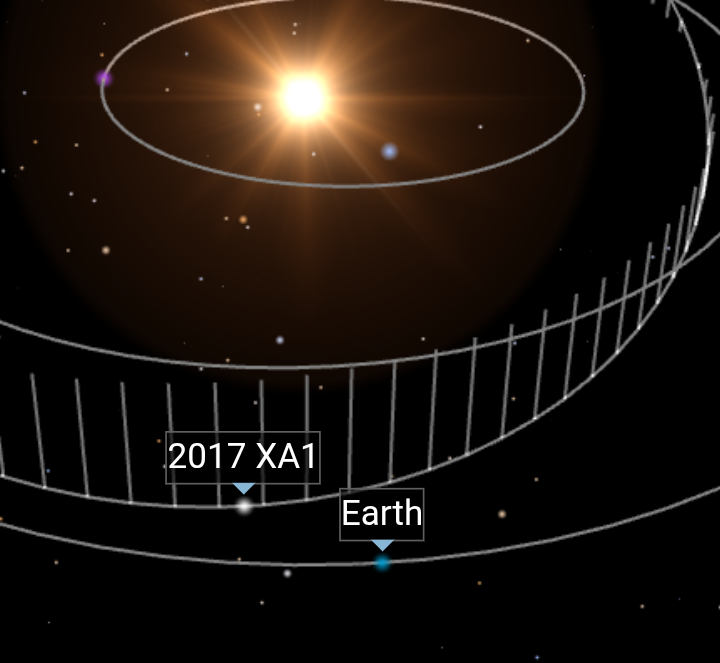
Asteroid 2017 XA1 is a small near-Earth body with a distinctly interior orbit relative to Earth's — meaning its path around the Sun remains mostly within Earth’s orbital distance. Although it is formally classified as a Potentially Hazardous Asteroid (PHA), its orbit, as determined from three years of observations keeps it at safe distances during close approaches for the foreseeable future. 

Friday, 13 February 2026

Asteroid 2015 FQ117 an In-Depth Profile of Potentially Hazardous Asteroid (PHA) 2026 Data

MONITORING ACTIVE

Written By: Astrophyzix Science Communication
Article Type
: Evidence Check, Explainer, Series, Asteroid Data

Fq117


Introduction 

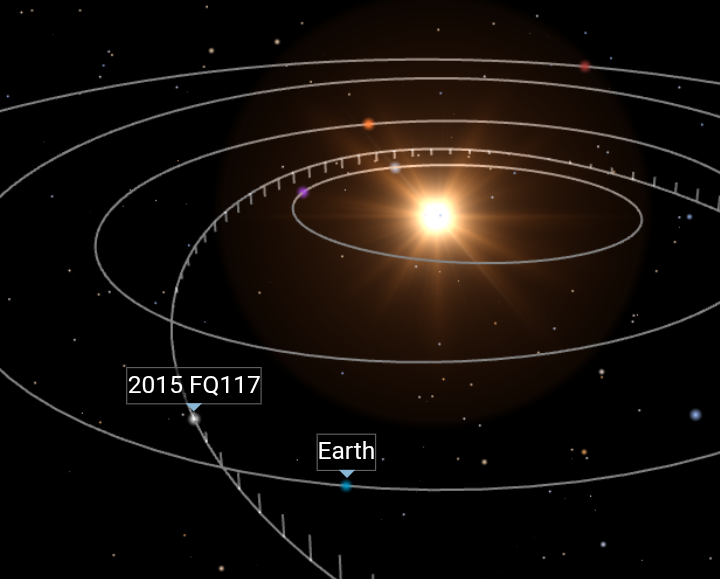
Asteroid 2015 FQ117 is a small Aten-class near-Earth object and Potentially Hazardous Asteroid. Although it poses no immediate threat, its orbit and characteristics are closely monitored by astronomers. This article explores its size, trajectory, predicted close approaches, and ongoing tracking efforts by international observatories.

Tuesday, 10 February 2026

Asteroid (1999 AO10): Its February 2026 Close Approach - Scientific Overview

MONITORING ACTIVE
Astrophyzix Asteroid Close Approach Series 
Written by: Astrophyzix Science Communication 
Article Type: News, Explainer, Evidence Check
Information Updated: 10 February 2026

Ao10


Introduction to Asteroid 1999 AO10

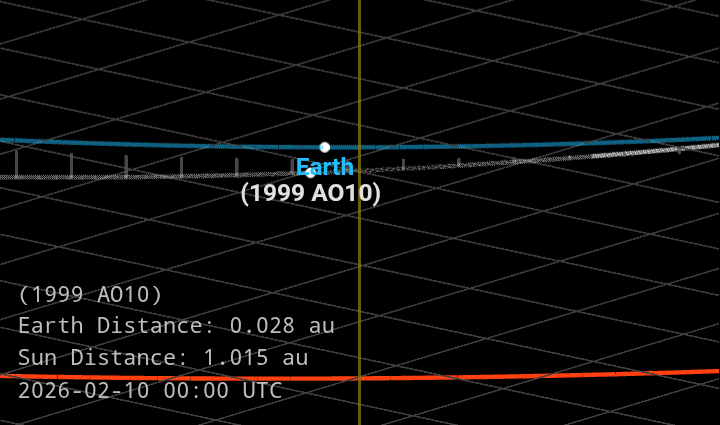
Asteroid 1999 AO10 is a near-Earth object that was first observed on 13 January 1999 by the LINEAR survey at Lincoln Laboratory’s Experimental Test Site in New Mexico, USA. It belongs to the Aten class of asteroids, a group defined by orbits that bring them inside Earth’s orbital radius around the Sun. 


Near Earth Asteroid (2020 BE15) A Safe Close Approach to Earth on 10 February 2026

MONITORING ACTIVE
Astrophyzix Asteroid Close Approach Series
Information and Data Updated: 10 February 2026
Written by: Astrophyzix Science Communication

Close asteroid 10/02/2026


Introduction to Asteroid 2020 BE15


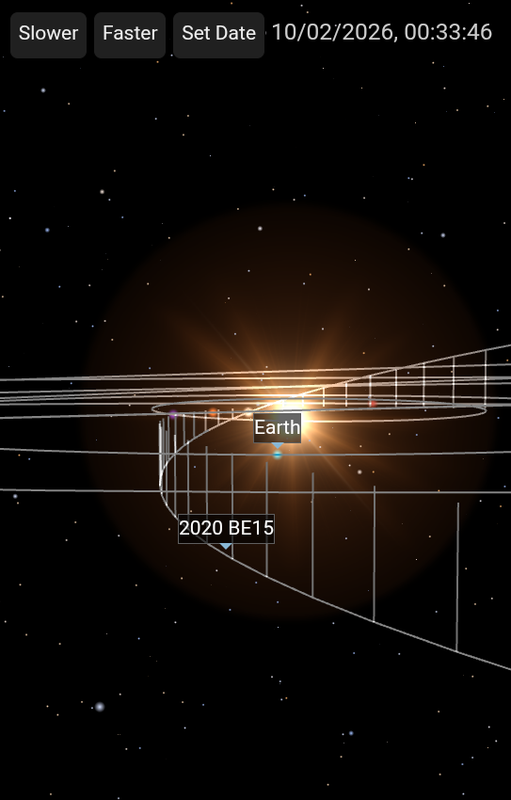
Asteroid 2020 BE15 is a small near-Earth asteroid that belongs to the population of solar system bodies whose orbits bring them into the vicinity of Earth. It is categorized as a near-Earth object (NEO), meaning that its orbital path crosses or approaches the orbit of our planet. 

Objects of this class are scientifically important because they provide insight into the formation and evolution of the early solar system and are also monitored for planetary defense purposes. Asteroid 2020 BE15 is considered a relatively small asteroid compared to many known objects, yet it is still large enough to be studied as part of ongoing research into near-Earth asteroid dynamics. It poses absolutely no risk to planet Earth. 

Monday, 9 February 2026

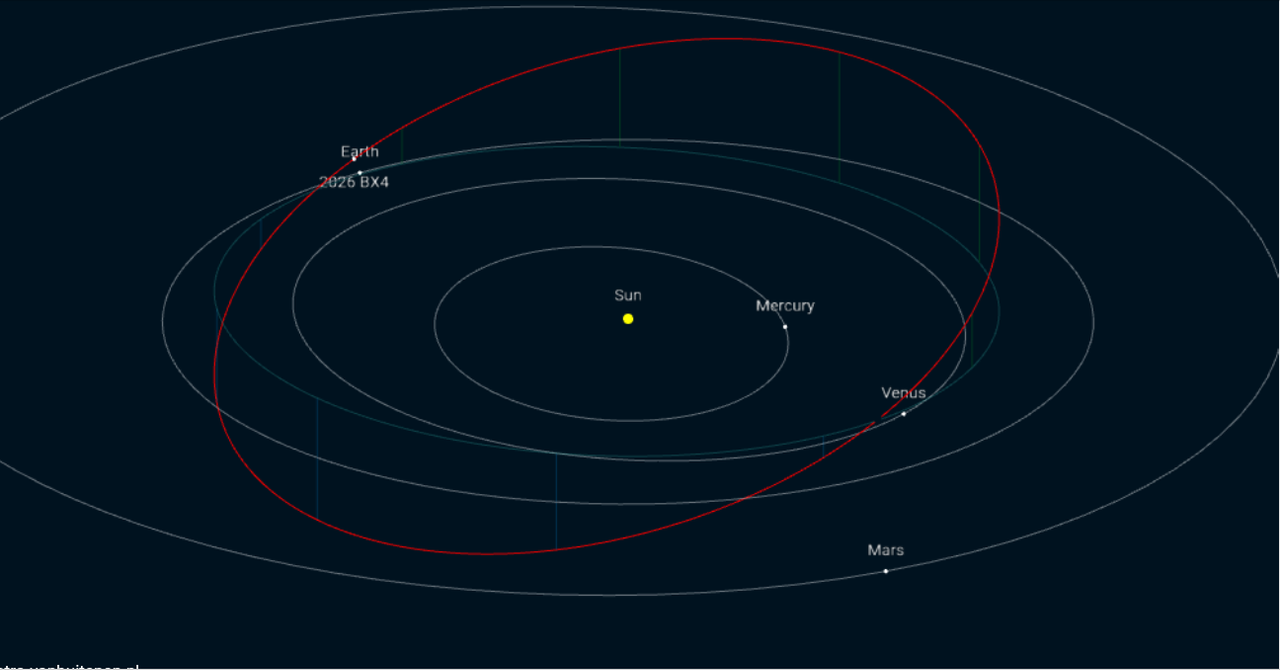
Newly Discovered Asteroid (2026 BX4) and Its February 2026 Close Approach to Earth

MONITORING ACTIVE
Astrophyzix Asteroid Close Approach Series
Information and Data Updated: 10 February 2026
Written by: Astrophyzix Science Communication
 
📌 Cited

Bx4


Newly Discovered Asteroid 2026 BX4

Asteroid 2026 BX4 is a near-Earth asteroid (NEA) identified in early 2026 whose orbital trajectory brings it into relatively close proximity with Earth on 16 February 2026. Near-Earth asteroids are remnants of the early Solar System whose paths have been altered over time by gravitational interactions with planets, particularly Jupiter and Earth. 

Will Asteroid BX4 Hit Earth? No, this asteroid poses no threat to Earth. 

Tuesday, 3 February 2026

ASTEROID NEWS: (276033) 2002 AJ129 Asteroid Close Approach to Earth on 09 February 2026

MONITORING ACTIVE
Written by: Astrophyzix Science Communication 
Published: 03 February 2026
Read time: 7 minutes 
Updated: 9 February 2026

Asteroid (276033) 2002 AJ129


Introduction

Asteroid (276033) 2002 AJ129 is a near-Earth object (NEO that has attracted scientific attention due to its highly elongated orbit through the inner solar system and its periodic close approaches to Earth. Discovered in January 2002 by the Near Earth Asteroid Tracking (NEAT) program at Haleakala Observatory, the asteroid crosses the orbits of Mercury, Venus, Earth, and Mars during each revolution around the Sun.

Will Asteroid (276033) 2002 AJ129 hit Earth in 2026?

The straight, honest answer is no. This artcle tells you everything science knows about this interesting near-Earth object. 

Tuesday, 20 January 2026

Asteroid 2002 LX and Its 2026 Flyby: A Cosmic Near-Miss on 27 January 2026

MONITORING ACTIVE
Astrophyzix Asteroid Close Approach Series
Information and Data Updated: 9 February 2026

Asteroid 2002 LX Orbit chart

Written by: Astrophyzix Science News on 20/01/2026


Asteroid 2002 LX Overview

Asteroid 2002 LX is a near-Earth object belonging to the Apollo group of asteroids, meaning its orbit crosses Earth’s path around the Sun. It was discovered in 2002 and has been observed regularly since then, allowing astronomers to build a well-defined orbital model. Because its orbit brings it relatively close to Earth on occasion, it is classified as a Potentially Hazardous Asteroid, a technical designation based on proximity rather than any imminent danger.

Independent Direct Source Verification
Uncompromised Crossref DOI Resolver · Live and direct meta data fetch
Awaiting DOI input