Astrophyzix Digital Observatory's
Evidence-First Asteroid Reporting

Astrophyzix.com is the publication of the Astrophyzix Digital Observatory, offering unpaywalled, evidence‑driven analysis and real‑time monitoring of PHAs and NEOs. Our tracking consoles and reporting systems use and provide access to official NASA CNEOS Scout, JPL CAD, NeoWs, JPL SBDB, Horizons and NOAA observational datasets, peer‑reviewed sources, and high‑precision numerical methods (IEEE‑754 Float64, RKN4). Designed for students, educators, researchers, and the public, every console is uniquely designed and engineered by the Astrophyzix Digital Observatory. Our research notes and papers can be found at Astrophyzix.Academia.Edu

Showing posts with label Asteroid Tracking. Show all posts

Thursday, 7 May 2026

Asteroid (2001 MS3 / 2026 GF) — 2026 Scientific Close‑Approach Report and Asteroid Profile - Official NASA Data - Latest Potentially Hazardous Asteroid News by Astrophyzix Digital Observatory

Near Earth Asteroid (2001 MS3) — 2026 Scientific Close‑Approach Report and Asteroid Profile - Official NASA Data Sources


Responsive image
Apollo [NEO] SPKID: 50092326 JPL Solution 16 Epoch 2461000.5 (2025‑Nov‑21.0 TDB)

Condition Code 0

Asteroid 2001 MS3 Key Takeaways

  • Precisely determined Apollo NEO: (2001 MS3) is an Apollo‑class Near‑Earth Object with semi‑major axis a = 2.139 au and perihelion q ≈ 0.997 au, crossing Earth’s orbital region on a ~3.13‑year cycle.
  • Epoch‑anchored orbit: All osculating elements are referenced to Epoch 2461000.5 (2025‑Nov‑21.0 TDB) in the heliocentric IAU76/J2000 ecliptic frame (JPL Solution 16).
  • 2026 flyby is distant and safe: On 2026‑May‑13, 2001 MS3 passes Earth at a nominal distance of 0.05306 au (~7.94 million km), with minimum and maximum distances identical at the quoted precision.
  • Elite orbit quality: A 24.82‑year data arc (39 observations) with DE441 and SB441‑N16 yields a Condition Code 0 solution and normalized RMS 0.60351.
  • Small, non‑hazardous body: With absolute magnitude H = 24.0, the diameter is of order tens of metres; Earth MOID is 0.0243864 au, and no impact solutions are known.

Scientific consensus snapshot (preliminary)

Parameter Status
Orbit determination quality Excellent — Condition Code 0, long data arc, low RMS
Impact risk No known impact trajectories; not on active risk lists
2026 Earth encounter Distant, dynamically routine, fully non‑hazardous
Long‑term dynamics Moderate secular evolution; weak Jovian perturbations (Tjup = 3.514)
Planetary‑defence relevance Benchmark small Apollo NEO for MOID‑based classification and tracking

Object overview and physical characteristics

Parameter Value
Primary designation (2001 MS3)
Alternate designation 2026 GF
Classification Apollo‑class Near‑Earth Object (NEO)
Absolute magnitude (H) 24.0 (reference: MPO74093)
Estimated diameter (typical NEO albedo) ~40–60 m (order‑of‑magnitude)
Rotation period Not determined
Albedo / spectral type Unknown; no published taxonomy at this solution


Sunday, 5 April 2026

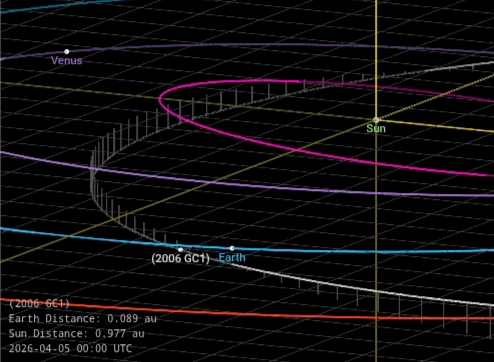
Asteroid 2006 GC1 Potentially Hazardous Asteroid (PHA) Close Approach 2026 and Asteroid Profile - Astrophyzix Digital Observatory - Official Data Set

Astrophyzix Near-Earth Object (NEO) (PHA) Close Approach Report and Object Profile: Asteroid 2006 GC1 


NEO orbital diagram

Image Credit: NASA JPL SBDB

πŸ“Œ Referenced by iAsk Student


Introduction


A Potentially Hazardous Asteroid (PHA)  is a near-Earth object with an absolute magnitude of 22.0 or brighter (typically larger than ~140 metres) and a minimum orbit intersection distance (MOID) of 0.05 AU or less. This classification does not indicate an impact threat, but identifies objects that require precise orbital monitoring.


Asteroid (2006 GC1) is a well-characterised Apollo-class near-Earth object (NEO) and is formally classified as a Potentially Hazardous Asteroid (PHA). This designation is based on its size and its Minimum Orbit Intersection Distance (MOID) with Earth. Unlike recently discovered objects with short observational arcs, (2006 GC1) benefits from a long-term observational dataset spanning over 15 years, resulting in a highly constrained and reliable orbital solution.


This report provides a detailed orbital, physical, and close-approach analysis using data derived from the NASA JPL Small-Body Database and associated dynamical models. All values presented reflect current best-fit solutions and should be interpreted within the context of continuous observational refinement.

Key Takeaways


  • (2006 GC1) is classified as both an Apollo NEO and a Potentially Hazardous Asteroid (PHA).
  • Extremely well-constrained orbit (condition code 0) based on 92 observations over 15.3 years.
  • Highly eccentric orbit (e = 0.817) with a perihelion deep inside Mercury’s orbital region.
  • Estimated size range: ~200–400 meters (based on H = 20.5).
  • Earth MOID: 0.00914 AU (~1.37 million km), within the PHA threshold.
  • Next notable Earth close approach: 2026-Apr-05 at 0.08876 AU (~13.3 million km).
  • Relative velocity during Earth encounter: ~30.66 km/s.
  • No impact risk indicated for any known approach in current orbital solutions.


Scientific Consensus Snapshot


The orbital solution for (2006 GC1) is derived using high-precision numerical integrations incorporating the DE441 planetary ephemeris and perturbations from major solar system bodies. With a condition code of 0 and a multi-decade observation arc, the orbit is considered highly reliable. Uncertainty margins in orbital elements are extremely low, allowing for precise long-term trajectory propagation and close-approach prediction.


Saturday, 4 April 2026

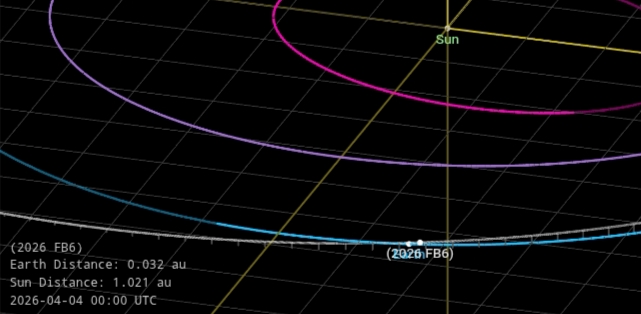
Near Earth Object (NEO) Close Approach Report: Asteroid 2026 FB6 Official Data Profile - Latest Asteroid News

Astrophyzix Near-Earth Object (NEO) Close Approach Report: 2026 FB6 - Real Time, Trusted Asteroid News 

Written by: Astrophyzix Digital Observatory 

πŸ“Œ Referenced by iAsk Student

NEO close approach image

Introduction

This report presents an institutional summary of near-Earth asteroid 2026 FB6, an Apollo-class near-Earth object (NEO) with a trajectory that intersects Earth's orbital path. The analysis is based on orbital data derived from NASA’s JPL Small-Body Database and ephemerides generated using JPL dynamical models and planetary perturbation integrations.

Due to the limited observational arc and associated high condition code, orbital parameters remain uncertain and subject to refinement through continued astrometric tracking.

Key Takeaways (ADO) 

  • 2026 FB6 is classified as an Apollo-type near-Earth asteroid.
  • Semi-major axis: 1.658 AU, indicating an orbit extending well beyond Earth’s orbit.
  • Eccentricity: 0.398, representing a moderately elongated orbit.
  • Perihelion distance: 0.999 AU, near Earth’s orbital distance.
  • Earth MOID: 0.0141 AU (~2.1 million km), indicating a relatively safe orbital separation.
  • Absolute magnitude (H): 27.82, implying a small object (tens of meters in diameter, size dependent on albedo).
  • Observational arc: 5 days with 17 observations; condition code: 9 (high uncertainty).
  • Predicted close approach: 2026-Apr-04 03:48 TDB (±2 minutes).


Scientific Consensus Snapshot


Orbital solutions for 2026 FB6 are computed using heliocentric dynamics referenced to the JPL DE441 planetary ephemeris. The solution incorporates gravitational perturbations from major planetary bodies and is constrained by a limited observational dataset spanning five days. The high condition code indicates that additional observations are required to significantly reduce uncertainties in the orbital solution.


Friday, 13 February 2026

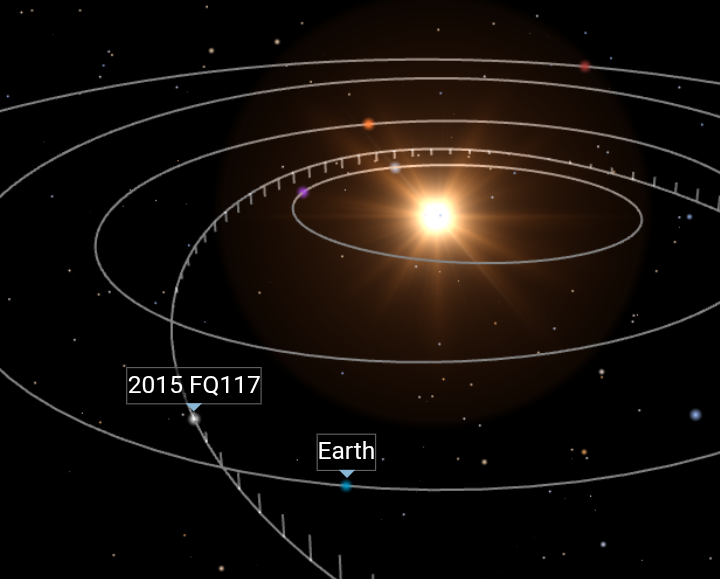
Asteroid 2015 FQ117 an In-Depth Profile of Potentially Hazardous Asteroid (PHA) 2026 Data

MONITORING ACTIVE

Written By: Astrophyzix Science Communication
Article Type
: Evidence Check, Explainer, Series, Asteroid Data

Fq117


Introduction 

Asteroid 2015 FQ117 is a small Aten-class near-Earth object and Potentially Hazardous Asteroid. Although it poses no immediate threat, its orbit and characteristics are closely monitored by astronomers. This article explores its size, trajectory, predicted close approaches, and ongoing tracking efforts by international observatories.

Tuesday, 3 February 2026

ASTEROID NEWS: (276033) 2002 AJ129 Asteroid Close Approach to Earth on 09 February 2026

MONITORING ACTIVE
Written by: Astrophyzix Science Communication 
Published: 03 February 2026
Read time: 7 minutes 
Updated: 9 February 2026

Asteroid (276033) 2002 AJ129


Introduction

Asteroid (276033) 2002 AJ129 is a near-Earth object (NEO that has attracted scientific attention due to its highly elongated orbit through the inner solar system and its periodic close approaches to Earth. Discovered in January 2002 by the Near Earth Asteroid Tracking (NEAT) program at Haleakala Observatory, the asteroid crosses the orbits of Mercury, Venus, Earth, and Mars during each revolution around the Sun.

Will Asteroid (276033) 2002 AJ129 hit Earth in 2026?

The straight, honest answer is no. This artcle tells you everything science knows about this interesting near-Earth object. 

Tuesday, 20 January 2026

Asteroid 2002 LX and Its 2026 Flyby: A Cosmic Near-Miss on 27 January 2026

MONITORING ACTIVE
Astrophyzix Asteroid Close Approach Series
Information and Data Updated: 9 February 2026

Asteroid 2002 LX Orbit chart

Written by: Astrophyzix Science News on 20/01/2026


Asteroid 2002 LX Overview

Asteroid 2002 LX is a near-Earth object belonging to the Apollo group of asteroids, meaning its orbit crosses Earth’s path around the Sun. It was discovered in 2002 and has been observed regularly since then, allowing astronomers to build a well-defined orbital model. Because its orbit brings it relatively close to Earth on occasion, it is classified as a Potentially Hazardous Asteroid, a technical designation based on proximity rather than any imminent danger.

Friday, 16 January 2026

Close Approach of Potentially Hazardous Apollo-class Small Asteroid 2018 UY on 20th January 2026

MONITORING ACTIVE
Written by: L.W - Independent Science Communicator
Published: 16 January 2026 by Astrophyzix.com
Read time: 9 minutes


2026 Close approach chart asteroid 2018 UY


Abstract

The near-Earth asteroid (2018 UY) will make a close but non-threatening passage of Earth on 20 January 2026 as part of its regular sequence of planetary encounters. Classified as an Apollo-type Near-Earth Asteroid and a Potentially Hazardous Asteroid due to its orbital geometry, 2018 UY poses no impact risk during this flyby. 

Thursday, 15 January 2026

Asteroid 509352 (2007 AG) Close Approach to Earth on 22/01/2026

MONITORING ACTIVE
Astrophyzix Asteroid Close Approach Series
Information and Data Updated: 10 February 2026
Published: 15 January 2026
Image Credit: Nasa/Arecibo/NSF

Asteroid 2007 AG Close Approach


Introduction 

Upcoming Close Approach: On January 22, 2026, the well tracked and observed asteroid 509352 (2007 AG) will pass near Earth at a safe distance beyond the Moon's orbit. This asteroid is classified as a Potentially Hazardous Asteroid but poses no threat on this close approach. 

Asteroid 2340 Hathor Close Approach 17/01/26

MONITORING ACTIVE

Earth’s Slender Neighbor from the Sky

Astrophyzix Asteroid Close Approach Series
Information and Data Updated: 10 February 2026
Written by: Astrophyzix Science Communication 
7 Minute read 
Published: 15 January 2026

Asteroid Hathor Charts for 2026 close approach

Abstract

Floating through the inner Solar System with the grace of an orbital dancer, asteroid 2340 Hathor is a fascinating space rock that has captured astronomers’ attention since the mid-1970s. Named after an ancient goddess yet rooted in modern science, Hathor embodies the intersection of myth, celestial mechanics, and planetary defense.

While it poses no imminent danger, Hathor is notable for an upcoming close approach to Earth on 17 January 2026, an event that has placed it firmly back on astronomers’ observation schedules.

Wednesday, 14 January 2026

Asteroid 242708 (2005 UK1) 2026 Observational Study Notes

MONITORING ACTIVE

Close-Approach of Asteroid 2005 UK1 - Astrophyzix Asteroid Close Approach Series 

Written by: Astrophyzix Science Communication
Date published:: 14 January 2026
Date Modifed
: 11 February 2026

Orbital chart of asteroid 242708 (2005 UK1) showing its trajectory relative to Earth and the Sun, with close approach on 12 January 2026.
Figure 1. Orbit of 242708 (2005 UK1) relative to Earth and the Sun, showing its close approach on 12 January 2026.


Abstract

This article provides a detailed overview of asteroid 242708 (2005 UK1), an Apollo-class near-Earth object that made a safe close approach to Earth on 12 January 2026. The article summarizes its discovery, orbital characteristics, size estimates, and monitoring status, providing context for near-Earth object research and planetary defense efforts.

Independent Direct Source Verification
Uncompromised Crossref DOI Resolver · Live and direct meta data fetch
Awaiting DOI input