
Weekly Near-Earth Object Flyby Report: 17–20 February 2026
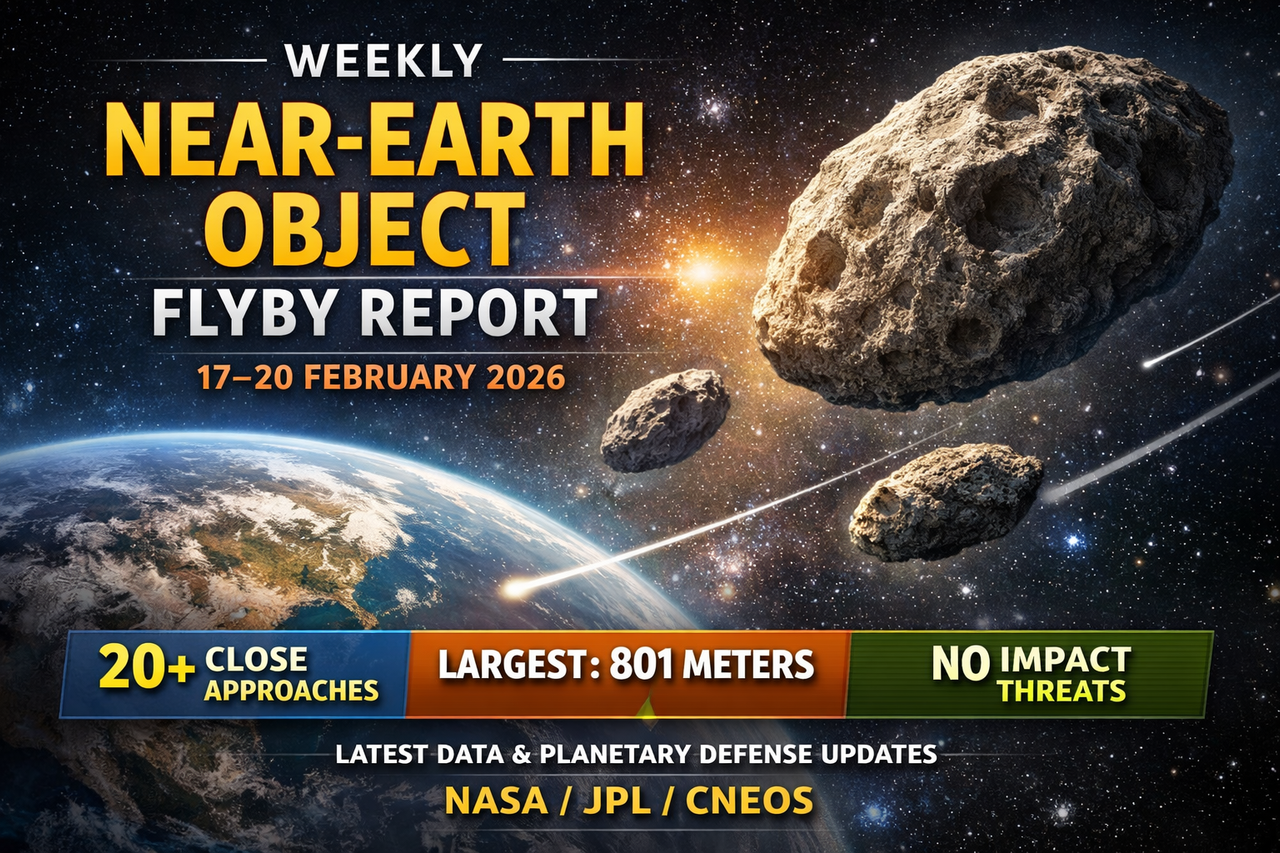
Track this week’s closest asteroid flybys: over 20 Near-Earth Objects passing within 75 lunar distances, including the largest 801 m asteroid 2001 EC. All objects confirmed safe. Stay updated with NASA/JPL data and planetary-defence insights.Introduction
A cluster of Near-Earth Objects (NEOs) is making routine close approaches to Earth between 17 and 20 February 2026. According to orbital solutions maintained by NASA’s Center for Near-Earth Object Studies (CNEOS) and the Jet Propulsion Laboratory Small-Body Database, more than twenty catalogued asteroids will pass within roughly 75 lunar distances during this four-day interval. None of the objects listed in current orbital datasets present an impact risk to Earth.
Close-approach monitoring is a standard part of planetary-defence operations. Observatories worldwide continuously refine asteroid orbits using optical astrometry, radar measurements, and automated sky surveys. Objects passing within 1 lunar distance (LD ≈ 384,400 km) are uncommon but not unusual, and most are small bodies only a few metres across. The current week illustrates a typical distribution of small and medium-sized asteroids crossing Earth’s orbital neighbourhood.
This report summarises the most notable flybys, highlighting the closest approaches, the largest bodies, and the officially classified potentially hazardous asteroid within the dataset.
Closest Approaches This Week
The smallest distance recorded in the current list belongs to asteroid 2026 CR2, predicted to pass at just 0.36 lunar distances. At roughly four metres in diameter, this object is comparable in size to a small vehicle and would disintegrate in Earth’s atmosphere if it entered. Objects in this size range frequently go undetected until shortly before close approach because they reflect very little sunlight.
- 2026 CR2 — 4 m, 5.64 km/s, miss distance 0.36 LD (17 Feb)
- 2026 CO — 32 m, 7.49 km/s, miss distance 4.49 LD (20 Feb)
- 2026 CU — 31 m, 7.98 km/s, miss distance 5.40 LD (18 Feb)
- 2026 CA2 — 42 m, 8.84 km/s, miss distance 11.01 LD (19 Feb)
- 2026 AH17 — 99 m, 7.30 km/s, miss distance 11.26 LD (20 Feb)
Planetary-defence researchers note that asteroids under about 30 metres typically burn up or fragment at high altitude, producing airbursts rather than ground impacts. Larger objects, however, can survive atmospheric entry depending on composition and velocity. Continuous detection efforts aim to identify these bodies years or decades before any potential impact scenario.
Medium-Size Asteroids Passing Within 20 Lunar Distances
Several additional asteroids ranging between 40 and 124 metres in diameter will pass at moderate astronomical distances this week. Although these are safely distant, they fall into the size category capable of regional damage in the extremely unlikely event of an impact.
- 2026 BQ8 — 80 m, miss distance 12.20 LD
- 2026 AJ17 — 40 m, miss distance 17.32 LD
- 2006 QZ57 — 124 m, high velocity 22.69 km/s, miss distance 25.66 LD
Asteroid velocity varies widely depending on orbital geometry. For example, 2006 QZ57 travels at more than 22 km/s relative to Earth — over three times faster than typical orbital spacecraft speeds. High relative velocity increases kinetic energy dramatically, which is why impact-hazard assessments consider both size and speed.
Largest Object in the Weekly Dataset
The largest object approaching this week is asteroid 2001 EC, estimated at approximately 801 metres in diameter. This places it in the kilometre-class category often used in long-term global hazard modelling.
Its predicted closest approach distance of 32.07 lunar distances ensures it poses no threat during this encounter. However, the asteroid is flagged in hazard catalogues because its orbit crosses Earth’s orbital region and its size exceeds the 140-metre threshold commonly used in planetary-defence surveys.
Large objects of this scale are priority targets for continuous orbital refinement because they would have global environmental consequences if an impact occurred. Fortunately, kilometre-class asteroids are typically discovered decades or centuries before any potential close approach requiring analysis.
Other Notable Flybys Between 17–20 February
The remainder of the weekly objects consist mostly of small to mid-sized asteroids at distances greater than 30 lunar distances. These encounters are astronomically routine and primarily useful for refining orbital solutions and improving statistical models of the near-Earth population.
- 2021 TK13 — 36 m, 32.49 LD
- 2016 CA138 — 94 m, 33.31 LD
- 2008 VR4 — 105 m, 33.42 LD
- 2026 CH3 — 45 m, 37.03 LD
- 2025 DG25 — 23 m, 37.24 LD
- 2020 BP7 — 55 m, 40.36 LD
- 2026 AN1 — 76 m, 43.50 LD
- 2018 CW2 — 32 m, 52.92 LD
- 2025 YC10 — 232 m, 55.94 LD
- 2024 BS4 — 29 m, 56.82 LD
- 2020 CX1 — 64 m, 60.35 LD
- 2015 VU64 — 3 m, 61.07 LD
- 2024 GG1 — 164 m, 64.16 LD
- 2013 BF27 — 218 m, 69.24 LD
- 2022 DQ5 — 63 m, 69.33 LD
- 2016 NN39 — 570 m, 74.29 LD
Although these distances may sound small in popular reporting, even a separation of 30 lunar distances corresponds to more than eleven million kilometres. Astronomers classify such flybys as “close approaches” primarily for tracking convenience rather than risk indication.
Understanding the “Potentially Hazardous Asteroid” Label
One asteroid in the weekly dataset, 2001 EC, carries a “potentially hazardous” designation. This classification does not indicate an impact prediction. Instead, planetary-defence agencies apply the label using two objective criteria:
- Minimum orbit intersection distance of 0.05 AU or less
- Estimated diameter greater than roughly 140 metres
Objects meeting both conditions are tracked carefully because gravitational perturbations over decades or centuries could theoretically shift future orbital alignments. Continuous measurement reduces uncertainties and allows extremely precise predictions for centuries ahead.
Modern orbit determination methods frequently achieve positional uncertainties of only a few kilometres even when forecasting decades into the future.
Why Small Asteroids Are Detected So Late
The extremely close approach of the four-metre asteroid 2026 CR2 illustrates a well-known observational limitation. Small asteroids reflect minimal sunlight and often remain invisible until they approach the inner Solar System.
Survey programmes such as wide-field automated telescopes scan the sky nightly, but detection sensitivity depends strongly on object brightness, viewing geometry, and atmospheric conditions.
Planetary scientists expect that many metre-scale asteroids pass closer than the Moon every year without detection. These objects typically burn up harmlessly in the upper atmosphere, producing fireballs similar to the Chelyabinsk airburst of 2013, which itself originated from an object only about 20 metres wide.
How Planetary Defence Monitoring Works
Global asteroid tracking relies on a coordinated network of observational surveys and orbit-analysis centres. Optical discovery surveys detect moving objects, after which follow-up telescopes refine trajectories. Radar observations, when available, dramatically improve positional precision by directly measuring distance and velocity.
Orbit-determination software then integrates gravitational influences from planets, relativistic corrections, and non-gravitational forces such as the Yarkovsky thermal effect.
These calculations allow agencies to maintain continuously updated risk tables extending more than a century into the future. At present, no known asteroid poses an impact threat to Earth within the next 100 years according to current observational data.
Why Weekly Flyby Clusters Are Normal
Weeks containing numerous recorded flybys are not unusual. Earth moves through a region populated by millions of small asteroids whose orbital paths occasionally bring them relatively nearby in astronomical terms.
Improvements in telescope sensitivity and automated detection pipelines have dramatically increased the number of known NEOs over the past two decades. The rising count of reported flybys therefore reflects improved discovery capability rather than any change in impact risk.
Statistical models estimate that more than 95% of kilometre-scale near-Earth asteroids are already catalogued, while detection completeness continues improving for objects larger than 140 metres.
Summary of the Week’s Key Points
- More than twenty NEOs pass Earth between 17–20 February 2026
- The closest approach is asteroid 2026 CR2 at 0.36 lunar distances
- The largest object is 2001 EC at roughly 801 metres
- Only one asteroid in the list meets the “potentially hazardous” classification
- No impact risks are identified for any object in this dataset
Routine close-approach monitoring remains one of the most mature and data-driven areas of modern astronomy. Continuous observational coverage ensures that even newly discovered objects can be rapidly characterised and tracked with high precision.
Authoritative Sources and Scientific References
- NASA Center for Near-Earth Object Studies Close Approach Database
https://cneos.jpl.nasa.gov/ca/ - JPL Small-Body Database Browser
https://ssd.jpl.nasa.gov/tools/sbdb_lookup.html - ESA Near-Earth Object Coordination Centre
https://neo.ssa.esa.int/ - NASA Planetary Defense Overview
https://science.nasa.gov/planetary-defense/ - Neophyzix.com CNEOS Live Data
https://www.neophyzix.com/p/planetary-defence-dashboard.html - Peer-reviewed overview of asteroid impact hazard assessment
https://doi.org/10.1016/j.pss.2015.12.009 - Survey completeness of near-Earth asteroids (peer-reviewed)
https://doi.org/10.1038/nature23626
This report is based on published orbital solutions and observational datasets available at the time of writing. Orbital parameters may be refined as additional astrometric observations are obtained.