Astrophyzix Observatory
Evidence-First Publication

Astrophyzix.com is an independent digital observatory publication offering unpaywalled, evidence‑driven analysis and real‑time monitoring of PHAs and NEOs. Our tracking consoles and reporting systems use and provide access to official NASA CNEOS Scout, JPL CAD, NeoWs, JPL SBDB, Horizons and NOAA observational datasets, peer‑reviewed sources, and high‑precision numerical methods (IEEE‑754 Float64, RKN4). Designed for students, educators, researchers, and the public, every console is uniquely designed and engineered by the Astrophyzix Digital Observatory. Our research notes and papers can be found at Astrophyzix.Academia.Edu

Showing posts with label CNEOS. Show all posts

Saturday, 16 May 2026

Newly Discovered Asteroid 2026 JH2 Pre-approach Report and Asteroid Data Profile & Simulator - Latest Evidence-First PHA NEO Asteroid News By Astrophyzix Digital Observatory

NASA SBDB Horizons Data · Astrophyzix Scientific Close‑Approach Report 

Asteroid 2026 JH2 — Pre‑Close Approach Analysis · 16 May 2026 - (Image: Astrophyzix Orbital Viewer)  

📌 Cited by MSN News (May 2026) alongside NASA and ESA as a confirming source for 2026 JH2 safety assessment
✨ Referenced by: MSN News, Copilot News, AviationToday News, iAsk Student, Mojeek, Perplexity, Ecosia, AI insights, Crowdbyte News 

Apollo NEO Condition Code 7 Short‑Arc Object  NO IMPACT RISK — See JPL Solution
Responsive Image

Key Takeaways of Asteroid 2026 JH2

  • NASA JPL Solution: 2026-May-16 06:48:56 | SPK-ID 54629847 (see updated solution report) 
  • Closest pass: 18 May 2026 at 21:23 UTC — 0.24 LD (~91,500 km), well inside GEO but with No current risk of impact reported. 
  • Size estimate: H = 27.3 → ~9–20 m diameter (albedo‑dependent), below radar detectability.
  • Orbit class: Apollo NEO — highly eccentric (e = 0.582), period 3.76 years.
  • Uncertainty: Condition code 7 from a 5‑day arc; short‑warning discovery (8 days).
  • Risk context: Not a PHA; too small for hazard classification.
  • Ignore clickbait, sensational videos and news reports which claim that "there is a big rock about to hit us" — that's simply not true. Follow the evidence, not the entertainment. 

Scientific Consensus Snapshot of 2026 JH2

ParameterStatus
Closest approach2026‑05‑18 21:23 UTC at 0.000611 AU
Nominal miss distance0.238 LD / 91,500 km
Largest uncertaintyCondition code 7 (47 obs, 5‑day arc)
PHA statusNo (H > 22)
Hazard levelNon‑hazardous size; no impact geometry

Wednesday, 8 April 2026

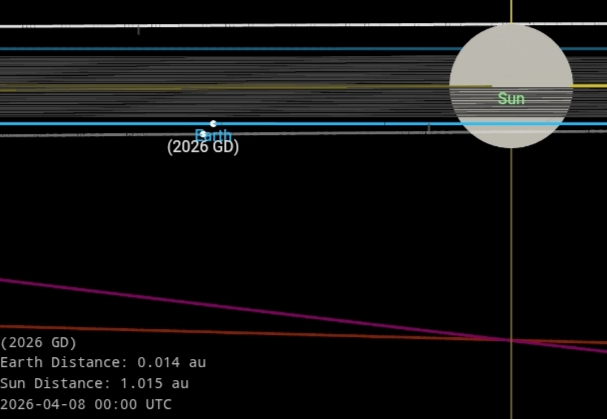
Near Earth Object NEO Close Approach Report: Asteroid (2026 GD) Updated Solution JPL 2

Astrophyzix Near-Earth Object (NEO) Close Approach Report: (2026 GD) — Updated Solution (JPL 2) - Real Time NEO News

Written by: Astrophyzix Digital Observatory

📌 Cited by DiscoverWildScience 📌 Cited by MSN News 📌 Cited by Bing Copilot News
Astrophyzix Image
Image Credit: NASA JPL SBDB

Introduction


Asteroid (2026 GD) is an Apollo-class near-Earth object (NEO) currently undergoing rapid orbital refinement following its recent discovery in April 2026. This report is a follow-up of our initial report and is based on the updated JPL solution (Solution 2), incorporating an expanded observational dataset and improved orbital constraints.


The object is notable for an exceptionally close Earth flyby occurring on April 9, 2026, within lunar distance. Although the orbit remains classified with moderate uncertainty, current data provides a consistent and stable close-approach solution with no indication of impact risk.

Key Takeaways


  • Very close Earth approach on 2026-Apr-09 at 22:59 (TBD) at ~0.00168 AU.
  • Equivalent to approximately 0.65 lunar distances (~251,000 km).
  • Relative velocity: ~12.66 km/s.
  • Small object (~20–30 meters estimated diameter).
  • Earth MOID: 0.000525 AU (very low orbital intersection distance).
  • Orbit refined using 117 observations over 2 days.
  • Condition code remains 7 (moderate uncertainty).
  • No impact threat identified. 


Scientific Consensus Snapshot


The updated orbital solution reflects improved constraint quality due to an increased number of observations and an extended data arc. While uncertainties have decreased across all orbital parameters, the orbit remains in an early refinement stage. 


Close approach predictions are now more precise, particularly in timing, but continued observation is required to fully stabilise the solution.


Newly Discovered NEO Asteroid (2026 GD) Exclusive Close Approach Report and Object Profile Astrophyzix Digital Observatory NASA Data

Astrophyzix Near-Earth Object (NEO) Close Approach Report: (2026 GD) Newly Discovered Asteroid Will Pass Closer than the Moon. 

Written by: Astrophyzix Digital Observatory

📌 Cited by DiscoverWildScience 📌 Cited by MSN News 📌 Cited by Bing Copilot News
NEO close approach visualisation

Introduction

New updates found in our JPL Solution 2 Report


Asteroid (2026 GD) is a recently observed Apollo-class near-Earth object (NEO) identified in April 2026. With a short observational arc of just 1 day, its orbital solution remains preliminary and subject to refinement. Despite this, current data indicates an exceptionally close Earth approach occurring on 09 April 2026.


The object’s very low Earth Minimum Orbit Intersection Distance (MOID) and near-term encounter geometry place it within the category of close-approach monitoring priority objects, although no confirmed impact risk is currently established based on available solutions at this time. Astrophyzix will update you as new data comes in. 

Key Takeaways


  • Apollo-class near-Earth asteroid with Earth-crossing orbit.
  • Very close Earth approach on 2026-Apr-09 at ~0.00168 AU.
  • Equivalent to approximately 0.65 lunar distances (~251,000 km).
  • Estimated relative velocity: ~12.66 km/s.
  • Small object (~20–30 meters estimated diameter range).
  • Extremely low Earth MOID: 0.000525 AU.
  • Orbit uncertainty remains high (condition code 7).
  • No confirmed impact risk in current datasets at the time of this report. 


Scientific Consensus Snapshot


The orbital parameters for (2026 GD) are based on a limited observational dataset spanning approximately one day. As a result, uncertainties remain significant, reflected in its condition code of 7. (Explanation of Code 7 below


Additional observations are required to refine its trajectory and reduce positional uncertainty. Close-approach predictions at this stage should be treated as provisional.


Tuesday, 7 April 2026

Near Earth Object NEO Close Approach Report April 07–13, 2026 Official Data

Astrophyzix Near-Earth Object (NEO) Close Approach Report: April 07–13, 2026. Real Time Asteroid News

Written by: Astrophyzix Digital Observatory

Astrophyzix Weekly NEO Report Header

Introduction


This report summarises near-Earth object (NEO) activity during the monitoring window of April 07–13, 2026, based on live data from NASA’s CNEOS NeoWs API. A total of 66 objects are tracked within this interval, including 4 classified as Potentially Hazardous Asteroids (PHAs).

The dataset reflects real-time orbital solutions and close-approach predictions. While multiple objects pass within lunar-distance scales, all currently known trajectories indicate no impact threat. The Astrophyzix Risk Index® (ARI) is included as an internal comparative metric and does not represent official hazard classification.

Key Takeaways (Data correct at time of publication)


  • Total monitored NEOs: 66
  • Potentially Hazardous Asteroids (PHA): 4
  • Objects passing within 10 lunar distances: 4
  • Closest approach: (2011 FT9) at 3.437 LD
  • Average relative velocity: 13.3 km/s
  • Largest object: 302831 (2003 FH) at ~645 meters
  • No confirmed impact risks identified


Scientific Consensus Snapshot


All orbital predictions are derived from NASA CNEOS datasets and are continuously refined through optical and radar tracking. Close approach distances are calculated using numerical integration models incorporating gravitational perturbations from major planetary bodies. 


Objects classified as PHAs meet defined thresholds for size and Earth MOID but do not imply imminent impact.


Monday, 6 April 2026

Potentially Hazardous Asteroid PHA 363599 (2004 FG11) Close Approach Report and PHA NEO Profile Official Data - Real Time Asteroid News

Astrophyzix Near-Earth Object (NEO) Close Approach Report: 363599 (2004 FG11)  Official Data, Real Time Reporting

Written by: Astrophyzix Digital Observatory

NEO orbital or close approach image

Image Credit: NASA JPL SBDB

2026 Relevance: Illustrates orbital geometry and Earth-approach context for monitored near-Earth objects during the 2026 observation window.

Introduction

A Potentially Hazardous Asteroid (PHA)  is a near-Earth object with an absolute magnitude of 22.0 or brighter (typically larger than ~140 metres) and a minimum orbit intersection distance (MOID) of 0.05 AU or less. This classification does not indicate an impact threat, but identifies objects that require precise orbital monitoring.


Asteroid 363599 (2004 FG11) is a well-studied Apollo-class near-Earth object (NEO) and is formally classified as a Potentially Hazardous Asteroid (PHA). This classification arises from its size and orbital proximity to Earth, specifically its Minimum Orbit Intersection Distance (MOID). The object has been extensively observed since its discovery in 2004, resulting in a highly refined orbital solution with exceptionally low uncertainty.


Notably, (2004 FG11) is a binary system with a confirmed satellite, making it scientifically significant for studies of asteroid mass, density, and internal structure. Its repeated close approaches to Earth make it a key object in long-term planetary defence monitoring.

Key Takeaways


  • Binary Apollo-class NEO and Potentially Hazardous Asteroid (PHA).
  • Highly reliable orbit (condition code 0) based on 22+ years of observations.
  • Estimated diameter: ~152 meters with relatively high albedo (0.306).
  • Rotation period: ~7.02 hours.
  • Earth MOID: 0.0203 AU (~3.04 million km).
  • Regular Earth close approaches approximately every 2 years.
  • Next significant Earth approach: 2026-Apr-11 at 0.05652 AU (~8.46 million km).
  • No impact risk identified in current orbital solutions.


Scientific Consensus Snapshot


The orbital solution for (2004 FG11) is based on 507 optical observations and radar astrometry spanning over 22 years. The inclusion of radar delay and Doppler measurements significantly enhances orbital precision, resulting in a condition code of 0. This allows for highly accurate forward propagation of the orbit and reliable close-approach predictions.


Sunday, 5 April 2026

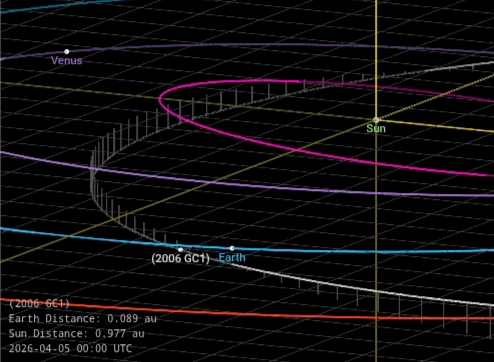
Asteroid 2006 GC1 Potentially Hazardous Asteroid (PHA) Close Approach 2026 and Asteroid Profile - Astrophyzix Digital Observatory - Official Data Set

Astrophyzix Near-Earth Object (NEO) (PHA) Close Approach Report and Object Profile: Asteroid 2006 GC1 


NEO orbital diagram

Image Credit: NASA JPL SBDB

📌 Referenced by iAsk Student


Introduction


A Potentially Hazardous Asteroid (PHA)  is a near-Earth object with an absolute magnitude of 22.0 or brighter (typically larger than ~140 metres) and a minimum orbit intersection distance (MOID) of 0.05 AU or less. This classification does not indicate an impact threat, but identifies objects that require precise orbital monitoring.


Asteroid (2006 GC1) is a well-characterised Apollo-class near-Earth object (NEO) and is formally classified as a Potentially Hazardous Asteroid (PHA). This designation is based on its size and its Minimum Orbit Intersection Distance (MOID) with Earth. Unlike recently discovered objects with short observational arcs, (2006 GC1) benefits from a long-term observational dataset spanning over 15 years, resulting in a highly constrained and reliable orbital solution.


This report provides a detailed orbital, physical, and close-approach analysis using data derived from the NASA JPL Small-Body Database and associated dynamical models. All values presented reflect current best-fit solutions and should be interpreted within the context of continuous observational refinement.

Key Takeaways


  • (2006 GC1) is classified as both an Apollo NEO and a Potentially Hazardous Asteroid (PHA).
  • Extremely well-constrained orbit (condition code 0) based on 92 observations over 15.3 years.
  • Highly eccentric orbit (e = 0.817) with a perihelion deep inside Mercury’s orbital region.
  • Estimated size range: ~200–400 meters (based on H = 20.5).
  • Earth MOID: 0.00914 AU (~1.37 million km), within the PHA threshold.
  • Next notable Earth close approach: 2026-Apr-05 at 0.08876 AU (~13.3 million km).
  • Relative velocity during Earth encounter: ~30.66 km/s.
  • No impact risk indicated for any known approach in current orbital solutions.


Scientific Consensus Snapshot


The orbital solution for (2006 GC1) is derived using high-precision numerical integrations incorporating the DE441 planetary ephemeris and perturbations from major solar system bodies. With a condition code of 0 and a multi-decade observation arc, the orbit is considered highly reliable. Uncertainty margins in orbital elements are extremely low, allowing for precise long-term trajectory propagation and close-approach prediction.


Saturday, 4 April 2026

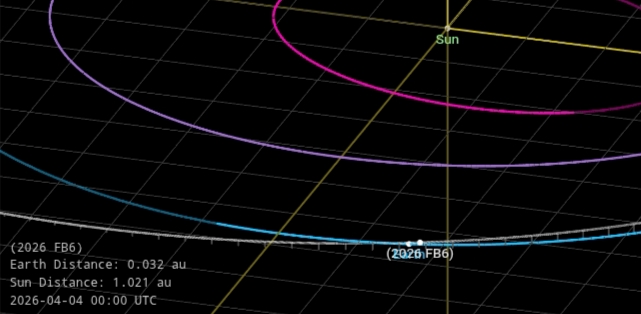
Near Earth Object (NEO) Close Approach Report: Asteroid 2026 FB6 Official Data Profile - Latest Asteroid News

Astrophyzix Near-Earth Object (NEO) Close Approach Report: 2026 FB6 - Real Time, Trusted Asteroid News 

Written by: Astrophyzix Digital Observatory 

📌 Referenced by iAsk Student

NEO close approach image

Introduction

This report presents an institutional summary of near-Earth asteroid 2026 FB6, an Apollo-class near-Earth object (NEO) with a trajectory that intersects Earth's orbital path. The analysis is based on orbital data derived from NASA’s JPL Small-Body Database and ephemerides generated using JPL dynamical models and planetary perturbation integrations.

Due to the limited observational arc and associated high condition code, orbital parameters remain uncertain and subject to refinement through continued astrometric tracking.

Key Takeaways (ADO) 

  • 2026 FB6 is classified as an Apollo-type near-Earth asteroid.
  • Semi-major axis: 1.658 AU, indicating an orbit extending well beyond Earth’s orbit.
  • Eccentricity: 0.398, representing a moderately elongated orbit.
  • Perihelion distance: 0.999 AU, near Earth’s orbital distance.
  • Earth MOID: 0.0141 AU (~2.1 million km), indicating a relatively safe orbital separation.
  • Absolute magnitude (H): 27.82, implying a small object (tens of meters in diameter, size dependent on albedo).
  • Observational arc: 5 days with 17 observations; condition code: 9 (high uncertainty).
  • Predicted close approach: 2026-Apr-04 03:48 TDB (±2 minutes).


Scientific Consensus Snapshot


Orbital solutions for 2026 FB6 are computed using heliocentric dynamics referenced to the JPL DE441 planetary ephemeris. The solution incorporates gravitational perturbations from major planetary bodies and is constrained by a limited observational dataset spanning five days. The high condition code indicates that additional observations are required to significantly reduce uncertainties in the orbital solution.


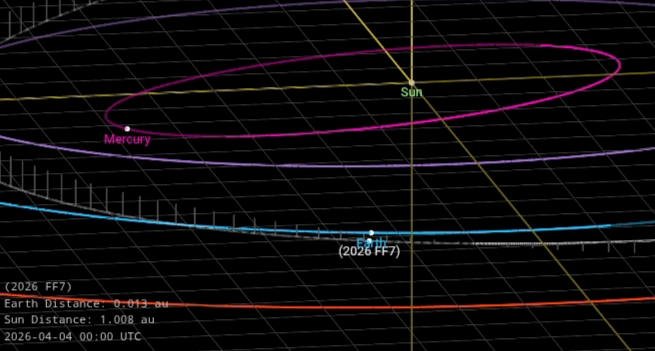
Near Earth Object (NEO) Close Approach Report Asteroid 2026 FF7 Official Data - Real Time NEO News

Astrophyzix Near-Earth Object (NEO) Close Approach Report: Asteroid 2026 FF7 - Credible Planetary Defence News


📌 Referenced by iAsk Student

NEO close approach visual

Introduction

This report summarizes the orbital characteristics and Earth close-approach context for the near-Earth asteroid 2026 FF7, an Apollo-class object classified as a near-Earth object (NEO). The analysis is derived from publicly available data provided by the NASA JPL Small-Body Database and associated ephemerides generated through NASA and JPL orbital computation systems operated by the Jet Propulsion Laboratory.


The dataset reflects a short observational arc and therefore carries significant orbital uncertainty. As such, all derived predictions should be interpreted within the context of ongoing refinement through additional astrometric observations.

Key Takeaways (ADO) 

  • 2026 FF7 is classified as an Apollo-type near-Earth asteroid with an Earth-crossing orbit.
  • Estimated semi-major axis: 1.236 AU, indicating an orbit extending beyond Earth's orbital path.
  • Orbital eccentricity of ~0.418 suggests a moderately elongated trajectory.
  • Perihelion distance: 0.720 AU; aphelion distance: 1.753 AU.
  • Earth MOID: 0.00494 AU (~739,000 km), indicating a potentially close orbital intersection.
  • Absolute magnitude (H): 27.47, implying a small object on the order of tens of meters in diameter (size estimate dependent on albedo assumptions).
  • Observational arc is limited to 2 days with 14 observations, resulting in a high condition code (9), indicating substantial orbital uncertainty.


Scientific Consensus Snapshot (ADO) 


Orbital parameters for 2026 FF7 are computed using heliocentric reference frames and the JPL DE441 planetary ephemeris. The solution is based on a limited observational dataset and therefore exhibits elevated uncertainty. Continuous follow-up observations are required to reduce uncertainties in orbital elements such as semi-major axis, eccentricity, and mean anomaly.


Sunday, 29 March 2026

CNEO NEO PHA Asteroid Close Approach Report: 29 March 2026 - 4 April 2026 Official Data

Astrophyzix Near-Earth Object (NEO) Close Approach Report

Written by: Astrophyzix Digital Observatory

Monitoring Window: 29 March – 4 April 2026 (UTC)

Astrophyzix Observatory Image


Official NEO Data Reporting

This report presents a comprehensive analysis of Near-Earth Object (NEO) activity detected within a 7-day monitoring window using live orbital data from the NASA Center for Near-Earth Object Studies (CNEOS) NeoWs API, integrated via the Astrophyzix Digital Observatory. All objects listed have been evaluated using standard orbital mechanics and observational datasets, alongside the Astrophyzix Risk Index (ARI v2) for comparative educational context.


Saturday, 28 March 2026

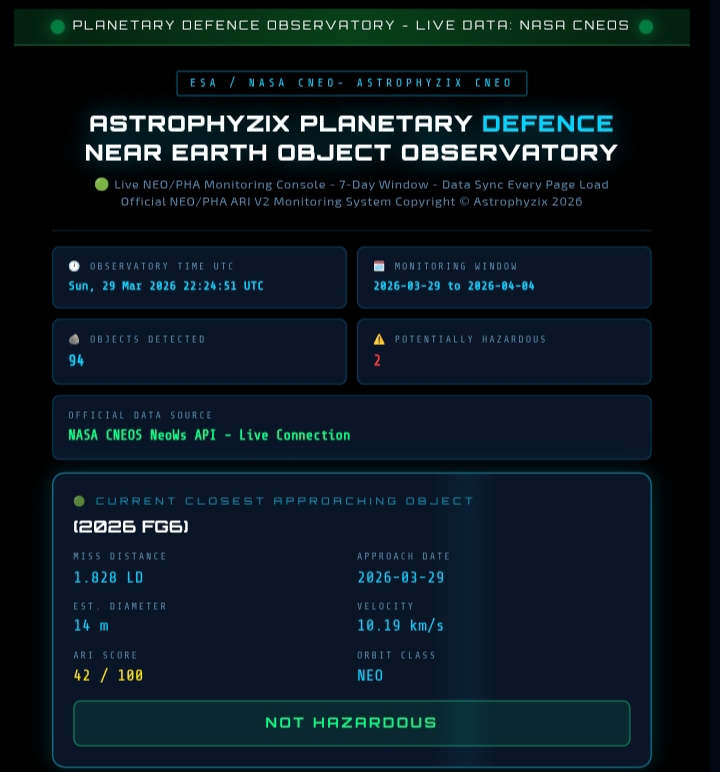
Newly Discovered NEO 2026 FG6: Orbital Refinement Update Official Data

Astrophyzix Follow-Up Report: 2026 FG6 — Orbital Refinement and Close Approach Confirmation


📌 Cited by iAsk Student 📌 Cited by Qwant Flash News

Astrophyzix image


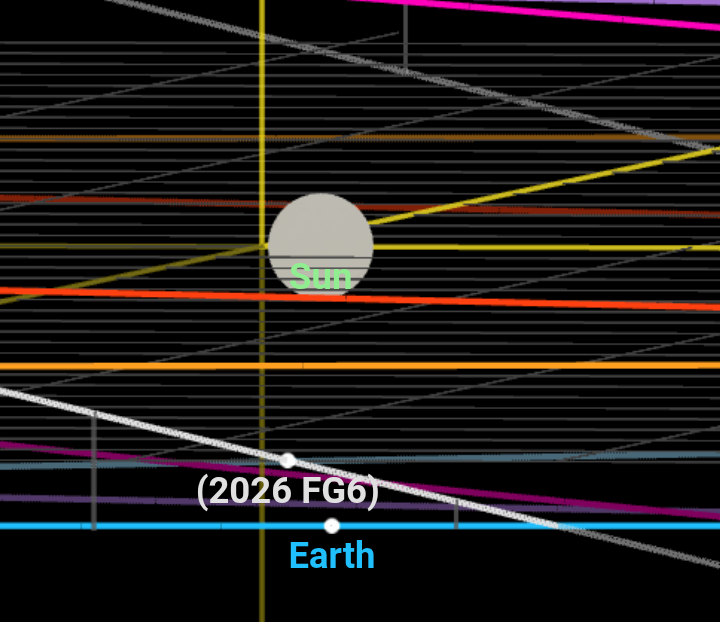
NEO 2026 FG6 Update

Following its initial identification on March 25, 2026, asteroid 2026 FG6 has undergone rapid orbital refinement based on additional observations extending the data arc to 3 days. The updated solution (JPL Solution 3, dated March 28, 2026) incorporates 29 observations, resulting in reduced uncertainties across all orbital elements while maintaining a condition code of 7. This reflects a typical early-stage solution for newly discovered small Near-Earth Objects (NEOs), where continued tracking is required to achieve long-term orbital certainty .

Newly Discovered NEO 2026 FG6: Orbital Refinement Update Astrophyzix Digital Observatory

Astrophyzix Follow-Up Report: 2026 FG6 — Orbital Refinement and Close Approach Confirmation

Updated URL Due to Permalink Error


📌 Cited by NewsBreak
Astrophyzix image


NEO 2026 FG6 Update

Following its initial identification on March 25, 2026, asteroid 2026 FG6 has undergone rapid orbital refinement based on additional observations extending the data arc to 3 days. The updated solution (JPL Solution 3, dated March 28, 2026) incorporates 29 observations, resulting in reduced uncertainties across all orbital elements while maintaining a condition code of 7. This reflects a typical early-stage solution for newly discovered small Near-Earth Objects (NEOs), where continued tracking is required to achieve long-term orbital certainty.


Updated Orbital Solution (JPL 3)

Element Previous (JPL 2) Updated (JPL 3) Change
Eccentricity (e) 0.228165 0.228035 Refined (-0.00013)
Semi-major axis (a) 1.067528 au 1.067428 au Refined
Inclination (i) 13.8936° 13.8866° Minor adjustment
Orbital Period 402.872 days 402.816 days Refined
Earth MOID 0.000450813 au 0.000451072 au Stable


Thursday, 26 March 2026

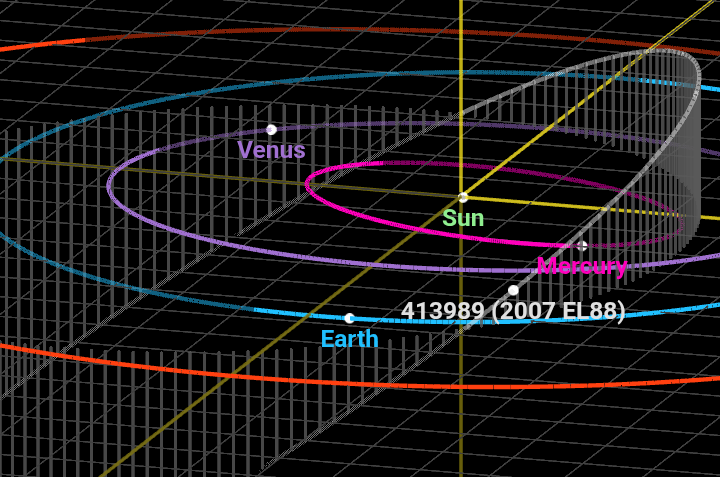
NEO PHA Profile: Asteroid 413989 (2007 EL88) Astrophyzix Digital Observatory NEO Close Approach Reports

Astrophyzix Object Profile: 413989 (2007 EL88)

Written by: Astrophyzix Digital Observatory for Planetary Defence 
Astrophyzix visual
Image Credit: NASA JPL Small Body Database 


Introduction

Asteroid 413989 (2007 EL88) is an Apollo-class Near-Earth Object (NEO) with a dynamically evolved, moderately high-eccentricity orbit that intersects the orbital path of Earth. It is classified as a Potentially Hazardous Asteroid (PHA) based on its size and orbital proximity, though current orbital solutions confirm no impact risk.

  • Current long‑term solutions show no impact scenarios within the next 100 years.


Classification and Discovery

Parameter Value
Object Name 413989 (2007 EL88)
Classification Apollo-class NEO, Potentially Hazardous Asteroid (PHA)
SPK-ID 20413989
Discovery Date 2007-03-14
Discovery Survey Siding Spring Survey


Tuesday, 24 March 2026

NEO Close Approach Report 24-27 March 2026: Astrophyzix Digital Observatory NEO Monitoring

25 Asteroids Are Flying Past Earth This Week  Here's What NASA's Data Actually Tells Us


NEO Close Approach Report | March 24–27, 2026

By Astrophyzix Digital Observatory | Published March 24, 2026


file-00000000ddb47246ab4a447e2cd719a2-5

Introduction 

Twenty-five near-Earth objects will make close approaches to our planet between March 24 and March 27, according to live data from NASA's Center for Near Earth Object Studies. The vast majority pose no threat whatsoever — but three carry a formal hazard classification, and one will pass closer to Earth than almost anything we've tracked in recent memory.

Here is what the numbers actually mean. 


The Closest One: A Six-Metre Pebble

The object arriving first and nearest is (2026 FM3), due to pass on March 25 at a distance of just 0.62 lunar distances — roughly 238,000 kilometres, barely farther than the Moon itself. 

  • It is travelling at 5.44 km/s and is estimated to be around six metres across: roughly the size of a large van. It carries no hazard classification. At that size, even if it were somehow on an impact trajectory, it would almost certainly burn up in the atmosphere before reaching the ground.

Close behind it, (2026 FB4) passes on March 26 at 1.69 LD, followed by (2026 FX3) and (2026 FT2) on the 24th at 2.99 and 4.13 LD respectively. All are small, all are fast, and none are considered dangerous.


Wednesday, 25 February 2026

Planetary Defence: Exploring the Observed Science Behind Multiple-Body Near-Earth Systems

Written by: Astrophyzix Digital Observatory and Planetary Defence Research Centre. 
Article Type: Astronomy, Physics, CNEOS News, Explainer, Peer-reviewed Sources, Planetary Defence 

✅ Modified: 27 February 2026 (added tag) 

Binary neo


Confirmed Binary and Triple Near-Earth Asteroids

Introduction

Near-Earth asteroids (NEAs) are small rocky bodies whose orbits bring them close to Earth. Recent radar and optical observations have revealed that many of these objects exist not as solitary rocks but as binary or triple systems, where two or three bodies orbit one another. This article examines the confirmed cases of such systems, presenting only verified, peer-reviewed findings to provide an accurate, factual overview of their physical properties, orbital dynamics, and significance for planetary science.

Monday, 23 February 2026

Mid-week Astrophyzix CNEOS Report 23-26 February Powered by NASA - No Impact Risks

Written By: Astrophyzix Science Communication 

News


Astrophyzix Midweek CNEOS Close-Approach Full Report for 23–26 February 2026 Powered by the Official NASA JPL CNEO API

This midweek Near-Earth Object monitoring report summarises confirmed close approaches recorded in NASA/JPL orbital databases for the period 23–26 February 2026. All orbital solutions referenced here are validated entries from the Small-Body Database and represent routine Solar System traffic with no impact risk.

A total of 25 catalogued near-Earth asteroids pass within 100 lunar distances during this reporting window. None are classified as hazardous.

Tuesday, 17 February 2026

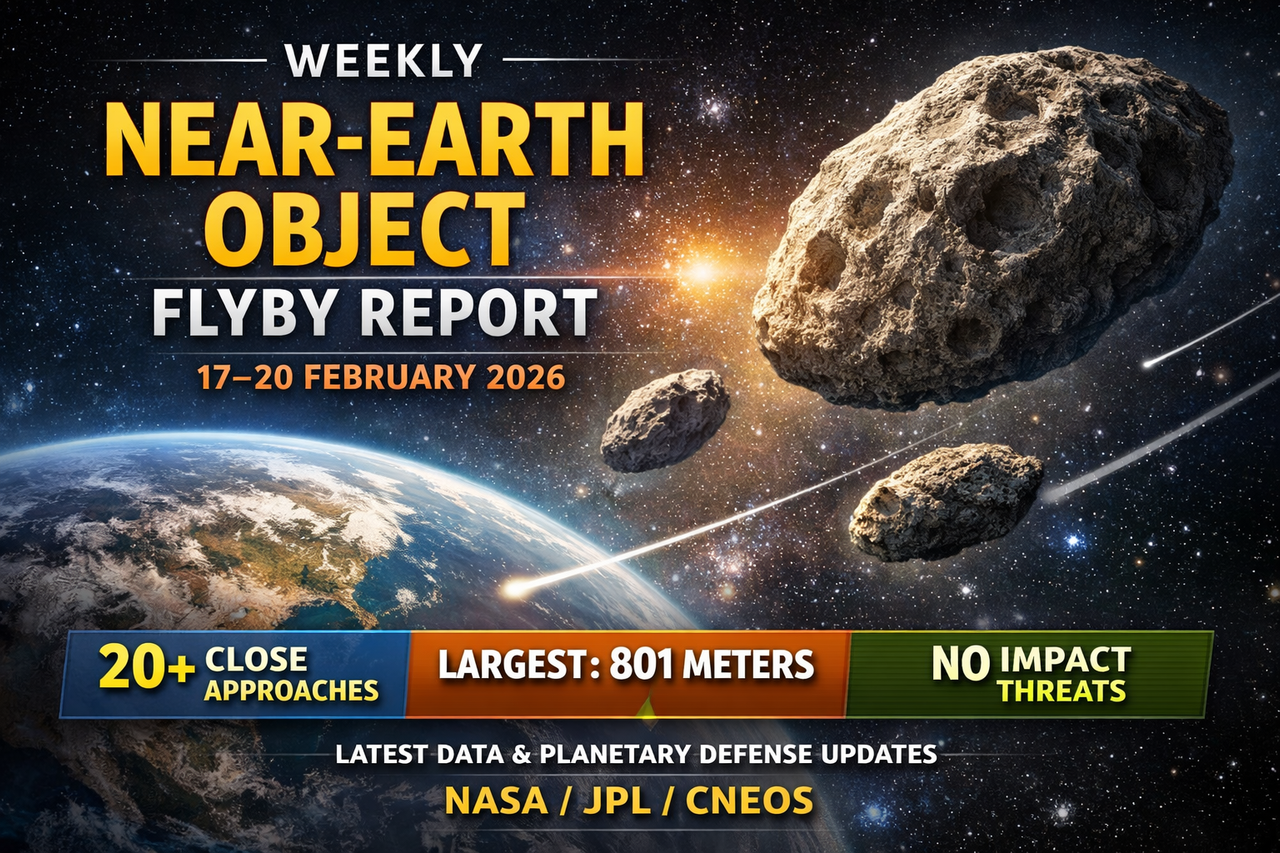
Weekly Near-Earth Object Flyby Report: 17–20 February 2026

Written By: Astrophyzix Science Communication 
Article type: Latest CNEO Asteroid News, Factual, Evidence-based 

Cneonews


Weekly Near-Earth Object Flyby Report: 17–20 February 2026

Track this week’s closest asteroid flybys: over 20 Near-Earth Objects passing within 75 lunar distances, including the largest 801 m asteroid 2001 EC. All objects confirmed safe. Stay updated with NASA/JPL data and planetary-defence insights.
Independent Direct Source Verification
Uncompromised Crossref DOI Resolver · Live and direct meta data fetch
Awaiting DOI input