

Newly Discovered Asteroid 2026 BX4
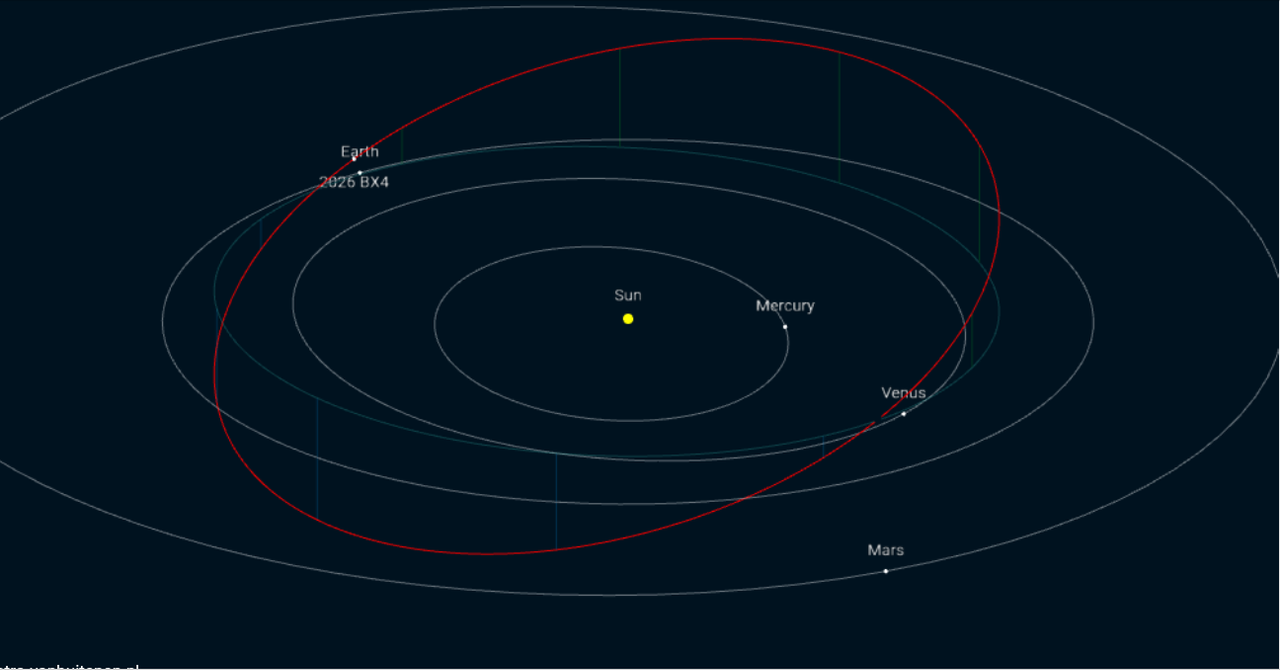
Asteroid 2026 BX4 is a near-Earth asteroid (NEA) identified in early 2026 whose orbital trajectory brings it into relatively close proximity with Earth on 16 February 2026. Near-Earth asteroids are remnants of the early Solar System whose paths have been altered over time by gravitational interactions with planets, particularly Jupiter and Earth.
Will Asteroid BX4 Hit Earth? No, this asteroid poses no threat to Earth.
The upcoming close approach of 2026 BX4 presents a scientifically valuable opportunity to study such an object in detail while reinforcing ongoing efforts in planetary defense and impact risk assessment.
Although close approaches by asteroids often attract public attention, the 2026 encounter of BX4 does not pose any threat to Earth. Instead, it serves as an example of how continuous monitoring and orbit prediction allow scientists to anticipate and evaluate asteroid flybys with high confidence, reducing uncertainty and enabling early detection of potential hazards decades in advance.
Discovery and Classification
Asteroid 2026 BX4 was discovered as part of modern near-Earth object survey programs that systematically scan the sky for moving objects against the background of stars. Once detected, follow-up observations were used to determine its preliminary orbit, allowing astronomers to classify it as a near-Earth asteroid based on its minimum distance from Earth’s orbit.
The asteroid is catalogued by NASA’s Jet Propulsion Laboratory and appears in the JPL radar target database, which identifies objects that may be suitable for detailed tracking during close approaches. Inclusion in this database reflects the importance of 2026 BX4 as a candidate for further study rather than an indication of any immediate danger.
Orbital and Physical Characteristics
The physical characteristics of asteroid 2026 BX4 are inferred primarily from optical observations, including its absolute magnitude, which measures intrinsic brightness. Because the surface reflectivity, or albedo, of the asteroid is not yet precisely known, its size must be estimated across a plausible range of values typical for near-Earth asteroids.
Current estimates suggest that 2026 BX4 is a mid-sized object within the NEA population. Asteroids of this scale are of particular interest to planetary scientists, as they are large enough to retain information about early Solar System processes while remaining small enough to be relatively common in Earth-crossing orbits.
- Estimated diameter: approximately 175–385 meters, depending on assumed albedo
- Absolute magnitude (H): approximately 20.9
- Orbit type: Earth-crossing near-Earth asteroid
- Estimated apparent magnitude at closest approach: approximately 17–18
At its predicted brightness during closest approach, asteroid 2026 BX4 will not be visible to the naked eye but may be observed using moderate to large ground-based telescopes. Such observations can provide valuable information on rotation rate, shape, and surface composition.
February 16, 2026 Close Approach
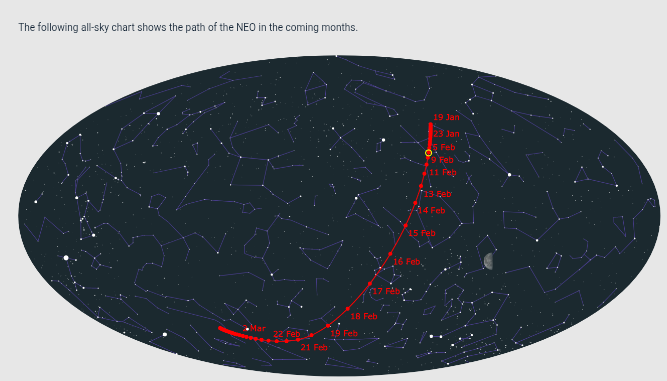
The closest predicted approach of asteroid 2026 BX4 to Earth occurs on 16 February 2026, when the asteroid will pass at a distance of approximately 0.020 astronomical units. In astronomical terms, this constitutes a close encounter, though it remains far beyond the distance at which Earth’s gravity would pose any risk of capture or collision.
During this flyby, the asteroid will travel through near-Earth space at high relative velocity, typical of objects on Earth-crossing orbits. The encounter geometry allows astronomers to refine the asteroid’s orbital parameters by comparing predicted positions with precise observations, thereby reducing long-term uncertainty in future trajectory projections.
- Date of closest approach: 16 February 2026
- Minimum distance from Earth: approximately 0.020 AU
- Equivalent distance: about 2.95 million kilometers
- Approximate Earth–Moon distances: about 7.7
- Predicted impact risk: none
Such encounters highlight the importance of continuous asteroid monitoring, as even small uncertainties in orbital parameters can accumulate over time without repeated observational updates.
Scientific Importance of the Encounter
The February 2026 close approach of asteroid 2026 BX4 offers an opportunity to improve scientific understanding of near-Earth asteroids and to validate observational and computational techniques used in planetary defense. Each close approach provides a natural experiment for testing orbit determination models under real-world conditions.
Data obtained during this period can be combined with future observations to better constrain the asteroid’s long-term orbital evolution, including the influence of gravitational perturbations and non-gravitational forces such as the Yarkovsky effect, which can subtly alter asteroid trajectories over extended timescales.
- Improved accuracy of orbital elements and future close-approach predictions
- Potential determination of rotation period and shape through light-curve analysis
- Constraints on surface composition through spectral observations
- Support for planetary defense preparedness and early-warning capabilities
Conclusion
Asteroid 2026 BX4 represents a scientifically significant but non-hazardous near-Earth asteroid whose close approach in February 2026 underscores the effectiveness of modern asteroid detection and tracking systems. While the encounter does not threaten Earth, it provides valuable opportunities for observation, analysis, and refinement of predictive models.
Continued monitoring and study of objects such as 2026 BX4 contribute to a broader understanding of the near-Earth asteroid population and support long-term planetary defense strategies aimed at identifying and mitigating potential risks well before they become critical.
Sources and References and Further Reading
-
NASA JPL Radar Target Browser – 2026 BX4
https://echo.jpl.nasa.gov/Browser/index.html?object=2026%20BX4&epoch-2026_BX4=2026-Feb-16 -
Near-Earth Object Ephemeris and Physical Estimates – Astro Van Buitenen
https://astro.vanbuitenen.nl/neo/2026%20BX4 -
NASA JPL Asteroid Watch Program
https://www.jpl.nasa.gov/asteroid-watch/ - Images Credit: https://astro.vanbuitenen.nl