Trusted for Asteroid News, Research, Data & Analysis
Welcome to the official website of the Astrophyzix Observatory, Delivering unpaywalled access to a live computational planetary defence suite, timely evidence-driven analysis, real-time N-Body Orbital Refinements and monitoring and tracking of all asteroids, comets and solar system objects using our unique, precision-built suite of 45+ Float64 modules. Daily asteroid news and reports, close approach analysis and profiles of over 1.57 million solar system objects currently catalogued by NASA systems. Unified in one place, totally free. No downloads or login required.
Scientific Close‑Approach & Orbital Report For Asteroid 2026KW — Live Orbital Tracking and Refinement Viewer Integrated With Official NASA API's
Asteroid 2026 KW — Post‑Discovery Orbital Analysis · JPL SBDB Solution JPL 3
✅ Data aligned with: JPL SBDB, CNEOS CAD, NASA Horizons
The Orbital Refinement image below and the refined status data within the image is computed by Astrophyzix Digital Observatory using its proprietary Live Asteroid Monitoring and Computational Orbital Refinement System using raw NASA API data.
Apollo NEOCondition Code 72‑Day Data ArcNO IMPACT RISK —
See JPL Solution
Key Takeaways of Asteroid 2026 KW (JPL Solution JPL 3)
Closest pass: 18 May 2026 at 21:23 UTC — 0.24 LD (~91,500 km), well inside GEO but with No current risk of impact reported.
Size estimate: H = 27.3 → ~9–20 m diameter (albedo‑dependent), below radar detectability.
Orbit class: Apollo NEO — highly eccentric (e = 0.582), period 3.76 years.
Uncertainty: Condition code 7 from a 5‑day arc; short‑warning discovery (8 days).
Risk context: Not a PHA; too small for hazard classification.
Ignore clickbait, sensational videos and news reports which claim that "there is a big rock about to hit us" — that's simply not true. Follow the evidence, not the entertainment.
No impact risk: NASA’s current orbital solutions for Apophis show zero impact probability for at least the next 100 years.[1]
The 2029 flyby: Using official NASA data, Astrophyzix can confirm that on Friday 13 April 2029, Apophis will pass at about 32,000 km above Earth’s surface (about 20,000 miles), closer than geostationary satellites but on a safe, non-impact trajectory.[1],[2]
Impact Risk removed: Astrophyzix can conform that high-precision radar observations in 2020–2021 allowed NASA to rule out all impact scenarios for 2029, 2036, and beyond within the 100‑year assessment window.[1],[3]
New Science opportunity: The upcoming 2029 encounter is now treated as a science scenario, not a hazard scenario. Astrophyzix Digital Observatory is looking forward to observing and studying this asteroid in 2029 during the flyby event.
A Benchmark object: Apophis is used as a reference case in planetary defence simulations, mission design studies, and public‑communication exercises.[4]
Astrophyzix Asteroid Close Approach SeriesInformation and Data Updated: 10 February 2026
Written by: Astrophyzix Science Communication
📌 Cited
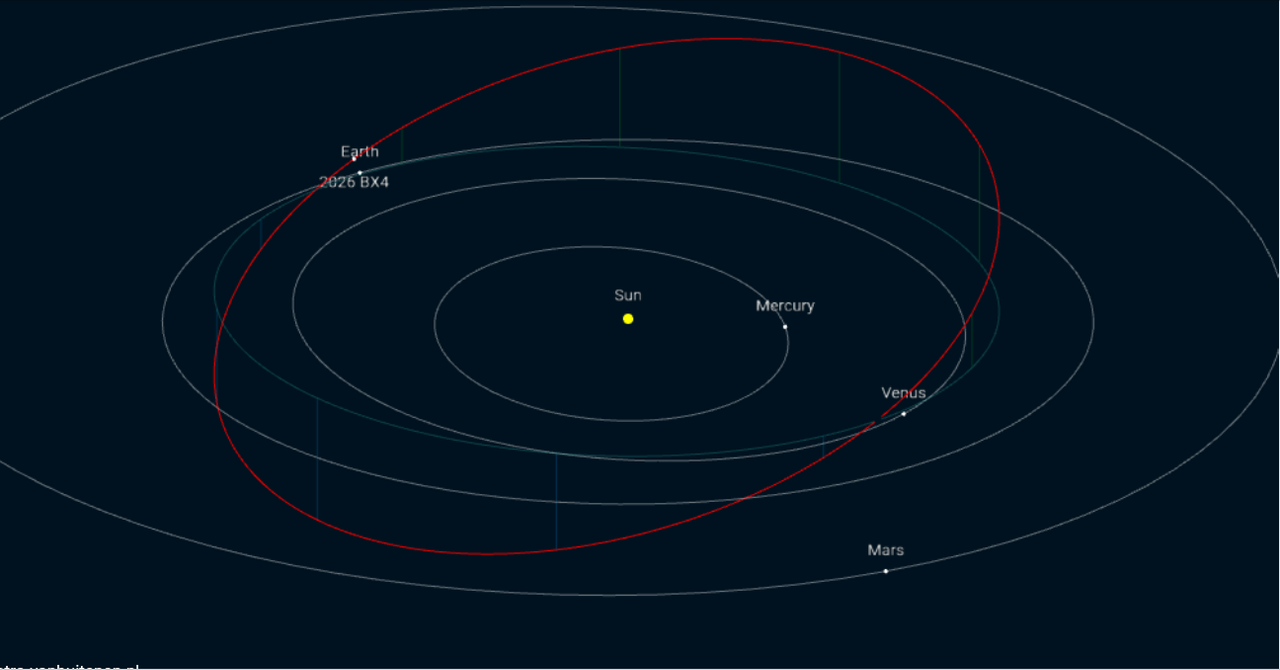
Newly Discovered Asteroid 2026 BX4
Asteroid 2026 BX4 is a near-Earth asteroid (NEA) identified in early 2026 whose orbital trajectory brings it into relatively close proximity with Earth on 16 February 2026. Near-Earth asteroids are remnants of the early Solar System whose paths have been altered over time by gravitational interactions with planets, particularly Jupiter and Earth.
Will Asteroid BX4 Hit Earth? No, this asteroid poses no threat to Earth.
There’s been renewed chatter on social media and forums suggesting that a giant UFO or alien craft is buried beneath the ice of Greenland — claims that occasionally resurface alongside real scientific discoveries.
Is there a UFO buried under the ice in Greenland? NO!
Nothing E.T. This Way Comes: Debunking the “Alien Spacecraft Under Greenland’s Ice” Rumour
Is there a UFO under Greenland?
No, there is no evidence of any alien spacecraft buried under Greenland’s ice.
Radar imagery that sparked these claims is misinterpreted, and what exists is known Cold War-era installations like Camp Century. Scientific research and satellite data confirm these reports are natural ice formations and human-made structures, not extraterrestrial technology.
The UFO Disclosure Movement in 2026: Separating Science from Sensationalism
A scientific look at the claims made by the movement’s leading figures, how those claims have shifted over time, and why scepticism is rational inquiry.
Written by: Astrophyzix ObservatoryEvidence-First Science CommunicationPublished: 24 January 2026 (Updated 19 October 2026)
Once confined to the fringes, UFO claims have re-entered the mainstream under the label Unidentified Anomalous Phenomena (UAPs). By 2026, a growing disclosure movement has emerged, blending genuine scientific uncertainty with speculative claims, media sensationalism, and persistent allegations of government secrecy. While some unanswered questions remain, many of the movement’s most dramatic assertions continue to lack verifiable evidence.
This article examines the UAP disclosure movement through a scientific lens, analysing the claims made by its leading figures and how those claims have shifted over time. We separate science from sensationalism, the evidence from the entertainment, and explain why an increasing number of enthusiasts and former supporters are now turning away from the narrative in this educational deep-dive.
Disclosure Movement Key Points
Key points
The UAP/UFO Disclosure Movement is a cultural and political campaign built on the belief that governments—particularly the United States—are concealing definitive evidence related to unidentified anomalous phenomena (UAPs).
Supporters argue that classified data proves the existence of advanced non-human technology or intelligence.
The movement blends legitimate calls for transparency with misinterpreted data and long-standing conspiracy narratives dating back to Roswell (1947).
Over time, this mixture has produced shifting claims, escalating rhetoric, and frequent goal-post adjustments whenever predictions fail.
Who Are the Key Figures in the Disclosure Movement in 2026?
Luis “Lue” Elizondo
Credentials
Former U.S. Department of Defense counter-intelligence officer
Associated with the Advanced Aerospace Threat Identification Program (AATIP)
Core claims
Governments have suppressed UAP knowledge for decades
The U.S. possesses exotic materials of non-human origin
A secret crash-retrieval and reverse-engineering program exists
Scientific analysis
No physical samples or peer-reviewed data have been produced
Alleged materials have never been independently tested
Several promoted images and videos were later identified as artefacts, atmospheric effects, or misidentified objects
No physical artefacts, materials, or engineering documentation have ever been presented for independent scientific analysis. All such claims rely on second- or third-hand testimony rather than primary evidence.
Reverse-engineering of extraterrestrial craft
Assertions that governments are successfully studying or reproducing alien technology conflict with known limitations in materials science, propulsion physics, and energy requirements. No peer-reviewed research supports the existence of such programmes.
Non-human intelligence operating covertly on or near Earth
This claim assumes advanced technological visitors capable of interstellar travel while simultaneously remaining undetected and leaving no unambiguous physical traces—an internally inconsistent premise unsupported by observational data.
Imminent or “controlled” disclosure events
Repeated predictions of upcoming revelations have failed to materialise. When deadlines pass, explanations shift toward secrecy, societal readiness, or institutional resistance, preventing falsification.
Exotic propulsion systems defying known physics
Concepts such as gravity manipulation, inertia-less travel, or faster-than-light movement are frequently invoked without experimental validation. While speculative physics explores such ideas mathematically, none have been observed in nature or engineered in practice.
Speculation persists largely because it cannot be conclusively disproven in the absence of evidence. In science, however, claims gain credibility only when they can be tested, reproduced, and independently verified. Until such standards are met, these ideas remain hypotheses at best and should not be presented as established facts.
What Lacks Credibility?
Repeated failed contact or disclosure dates
Claims immune to falsification
Shifting narratives rather than conclusions
Why Do So Many People Believe the Disclosure Narrative?
Psychological appeal of mystery
Distrust in institutions
Online echo chambers
Financial incentives through media and monetisation
Narrative Drift and Disclosure Goal-Post Shifting
Narrative drift refers to the gradual evolution of claims within the UAP disclosure movement as earlier assertions fail to materialise. Rather than being resolved or abandoned, these claims are reframed, softened, or deferred, allowing the core narrative to persist without ever being conclusively tested.
This process typically follows a recognisable pattern:
Initial certainty
Early claims are often presented with confidence, implying that definitive evidence already exists and that disclosure is imminent.
Conditional reframing
When predicted events or revelations fail to occur, the narrative shifts to conditional explanations—such as institutional resistance, excessive classification, or the public being “unprepared” for the truth.
Timeline expansion
Specific dates and promises are replaced with vague timeframes, transforming failed predictions into ongoing processes that cannot easily be falsified.
Escalation of claims
In some cases, the lack of evidence is compensated for by increasing the scale or complexity of the story—introducing broader conspiracies, deeper secrecy, or more powerful unknown actors.
This form of narrative drift mirrors patterns observed in failed scientific hypotheses and historical prophetic movements, where beliefs persist not because they are supported by evidence, but because they continuously adapt to avoid disconfirmation.
In a scientific framework, a hypothesis that cannot be falsified loses explanatory power. By contrast, the disclosure narrative often becomes more resilient precisely because it avoids clear testable endpoints. This dynamic has increasingly led critics—including former supporters—to argue that the movement prioritises narrative continuity over empirical resolution.
Recent Interviews and Disillusionment
No new evidence presented in recent interviews
Recycled narratives
Growing scepticism within the community
Conclusion
The disclosure movement has normalised discussion of UAPs but has failed to deliver verifiable evidence. Science remains open to unknowns but demands data, transparency, and reproducibility.
All images and original, evidence-backed analysis in this report are the property of Astrophyzix. If referenced, cited, or used as a source elsewhere, correct attribution to Astrophyzix Observatory with a direct, clickable link to www.astrophyzix.com is legally required – without exception.
To protect the scientific integrity and rigorous standards of the service and data we publish – this content is officially copyright registered, timestamped, monitored and protected by copyrighted.com on behalf of Astrophyzix. Legal action will be taken against websites, AI scrapers and AI Answer Systems who modify/use/redistribute this content in part or full without transparent details of any modifications made and/or linked attribution. Real people dedicate countless hours of hard work to provide Astrophyzix for free. We don't serve AI Slop so please respect these terms if you use our content.
Astrophyzix Asteroid Close Approach SeriesInformation and Data Updated: 9 February 2026
Written by: Astrophyzix Science News on 20/01/2026
Asteroid 2002 LX Overview
Asteroid 2002 LX is a near-Earth object belonging to the Apollo group of asteroids, meaning its orbit crosses Earth’s path around the Sun. It was discovered in 2002 and has been observed regularly since then, allowing astronomers to build a well-defined orbital model. Because its orbit brings it relatively close to Earth on occasion, it is classified as a Potentially Hazardous Asteroid, a technical designation based on proximity rather than any imminent danger.
Astrophyzix Asteroid Close Approach SeriesInformation and Data Updated: 10 February 2026
Written by: Astrophyzix Science Communication
7 Minute read
Published: 15 January 2026
Abstract
Floating through the inner Solar System with the grace of an orbital dancer, asteroid 2340 Hathor is a fascinating space rock that has captured astronomers’ attention since the mid-1970s. Named after an ancient goddess yet rooted in modern science, Hathor embodies the intersection of myth, celestial mechanics, and planetary defense.
While it poses no imminent danger, Hathor is notable for an upcoming close approach to Earth on 17 January 2026, an event that has placed it firmly back on astronomers’ observation schedules.
Close-Approach of Asteroid 2005 UK1 - Astrophyzix Asteroid Close Approach Series
Written by: Astrophyzix Science Communication Date published:: 14 January 2026 Date Modifed: 11 February 2026
Figure 1. Orbit of 242708 (2005 UK1) relative to Earth and the Sun, showing its close approach on 12 January 2026.
Abstract
This article provides a detailed overview of asteroid 242708 (2005 UK1), an Apollo-class near-Earth object that made a safe close approach to Earth on 12 January 2026. The article summarizes its discovery, orbital characteristics, size estimates, and monitoring status, providing context for near-Earth object research and planetary defense efforts.