
Purpose
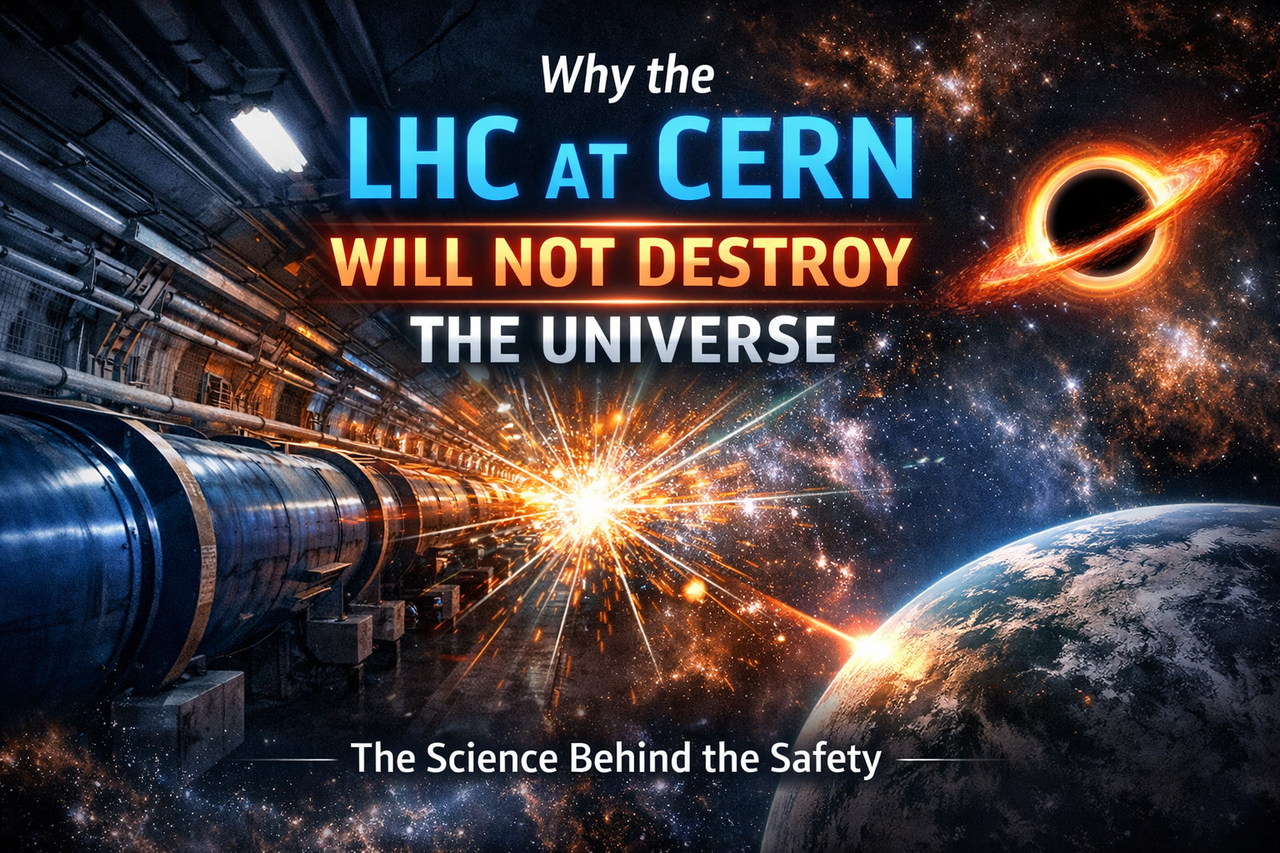
Following our previous article about the Large Hadron Collider (LHC) on Astrophyzix, we received several emails from readers asking whether the LHC could pose any threat to the universe. This follow-up article is intended to address those concerns directly and hopefully put your worries at ease, clarifying the science and evidence behind why the LHC poses no credible risk based on current observations and scientific understanding. Click the article title to read the full document.
Introduction: The Clickbait Fear
Across social media and video platforms, sensational claims warn that the Large Hadron Collider (LHC) at the European Organization for Nuclear Research (CERN) could “destroy the universe.” Some videos suggest that the LHC might trigger vacuum decay, produce runaway black holes, or create exotic matter that could consume the planet. None of these claims are supported by credible scientific evidence. Decades of research, safety studies, and observations of high-energy cosmic phenomena demonstrate conclusively that the LHC is safe. This article examines the science, the claims, and why the universe is not at risk.
Understanding the LHC
The LHC is the world’s largest and most powerful particle accelerator. A 27-kilometre ring buried along the France-Switzerland border, it accelerates protons and heavy ions to near-light speeds and collides them under highly controlled conditions. Scientists use these collisions to study the fundamental particles and forces of the universe, including the Higgs boson, quarks, and the strong nuclear force.
Despite its sophistication, the energy of LHC collisions is minuscule compared to natural cosmic events. The highest energies achieved at the LHC, in the teraelectronvolt (TeV) range, are dwarfed by cosmic ray collisions in Earth’s atmosphere, which are far more energetic. (CERN FAQs)
What Clickbait Videos Get Wrong
Most doomsday narratives focus on a few recurring fears:
- Microscopic black holes: Claims that collisions could create tiny black holes that grow uncontrollably.
- Vacuum decay: The speculative idea that the universe could collapse into a lower-energy state.
- Strangelets or exotic matter: Hypothetical matter that could convert ordinary matter into a destructive form.
Each of these claims has been evaluated in rigorous scientific studies and found to pose no credible risk.
Microscopic Black Holes and Hawking Radiation
Speculative models of physics involving extra dimensions suggest that microscopic black holes might theoretically form in high-energy collisions. Even if they could form, they would evaporate almost instantly via Hawking radiation, a quantum effect first described by Stephen Hawking. These black holes would disappear before interacting with surrounding matter. (PubMed Study)
Furthermore, cosmic rays regularly create far higher-energy collisions than the LHC without producing any destructive black holes. Stars, neutron stars, and white dwarfs are continually bombarded by such collisions and remain intact, offering real-world evidence that these scenarios are implausible. (CERN Safety Overview)
Cosmic Rays: Nature’s Particle Accelerators
Cosmic rays are high-energy particles from outer space that strike Earth and other celestial bodies constantly. Many collisions from cosmic rays far exceed the LHC’s energy. If the LHC could trigger catastrophic events, natural cosmic-ray collisions would have done so billions of times over. Observations show that these bodies remain stable, providing strong empirical evidence that high-energy collisions do not threaten planetary or universal safety. (CERN FAQs)
Strangelets and Exotic Matter
Strangelets, a hypothetical form of quark matter, have also been considered as a potential risk. However, no experimental evidence exists for their production. Experiments at previous heavy-ion colliders, such as RHIC, have shown no signs of strangelets. Safety studies conducted before the LHC’s startup determined that the probability of producing such matter is effectively zero. Cosmic ray data further confirm that if strangelets were possible, they would already have appeared naturally. (LHC Safety Assessment)
Vacuum Decay: Theoretical but Harmless
Vacuum decay, or a “false vacuum transition,” is a theoretical process in which a quantum fluctuation could shift the universe into a lower-energy state. While interesting for theoretical physics, the energies involved are far beyond the reach of the LHC. Additionally, the universe has been subjected to cosmic-ray collisions far exceeding the LHC’s energy without any catastrophic outcome. If the vacuum were unstable at accessible energies, natural cosmic-ray collisions would already have triggered it. This provides strong observational evidence that vacuum decay is not a risk. (ArXiv: Higgs Vacuum Stability)
Peer-Reviewed Safety Reviews
Before the LHC began operation, the LHC Safety Assessment Group (LSAG) conducted comprehensive reviews of all plausible catastrophic scenarios, including black holes, vacuum decay, and strangelets. The peer-reviewed results, published in Journal of Physics G: Nuclear and Particle Physics, concluded unequivocally that the LHC does not pose any threat. (Journal of Physics G: LHC Safety Assessment)
Independent physicists, including Nobel laureates, reviewed the findings and agreed that the LHC is safe. CERN has consistently reiterated this conclusion in official communications. (CERN Press Release)
Why the Universe Is Not Fragile
A common misconception is that the universe is on a knife’s edge. In reality, the universe has survived billions of years of highly energetic events — supernovae, gamma-ray bursts, cosmic ray collisions — without catastrophic collapse. Even in theoretical scenarios suggesting metastability of the Higgs field, the energies needed to trigger vacuum decay are astronomically higher than what the LHC can achieve. Observational evidence confirms the robustness of the universe against human-made experiments. (ArXiv: Higgs Vacuum Stability)
Scientific Transparency and Communication
The abstract nature of particle physics sometimes leads to misinterpretation in public discussions. Sensationalist metaphors such as “big bangs” or “planet-eating black holes” are misleading. CERN maintains extensive public resources explaining the safety, purpose, and science of the LHC. These are grounded in empirical evidence, peer-reviewed research, and decades of experience — unlike clickbait content focused on engagement rather than accuracy. (CERN FAQs)
Conclusion
All credible scientific evidence confirms that the LHC at CERN is completely safe. Observational astronomy, theoretical physics, cosmic-ray data, and peer-reviewed safety studies all converge on the same conclusion: the LHC cannot destroy the Earth, the universe, or trigger any catastrophic process. Cosmic rays naturally perform collisions far more energetic than the LHC every day, and peer-reviewed assessments consistently affirm safety. The LHC remains a remarkable scientific instrument that allows us to explore the universe at its most fundamental level — without risk to our planet or cosmos.
Sources
- CERN FAQs – LHC Safety
- CERN Safety Overview
- Theoretical Study of Microscopic Black Holes
- CERN Peer Review and Observational Constraints
- LHC Safety Assessment on Strangelets
- ArXiv: Higgs Vacuum Stability
- Journal of Physics G: LHC Safety Assessment
- CERN Press Release on LHC Safety