
Midweek Planetary Defence Update: Close-Approach Near-Earth Objects
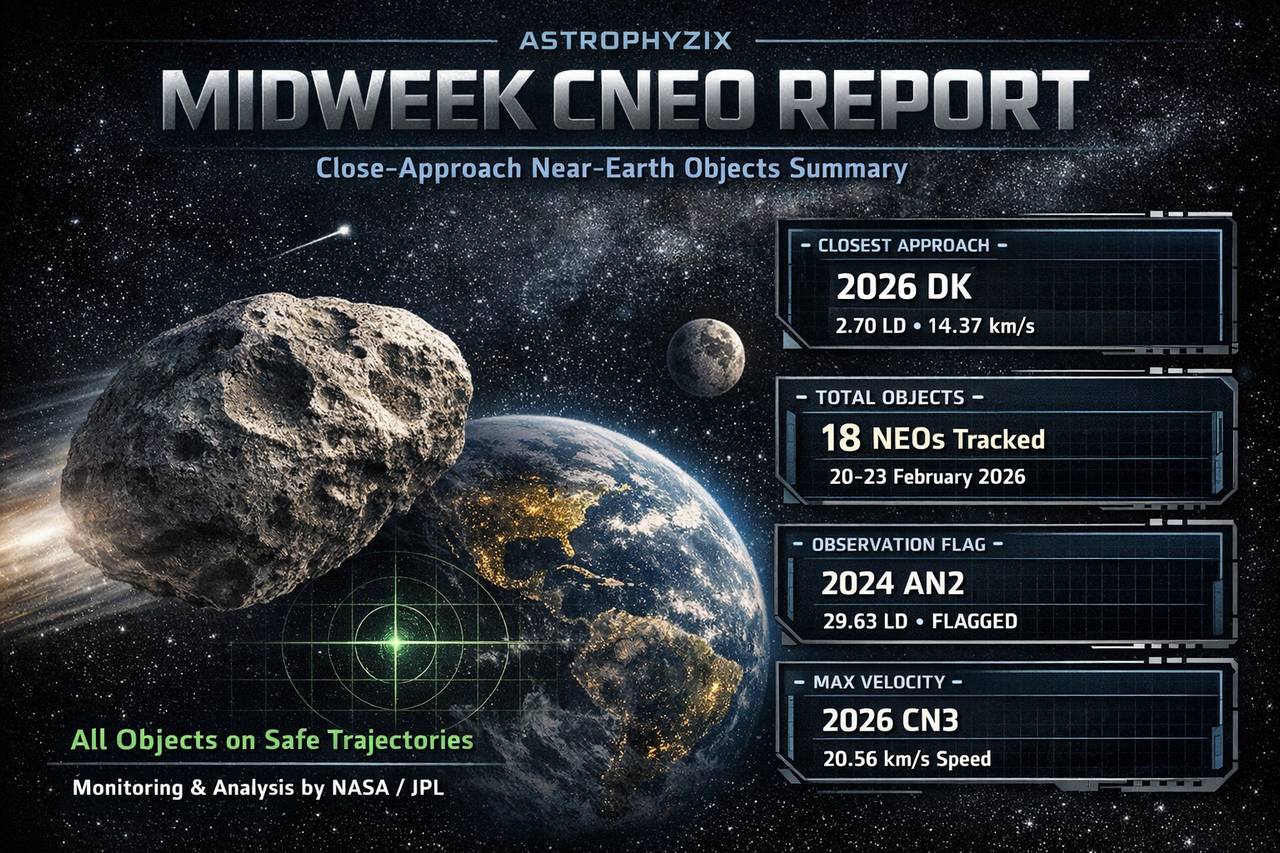
This midweek observational report summarises confirmed Near-Earth Object (NEO) close approaches recorded between 20 February 2026 and 23 February 2026. All orbital parameters correspond to official small-body trajectory solutions maintained by NASA's Jet Propulsion Laboratory Small-Body Database.
No objects in this reporting window present an impact threat to Earth. All listed objects remain on well-constrained trajectories with safe lunar-distance separations.
Closest Approaches This Week
The following objects represent the smallest lunar-distance passes within the reporting window.
- 2026 DK — 22 Feb 2026 — 2.70 LD — velocity 14.37 km/s — approx. diameter 25 m
- 2025 DQ — 21 Feb 2026 — 3.02 LD — velocity 6.78 km/s — approx. diameter 4 m
- 2026 CO — 20 Feb 2026 — 4.50 LD — velocity 7.49 km/s — approx. diameter 32 m
- 2026 CZ3 — 20 Feb 2026 — 6.71 LD — velocity 17.75 km/s — approx. diameter 33 m
- 2026 DJ — 22 Feb 2026 — 7.37 LD — velocity 12.59 km/s — approx. diameter 18 m
For context, one lunar distance (LD) equals the average separation between Earth and the Moon (~384,400 km). Objects beyond 1 LD remain well outside the Earth–Moon system’s immediate gravitational hazard zone.
Moderate-Distance Observational Passes
A larger group of objects passed Earth between roughly 8 and 20 lunar distances. These represent routine detections tracked through standard survey pipelines.
- 2026 DT — 8.37 LD
- 2026 CN3 — 8.58 LD
- 2026 CQ4 — 8.74 LD
- 2007 DB61 — 8.93 LD
- 2026 DH — 9.48 LD
- 2026 AH17 — 11.26 LD
- 2026 BQ8 — 12.19 LD
- 2026 BM8 — 13.23 LD
- 2026 CJ1 — 13.70 LD
- 2026 CW2 — 14.59 LD
- 2025 YU15 — 15.31 LD
- 2012 XF55 — 16.29 LD
- 2026 AM4 — 17.37 LD
- 2026 CY3 — 20.47 LD
Large-Distance Monitoring Objects
Several additional bodies passed at distances exceeding 20 lunar distances. While included for completeness in observational logs, these objects represent routine monitoring targets rather than close planetary-defence concerns.
Objects Flagged for Additional Observation
One object in the dataset carries an internal observation flag:
- 2024 AN2 — 29.63 LD — observational flag: YES
This designation does not imply an impact risk. Instead, such flags typically indicate the object benefits from continued astrometric tracking to refine orbital uncertainty or improve long-term trajectory models.
Velocity Characteristics
Encounter velocities across the dataset span roughly 3 km/s to over 20 km/s. The fastest object in this reporting window is 2026 CN3 at approximately 20.56 km/s relative velocity, while the slowest approach is 2026 AM4 at roughly 3.11 km/s.
Relative velocity affects observation planning and radar tracking opportunities but does not independently determine hazard classification. Impact probability analysis depends primarily on orbital intersection solutions rather than instantaneous encounter speed.
Planetary Defence Status Assessment
All objects listed in this midweek report remain categorised as non-threatening. None possess Earth-impact solutions within current orbital uncertainties.
Routine close approaches of small bodies within several lunar distances are statistically normal. Modern sky surveys continuously detect metre-scale to hundred-metre-scale asteroids passing Earth every week.
The majority of objects in this report fall below ~100 metres estimated diameter, placing them in the category of small near-Earth asteroids frequently detected by automated survey systems.
Summary
The current midweek monitoring window shows typical small-body traffic within near-Earth space. The closest approach, asteroid 2026 DK at 2.70 lunar distances, remained safely outside the Earth–Moon orbital region.
No impact risks are identified, and all trajectories remain well constrained under current orbital solutions.
Continuous monitoring of near-Earth space remains active through global survey networks and NASA’s planetary defence coordination infrastructure.
Verification Methodology
All Near-Earth Object (NEO) close-approach data presented in this report are verified against official orbital solutions maintained by NASA’s Jet Propulsion Laboratory Small-Body Database and the Center for Near-Earth Object Studies (CNEOS).
Trajectory parameters including minimum Earth distance, encounter velocity, and estimated object size are derived from numerically integrated orbital solutions based on global astrometric observations submitted through the International Astronomical Union’s Minor Planet Center.
Each listed object is cross-checked using its unique small-body designation within the JPL database to confirm:
- Current heliocentric orbital solution
- Latest observational arc and uncertainty model
- Earth close-approach distance calculations
- Impact probability solutions (where applicable)
- Updated physical parameter estimates
Distances expressed in lunar distances (LD) use the standard mean Earth–Moon separation of approximately 384,400 kilometres.
Objects identified as requiring additional monitoring are flagged solely for continued observational refinement and do not indicate confirmed impact risk unless explicitly stated by official planetary-defence monitoring systems.
This report reflects confirmed observational data available at the time of publication. Orbital parameters may be refined as additional astrometric measurements are incorporated into ongoing numerical solutions.
Data Integrity Statement
Astrophyzix planetary defence information is generated exclusively from official institutional datasets and peer-reviewed scientific sources. All Near-Earth Object tracking, orbital solutions, and risk assessments are sourced directly from recognised space agency databases and scientific monitoring systems.
Live monitoring panels automatically retrieve structured observational data from agency feeds where available. No speculative, social media, or unofficial astronomy sources are used in automated threat displays.
- Primary data obtained from official space agency object tracking systems
- Orbital parameters derived from published scientific solutions
- Risk classifications follow institutional hazard scale definitions
- Displayed timestamps reflect most recent verified dataset update
- System automatically suppresses alerts when verification confidence is low
This page is designed for scientific transparency, public education, and responsible situational awareness. All information should be interpreted as observational data, not emergency instruction.