
Astrophyzix Near-Earth Object (NEO) Close Approach Report: Asteroid 2026 FF7 - Credible Planetary Defence News
📌 Referenced by iAsk Student
Introduction
This report summarizes the orbital characteristics and Earth close-approach context for the near-Earth asteroid 2026 FF7, an Apollo-class object classified as a near-Earth object (NEO). The analysis is derived from publicly available data provided by the NASA JPL Small-Body Database and associated ephemerides generated through NASA and JPL orbital computation systems operated by the Jet Propulsion Laboratory.
The dataset reflects a short observational arc and therefore carries significant orbital uncertainty. As such, all derived predictions should be interpreted within the context of ongoing refinement through additional astrometric observations.
Key Takeaways (ADO)
- 2026 FF7 is classified as an Apollo-type near-Earth asteroid with an Earth-crossing orbit.
- Estimated semi-major axis: 1.236 AU, indicating an orbit extending beyond Earth's orbital path.
- Orbital eccentricity of ~0.418 suggests a moderately elongated trajectory.
- Perihelion distance: 0.720 AU; aphelion distance: 1.753 AU.
- Earth MOID: 0.00494 AU (~739,000 km), indicating a potentially close orbital intersection.
- Absolute magnitude (H): 27.47, implying a small object on the order of tens of meters in diameter (size estimate dependent on albedo assumptions).
- Observational arc is limited to 2 days with 14 observations, resulting in a high condition code (9), indicating substantial orbital uncertainty.
Scientific Consensus Snapshot (ADO)
Orbital parameters for 2026 FF7 are computed using heliocentric reference frames and the JPL DE441 planetary ephemeris. The solution is based on a limited observational dataset and therefore exhibits elevated uncertainty. Continuous follow-up observations are required to reduce uncertainties in orbital elements such as semi-major axis, eccentricity, and mean anomaly.
Close approach predictions are generated using numerical integration techniques that account for gravitational perturbations from major planetary bodies. Risk and proximity assessments rely on parameters such as Minimum Orbit Intersection Distance (MOID), relative velocity, and covariance propagation.
Orbital Characteristics Summary (ADO)
- Orbit Type: Apollo-class NEO (Earth-crossing)
- Semi-major axis (a): 1.236 AU
- Eccentricity (e): 0.418
- Inclination (i): 4.07°
- Perihelion (q): 0.720 AU
- Aphelion (Q): 1.753 AU
- Orbital Period: ~502 days (~1.37 years)
- Earth MOID: 0.00494 AU (~0.74 million km)
- Jupiter Tisserand Parameter: 5.092 (asteroidal regime)
Physical Parameter Estimate (ADO)
The absolute magnitude (H = 27.47) suggests a small asteroid, typically estimated between ~10–40 meters in diameter depending on assumed albedo. Objects in this size range are generally not considered globally hazardous but may produce airburst events if they were to enter Earth's atmosphere.
Close Approach Context (ADO)
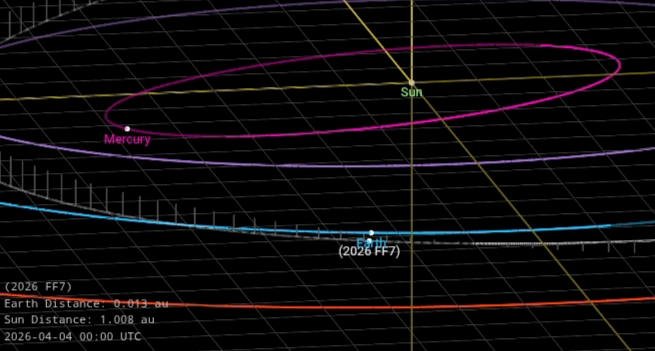
The available close approach data indicates a predicted Earth encounter on:-2026-Apr-04 19:50 TDB (±1h 15m). However, the excerpted dataset does not include nominal distance, minimum distance, or velocity values for this approach segment. This indicates that either:
- The close approach parameters are not fully resolved in the provided data snapshot, or
- The values are available through extended ephemeris queries (e.g., JPL Horizons).
Given the short observational arc (2 days) and high condition code (9), the uncertainty in the predicted trajectory remains significant. Additional astrometric observations will be required to constrain the encounter geometry and refine any proximity estimates.
Risk Assessment Overview (ADO)
Based on current orbital parameters and available data:
- No confirmed impact trajectory is indicated.
- Orbital uncertainty remains high due to limited observational coverage.
- Future refinements may alter the predicted close approach distance and timing.
- The Earth MOID indicates that geometrically close encounters are possible over long timescales, but not necessarily imminent impacts.
Conclusion
Asteroid 2026 FF7 is a small Apollo-class near-Earth object with a moderately eccentric orbit that intersects Earth’s orbital path. While a close approach is indicated in early April 2026, the current dataset does not provide fully resolved encounter parameters, and uncertainties remain substantial due to the limited observational arc. Continued tracking and updated ephemerides from sources such as the NASA JPL Small-Body Database are required to improve trajectory accuracy and characterize the encounter with greater precision.